

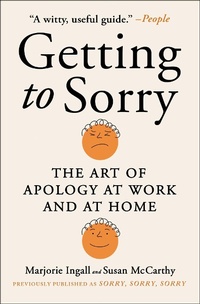
Getting to Sorry
The Art of Apology at Work and at Home
Published on 10. January 2023
368 pages
978-1-9821-6351-8 (ISBN)
Description

"A witty, useful guide" (People) to apologies, why they matter, and the healing power of saying you're sorry, from the dynamic duo behind the acclaimed SorryWatch site.
It's a truth universally acknowledged that terrible apologies are the worst. We've all been on the receiving end, and oh, how they make us seethe. Horrible public apologies?excuse-laden, victim blame-y, weaselly statements?often go viral instantaneously, whether they're from a celebrity, a politician, or a blogger. We all recognize bad apologies when we hear them. So why is it so hard to apologize well? How can we do better? How could they do better?
Marjorie Ingall and Susan McCarthy show us the way with this fresh book that is "philosophically deep, crisply reported, and funny as heck all the way through" (Clive Thompson, author of Coders). Drawing on a deep well of research in psychology, sociology, law, and medicine, they explain why a good apology is hard to find and why it doesn't have to be. Alongside their six (and a half)-step formula for apologizing beautifully, Ingall and McCarthy also delve into how to respond to a bad apology; why corporations, celebrities, and governments seldom apologize well; how to teach children to apologize; how gender and race affect both apologies and forgiveness; and most of all, why good apologies are essential, powerful, and restorative.
It's a truth universally acknowledged that terrible apologies are the worst. We've all been on the receiving end, and oh, how they make us seethe. Horrible public apologies?excuse-laden, victim blame-y, weaselly statements?often go viral instantaneously, whether they're from a celebrity, a politician, or a blogger. We all recognize bad apologies when we hear them. So why is it so hard to apologize well? How can we do better? How could they do better?
Marjorie Ingall and Susan McCarthy show us the way with this fresh book that is "philosophically deep, crisply reported, and funny as heck all the way through" (Clive Thompson, author of Coders). Drawing on a deep well of research in psychology, sociology, law, and medicine, they explain why a good apology is hard to find and why it doesn't have to be. Alongside their six (and a half)-step formula for apologizing beautifully, Ingall and McCarthy also delve into how to respond to a bad apology; why corporations, celebrities, and governments seldom apologize well; how to teach children to apologize; how gender and race affect both apologies and forgiveness; and most of all, why good apologies are essential, powerful, and restorative.
More details
Other editions
Additional editions
Book
02/2024
Gallery
€19.00
Shipment within 10-20 days
Book
01/2023
Simon & Schuster
€46.67
Article exhausted; check different version
Persons
Marjorie Ingall, who goes by "Snarly" on SorryWatch.com, is the author of Mamaleh Knows Best: What Jewish Mothers Do to Raise Creative, Empathetic, Independent Children and The Field Guide to North American Males, and is the coauthor of Hungry, with plus-size model Crystal Renn. A former columnist for Tablet magazine and the Forward, she is a frequent contributor to The New York Times Book Review and has also written for New York magazine, Town & Country, Ms., Glamour, Self, Elle, and Sassy (yes, that one). She lives in New York City.
Susan McCarthy, who goes by "Sumac" on SorryWatch.com, is the coauthor (with Jeffrey Moussaieff Masson) of the international bestseller When Elephants Weep: The Emotional Lives of Animals, which has been translated into twenty-one languages. She's also the author of Becoming a Tiger: How Baby Animals Learn to Live in the Wild. Publications she's written for include Parade, The Guardian, WIRED, Smithsonian magazine, Outside, and Salon. Her work has been anthologized in The Best American Science Writing and in Mirth of a Nation: The Best Contemporary Humor. She lives in San Francisco.
Susan McCarthy, who goes by "Sumac" on SorryWatch.com, is the coauthor (with Jeffrey Moussaieff Masson) of the international bestseller When Elephants Weep: The Emotional Lives of Animals, which has been translated into twenty-one languages. She's also the author of Becoming a Tiger: How Baby Animals Learn to Live in the Wild. Publications she's written for include Parade, The Guardian, WIRED, Smithsonian magazine, Outside, and Salon. Her work has been anthologized in The Best American Science Writing and in Mirth of a Nation: The Best Contemporary Humor. She lives in San Francisco.
Content
- Intro
- Title Page
- Dedication
- Epigraph
- Introduction
- Chapter 1: The Importance of Apologies, Good and Bad
- Chapter 2: Six Simple Steps to Getting It Right
- Chapter 3: Sorry If, Sorry But, Sorry You: Things Not to Say
- Chapter 4: Blame It on the Brain: The Science of Why We Say Such Dumb Stuff
- Chapter 5: "I'm Sorry I Chased You with a Booger": Teaching Children to Apologize
- Chapter 6: "Sorry, Our Policy Is That We Are Never at Fault": The Odiousness That Is Corporate
- Chapter 7: The Government Feels Sad About How That All Went Down: How Political Apologies Get Made
- Chapter 8: How to Accept an Apology and How to Forgive. and When to Do Neither
- Chapter 9: "What I Said on My Private Island Was Taken out of Context": An Evisceration of Celebrity Apologies
- Chapter 10: Girl, Stop Apologizing, or Maybe Don't, Ugh, It's Complicated: Gender, Race, and Power
- Chapter 11: Let the Moment Last
- Let the Ripples Widen
- Acknowledgments
- About the Authors
- Notes
- Bibliography
- Copyright
