

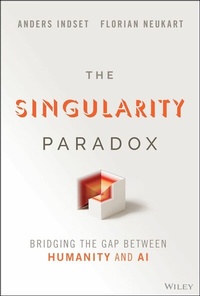
The Singularity Paradox
Description

Understand humanity's opportunity to create Artificial Conscious Entities in response to the singularity
The Singularity Paradox: Bridging the Gap Between Humanity and AI is a comprehensive exploration of how the fusion of biology, neuroscience, and artificial intelligence can lead to the creation of Artificial Human Intelligence (AHI) as a conscious response to the unconscious development of superintelligence. You will learn about how:
- Singularity highlights the tension between the boundless possibilities of technological advancement and the potential loss of human autonomy, control, and relevance.
- AHI may become essential in navigating this singularity and preventing the severe consequences that could arise.
- The convergence of humanity and technology, shedding light on the ethical, social, and scientific implications of this transformation is taken on with a fresh perspective.
Written by Anders Indset and Florian Neukart, The Singularity Paradox is a must-read read for anyone interested in the future of technology, artificial intelligence, neuroscience, and philosophy, as well as humanity's not-so-distant future, where science fiction may become reality.
More details
Other editions
Additional editions
Persons
ANDERS INDSET is a Norwegian-born philosopher and deep-tech investor. Recognized by Thinkers50 as one of the leading voices shaping technology and leadership, he is the author of four Spiegel bestsellers, with his works translated into over ten languages. Anders is the founder and Chairman of Njordis Group, a driving force behind initiatives like the Quantum Economy, and a sought-after international speaker on exponential technologies and the future of humanity.
DR. FLORIAN NEUKART is an Austrian physicist, computer scientist, and business executive specializing in quantum computing (QC) and artificial intelligence (AI). He serves on the Board of Trustees for the International Foundation of AI and QC and co-authored Germany's National Roadmap for Quantum Computing. Currently, he is Chief Product Officer at Terra Quantum AG, following over a decade leading global innovation and research labs at Volkswagen Group. He holds advanced degrees in computer science, physics, and IT, including a Ph.D. in AI and QC. A professor at Leiden University, Florian has authored books and published over 100 articles on topics including space propulsion, materials science, and AI.
Content
Preface: The Final Narcissistic Injury of Humankind ix
Introduction xiii
Chapter 1 Artificial Human Intelligence: Beyond the Human Mind 1
Chapter 2 The Nature of Life: Biological Foundations in a Technological World 27
Chapter 3 The Rise of Artificial General Intelligence: Engineering Universal Thinkers 49
Chapter 4 Theory of Mind: Understanding Consciousness 123
Chapter 5 Exploring the Human Brain: The Seat of Consciousness 169
Chapter 6 The Dual Nature of Consciousness: Algorithmic Precision or Quantum Mystery? 203
Chapter 7 Evolving Humanity: The Journey to Artificial Human Intelligence 233
Chapter 8 The Evolution to Godhood: Transcending Human Limits 283
Chapter 9 Final Reflections: Humanity's Next Evolutionary Leap 297
Epilogue: How to Avoid the Zombie Apocalypse Life in the Singularity: A Mirror to Nowhere 303
Glossary 309
References 315
About the Authors 321
Index 323
