

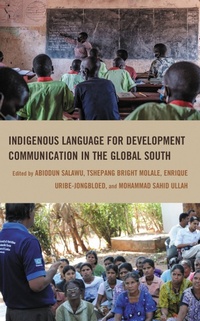
Indigenous Language for Development Communication in the Global South
Lexington Books (Publisher)
1st Edition
Published on 23. November 2022
1 pages
978-1-9787-5328-0 (ISBN)
Description

Indigenous Language for Development Communication in the Global South brings together voices from the margins in underrepresented regions of the Global South, within the context of scholarship focusing on indigenous languages and development communication. Contributors present cases as a starting point for further research and discussions about indigenous language and development communication in Latin America, Africa, and Asia. Scholars of communication, sociology, linguistics, and development studies will find this book of particular interest.
More details
Series
Edition
1. Auflage
Language
English
Place of publication
United States
Publishing group
Bloomsbury Publishing Plc
Target group
Professional and scholarly
ISBN-13
978-1-9787-5328-0 (9781978753280)
Copyright in bibliographic data and cover images is held by Nielsen Book Services Limited or by the publishers or by their respective licensors: all rights reserved.
Schweitzer Classification
Other editions
Additional editions
Abiodun Salawu | Tshepang Bright Molale | Enrique Uribe-Jongbloed
Indigenous Language for Development Communication in the Global South
Book
11/2022
Lexington Books
€121.30
Shipment within 3-4 weeks
Persons
Abiodun Salawu is professor of journalism, communication and media studies and director of the research entity, Indigenous Language Media in Africa (ILMA) at the North-West University, South Africa.
Tshepang Bright Molale is senior lecturer at the University of Mpumalanga's School of Social Sciences, specializing in communication for development and social change.
Enrique Uribe-Jongbloed is professor and researcher at the School of Social Communication and Journalism, Universidad Externado de Colombia.
Mohammad Sahid Ullah is professor in communication and journalism at the University of Chittagong, Bangladesh.
Tshepang Bright Molale is senior lecturer at the University of Mpumalanga's School of Social Sciences, specializing in communication for development and social change.
Enrique Uribe-Jongbloed is professor and researcher at the School of Social Communication and Journalism, Universidad Externado de Colombia.
Mohammad Sahid Ullah is professor in communication and journalism at the University of Chittagong, Bangladesh.
Content
Table of Contents
Acknowledgments
Introduction - Enrique Uribe-Jongbloed and Tshepang B Molale
Section I: Indigenous Language Media and Development Communication: Current Debates.
1-Towards a Model of Indigenous Language for Development Communication- Abiodun Salawu
2-Rethinking the Role of Indigenous African Language Newspapers in Development Journalism: The Case of uMthunywa, Zimbabwe - Thulani Tshabangu
3-Enhancing Political Knowledge and Opinion Through Indigenous Language Radio Programmes in Oyo State, Nigeria- Olayinka Egbokhare and Seun Idowu
4-Zimbabwe's African Language Press and Development Communication Nexus- The Missing Link- Philip Mpofu
5-Harnessing the Potentials of Indigenous Media Systems in South/East Nigeria for Rural Development - Kingsley Chukwuemeka Izuogu, Emenike Ikedichi Ubani and Dennis Ugochukwu Omeonu
Section II: Journalism, Gender and Empowerment of Marginalised Groups
6-Women Journalists in National Language Radio: A Voice to Mobilize and Foster Female Leadership - Vi
Acknowledgments
Introduction - Enrique Uribe-Jongbloed and Tshepang B Molale
Section I: Indigenous Language Media and Development Communication: Current Debates.
1-Towards a Model of Indigenous Language for Development Communication- Abiodun Salawu
2-Rethinking the Role of Indigenous African Language Newspapers in Development Journalism: The Case of uMthunywa, Zimbabwe - Thulani Tshabangu
3-Enhancing Political Knowledge and Opinion Through Indigenous Language Radio Programmes in Oyo State, Nigeria- Olayinka Egbokhare and Seun Idowu
4-Zimbabwe's African Language Press and Development Communication Nexus- The Missing Link- Philip Mpofu
5-Harnessing the Potentials of Indigenous Media Systems in South/East Nigeria for Rural Development - Kingsley Chukwuemeka Izuogu, Emenike Ikedichi Ubani and Dennis Ugochukwu Omeonu
Section II: Journalism, Gender and Empowerment of Marginalised Groups
6-Women Journalists in National Language Radio: A Voice to Mobilize and Foster Female Leadership - Vi
