

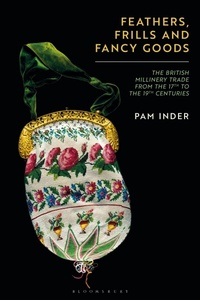
Feathers, Frills and Fancy Goods
The British Millinery Trade from the 17th to the 19th Centuries
1st Edition
Published on 11. December 2025
304 pages
978-1-350-25303-2 (ISBN)
Description

Tracing its development from a trade devoted to selling small needlework articles, ribbons and trimmings to one chiefly concerned with making and selling hats and bonnets, Feathers, Frills and Fancy Goods is an examination of the millinery trade from the early 17th century to the Victorian period.
The term 'milliner' derives from milan-er - seller of goods from Milan. Milliners sold 'small wares' - pins, needles, thread, tapes, ribbons, laces, soft leathers for belts and purses, gloves, hosiery and other decorative items which often, but not invariably, included caps and hats. Feathers, Frills and Fancy Goods traces the history of the millinery trade from the late 16th century, when most milliners were men, to the 19th century, when an increasing number of women had moved into the industry, and the term 'milliner' began to take on its contemporary meaning of 'hat maker/seller'.
Drawing on a wealth of unpublished and primary sources, and illustrated with over 65 images, Feathers, Frills and Fancy Goods traces the evolution of this complex and under-researched trade and grants new insights into working class life in 18th- and 19th-century Britain.
The term 'milliner' derives from milan-er - seller of goods from Milan. Milliners sold 'small wares' - pins, needles, thread, tapes, ribbons, laces, soft leathers for belts and purses, gloves, hosiery and other decorative items which often, but not invariably, included caps and hats. Feathers, Frills and Fancy Goods traces the history of the millinery trade from the late 16th century, when most milliners were men, to the 19th century, when an increasing number of women had moved into the industry, and the term 'milliner' began to take on its contemporary meaning of 'hat maker/seller'.
Drawing on a wealth of unpublished and primary sources, and illustrated with over 65 images, Feathers, Frills and Fancy Goods traces the evolution of this complex and under-researched trade and grants new insights into working class life in 18th- and 19th-century Britain.
More details
Edition
1. Auflage
Language
English
Place of publication
London
United Kingdom
Publishing group
Bloomsbury Publishing PLC
Target group
College/higher education
Illustrations
53 bw and 15 colour illus
ISBN-13
978-1-350-25303-2 (9781350253032)
Copyright in bibliographic data and cover images is held by Nielsen Book Services Limited or by the publishers or by their respective licensors: all rights reserved.
Schweitzer Classification
Other editions
Additional editions
Pam Inder
Feathers, Frills and Fancy Goods
The British millinery trade from the 17th to the 19th centuries
Book
approx. 01/2026
Bloomsbury Visual Arts
€116.50
Not yet published
Person
Pam Inder is an independent scholar and was formerly Curator of Applied Arts at first Exeter and then Leicestershire Museums, UK (specialising in dress history), after being an Assistant Curator at Birmingham City Art Gallery, UK. She later taught at Staffordshire and De Montfort Universities, UK. She is the author of the companion books, Busks, Basques and Brush-braid (Bloomsbury, 2020) and Shirts, Shifts and Sheets of Fine Linen (Bloomsbury, 2024).
Content
List of illustrations
Sources of illustrations
Acknowledgements
Notes on money, measurements and place names
Introduction
Chapter 1. 'As many etceteras ...'
Chapter 2. 'Wares in my Shoppe'
Chapter 3. 'Frivolous productions'
Chapter 4. 'The taste and caprice of the moment'
Chapter 5. 'At every fine shop'
Chapter 6. 'Headgear does date so'
Chapter 7. 'Her people are worked half to death'
Chapter 8. 'All milliners delight in show'
Conclusion
Glossary
Notes
Bibliography
Index
Sources of illustrations
Acknowledgements
Notes on money, measurements and place names
Introduction
Chapter 1. 'As many etceteras ...'
Chapter 2. 'Wares in my Shoppe'
Chapter 3. 'Frivolous productions'
Chapter 4. 'The taste and caprice of the moment'
Chapter 5. 'At every fine shop'
Chapter 6. 'Headgear does date so'
Chapter 7. 'Her people are worked half to death'
Chapter 8. 'All milliners delight in show'
Conclusion
Glossary
Notes
Bibliography
Index
