

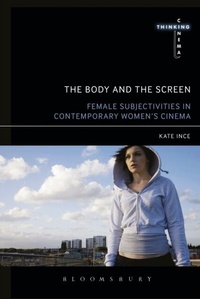
The Body and the Screen
Female Subjectivities in Contemporary Women's Cinema
1st Edition
Published on 12. January 2017
224 pages
978-1-62356-520-6 (ISBN)
Description

Winner of the British Association of Film, Television and Screen Studies Best Book Prize 2018
Since the 1980s the number of women regularly directing films has increased significantly in most Western countries; in France, Claire Denis and Catherine Breillat have joined Agnes Varda in gaining international renown, while British directors Lynne Ramsay and Andrea Arnold have forged award-winning careers in feature film. This new volume in the "Thinking Cinema" series draws on feminist philosophers and theorists from Simone de Beauvoir on to offer readings of a range of the most important and memorable of these films from the 1990s and 2000s, focusing as it does so on how the films convey women's lives and identities. Mainstream entertainment cinema traditionally distorts the representation of women, objectifying their bodies, minimizing their agency, and avoiding the most important questions about how cinema can "do justice" to female subjectivity. Kate Ince suggests that the films of independent women directors are progressively redressing the balance, reinvigorating both the narratives and the formal ambitions of European cinema. Ince uses feminist philosophers to interpret such films as Sex Is Comedy, Morvern Callar, White Material, and Fish Tank anew, suggesting that a philosophical understanding of female subjectivity as embodied and ethical should underpin future feminist film study.
Since the 1980s the number of women regularly directing films has increased significantly in most Western countries; in France, Claire Denis and Catherine Breillat have joined Agnes Varda in gaining international renown, while British directors Lynne Ramsay and Andrea Arnold have forged award-winning careers in feature film. This new volume in the "Thinking Cinema" series draws on feminist philosophers and theorists from Simone de Beauvoir on to offer readings of a range of the most important and memorable of these films from the 1990s and 2000s, focusing as it does so on how the films convey women's lives and identities. Mainstream entertainment cinema traditionally distorts the representation of women, objectifying their bodies, minimizing their agency, and avoiding the most important questions about how cinema can "do justice" to female subjectivity. Kate Ince suggests that the films of independent women directors are progressively redressing the balance, reinvigorating both the narratives and the formal ambitions of European cinema. Ince uses feminist philosophers to interpret such films as Sex Is Comedy, Morvern Callar, White Material, and Fish Tank anew, suggesting that a philosophical understanding of female subjectivity as embodied and ethical should underpin future feminist film study.
Reviews / Votes
The Body and the Screen makes a fine contribution to the field of film philosophy in its examination of how feminist phenomenology can be brought into dialogue with female subjectivity in film. * EuropeNow * This trenchant volume makes a fine and timely contribution to the field of film philosophy in its examination of how the work of leading feminist philosophers may be brought into dialogue with film. Through Simone de Beauvoir and others, Ince makes a case for rigorous thought about embodied female subjectivity as explored through cinema. This she addresses in close readings of works by the major British and French female directors of the last two decades. Whether in her discussion of the phenomenological geography of Agnes Varda's 'film-world' or of performed co-authorship in Sally Potter, Ince is an acute and erudite interlocutor. The Body and the Screen will quickly become a work of reference in its field. * Emma Wilson, Professor of French Literature and the Visual Arts, University of Cambridge, UK * Through insightful and attentive exploration of selected works by French and British women filmmakers of the last 25 years, Kate Ince demonstrates how feminist phenomenology, beginning with Simone de Beauvoir and continuing into the present decade, offers new and exciting ways of understanding women in, and, and of the cinema. Clearly and concisely written, Ince's book is a tour de force exploration of the ways in which philosophy and women's cinema can inform and enrich each other. * Judith Mayne, Emerita Professor of French, The Ohio State University, USA *More details
Series
Edition
1. Auflage
Language
English
Place of publication
New York
United States
Publishing group
Bloomsbury Publishing PLC (Digital)
Illustrations
12 bw illustrations
ISBN-13
978-1-62356-520-6 (9781623565206)
Copyright in bibliographic data and cover images is held by Nielsen Book Services Limited or by the publishers or by their respective licensors: all rights reserved.
Schweitzer Classification
Other editions
Additional editions
Book
01/2017
Bloomsbury Academic
€64.56
Shipment within 3-4 weeks
Person
Kate Ince is Reader in French Film and Gender Studies at the University of Birmingham, UK.
Content
Acknowledgements
List of Illustrations
Chapter 1 Female Subjectivity in Philosophy and Theory
Chapter 2 Feminist Film Studies and Women's Cinema After Psychoanalysis
Chapter 3 Body
Chapter 4 Look
Chapter 5 Speech
Chapter 6 Performance
Chapter 7 Desire
Chapter 8 Freedom
Conclusion
Bibliography
Filmography
List of Illustrations
Chapter 1 Female Subjectivity in Philosophy and Theory
Chapter 2 Feminist Film Studies and Women's Cinema After Psychoanalysis
Chapter 3 Body
Chapter 4 Look
Chapter 5 Speech
Chapter 6 Performance
Chapter 7 Desire
Chapter 8 Freedom
Conclusion
Bibliography
Filmography
