

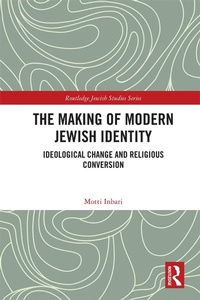
The Making of Modern Jewish Identity
Ideological Change and Religious Conversion
1st Edition
Published on 30. May 2019
182 pages
978-0-429-64859-5 (ISBN)
Description

This volume explores the processes that led several modern Jewish leaders - rabbis, politicians, and intellectuals - to make radical changes to their ideology regarding Zionism, Socialism, and Orthodoxy. Comparing their ideological change to acts of conversion, the study examines the philosophical, sociological, and psychological path of the leaders' transformation.
The individuals examined are novelist Arthur Koestler, who transformed from a devout Communist to an anti-Communist crusader following the atrocities of the Stalin regime; Norman Podhoretz, editor of Commentary magazine, who moved from the New Left to neoconservative, disillusioned by US liberal politics; Yissachar Shlomo Teichtel, who transformed from an ultra-Orthodox anti-Zionist Hungarian rabbi to messianic Religious-Zionist due to the events of the Holocaust; Ruth Ben-David, who converted to Judaism after the Second World War in France because of her sympathy with Zionism, eventually becoming a radical anti-Israeli advocate; Haim Herman Cohn, Israeli Supreme Court justice, who grew up as a non-Zionist Orthodox Jew in Germany, later renouncing his belief in God due to the events of the Holocaust; and Avraham (Avrum) Burg, prominent centrist Israeli politician who served as the Speaker of the Knesset and head of the Jewish Agency, who later became a post-Zionist.
Comparing aspects of modern politics to religion, the book will be of interest to researchers in a broad range of areas including modern Jewish studies, sociology of religion, and political science.
The individuals examined are novelist Arthur Koestler, who transformed from a devout Communist to an anti-Communist crusader following the atrocities of the Stalin regime; Norman Podhoretz, editor of Commentary magazine, who moved from the New Left to neoconservative, disillusioned by US liberal politics; Yissachar Shlomo Teichtel, who transformed from an ultra-Orthodox anti-Zionist Hungarian rabbi to messianic Religious-Zionist due to the events of the Holocaust; Ruth Ben-David, who converted to Judaism after the Second World War in France because of her sympathy with Zionism, eventually becoming a radical anti-Israeli advocate; Haim Herman Cohn, Israeli Supreme Court justice, who grew up as a non-Zionist Orthodox Jew in Germany, later renouncing his belief in God due to the events of the Holocaust; and Avraham (Avrum) Burg, prominent centrist Israeli politician who served as the Speaker of the Knesset and head of the Jewish Agency, who later became a post-Zionist.
Comparing aspects of modern politics to religion, the book will be of interest to researchers in a broad range of areas including modern Jewish studies, sociology of religion, and political science.
Reviews / Votes
"The book offers interesting glimpses into the relationship between the psychological, religious, and political biographies of noteworthy Jewish figures. Inbari's invitation to consider the experience of conversion, be it political or theological, as an important theme within the modern Jewish experience is a welcome one, and one can only hope that scholars will further pursue this line of inquiry that promises to challenge common assumptions." - Eva Gurevich, H-Judaic, H-Net Reviews, January 2020 "The book offers interesting glimpses into the relationship between the psychological, religious, and political biographies of noteworthy Jewish figures. Inbari's invitation to consider the experience of conversion, be it political or theological, as an important theme within the modern Jewish experience is a welcome one, and one can only hope that scholars will further pursue this line of inquiry that promises to challenge common assumptions." - Eva Gurevich, H-Judaic, H-Net Reviews, January 2020"The six personalities chosen by Inbari bring the reader to a more nuanced understanding of the major religious and ideological issues facing Jews in the past century. His choice of juxtaposing examples of radical religious and ideological change gives the reader a comparative perspective that can be brought to bear on further instances of this phenomenon. His useful discussion of the scholarly literature on ideological and religious conversion gives students a helpful theoretical framework into which they can place the individual cases examined. This survey of the scholarly literature on conversion will be of particular interest to those interested in the study of new religions." - Ira Robinson, Concordia University, Nova Religio, April 2020.
More details
Series
Edition
1. Auflage
Language
English
Place of publication
London
United Kingdom
Publishing group
Taylor & Francis Ltd
Target group
College/higher education
Product notice
Reflowable
ISBN-13
978-0-429-64859-5 (9780429648595)
Copyright in bibliographic data and cover images is held by Nielsen Book Services Limited or by the publishers or by their respective licensors: all rights reserved.
Schweitzer Classification
Other editions
Additional editions
Book
12/2020
1st Edition
Routledge
€61.00
Shipment within 15-20 days
Book
05/2019
1st Edition
Routledge
€179.51
Shipment within 15-20 days
Person
Motti Inbari is an Associate Professor of Religion at the University of North Carolina at Pembroke. An expert in the study of Jewish Orthodoxy, his books include Jewish Fundamentalism and the Temple Mount (2009), Messianic Religious Zionism Confronts Israeli Territorial Compromises (2012), and Jewish Radical Ultra-Orthodoxy Confronts Modernity, Zionism and Women's Equality (2016).
Content
Introduction 1. Moving Away From Communism: The Case of Arthur Koestler 2. "Is it good for the Jews?" The Conversion of Norman Podhoretz, Editor of Commentary magazine, from the New Left to Neoconservatism 3. From Anti-Zionist Orthodoxy to Messianic Religious Zionist: the Case of Yissachar Shlomo Teichtel 4. From Spiritual Conversion to Ideological Conversion: The Quest of Ruth Ben-David 5. The "Deconversion" of Haim Herman Cohn: A Model of Secular Religion 6. Avraham (Avrum) Burg between Religious Zionism and Post-Zionism Concluding remarks
