

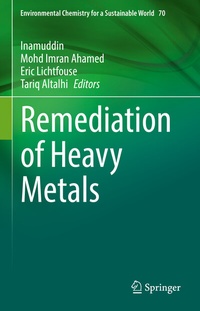
Remediation of Heavy Metals
Description

More details
Other editions
Additional editions
Persons
Dr. Mohd Imran Ahamed is working as Research Associate at the Department of Chemistry, Aligarh Muslim University (AMU), Aligarh, India. He received his B.Sc. (Hons) Chemistry and Ph.D. (Chemistry) degrees from AMU. He has completed his M.Sc. (Organic Chemistry) from Dr. Bhimrao Ambedkar University, Agra, India. He has published several research and review articles in various international scientific journals. He has co-edited 47 books of international repute. His research work includes ion-exchange chromatography, wastewater treatment, and analysis, bending actuator and electrospinning.
Dr. Eric Lichtfouse is a professor of environmental chemistry and scientific writing at Aix Marseille University and Xi'an Jiaotong University, and Chief Editor and co-founder of the journal Environmental Chemistry Letters. He has invented carbon-13 dating following the discovery of various temporal pools of a singleindividual organic substance in soils. He has published the book Scientific Writing for Impact Factors, which includes a new tool - the Micro-Article - to identify the novelty of research results. He got the analytical chemistry prize from the French Chemical Society, the grand prize of the Universities of Nancy and Metz, and a journal citation award by the Essential Indicators. He is world XTerra vice-champion and ITU cross triathlon world bronze medal in the age category.
Tariq Altalhi, PhD, joined the Department of Chemistry at Taif University, Saudi Arabia as Assistant Professor in 2014. He received his doctorate degree from University of Adelaide, Australia in the year 2014 with Dean's Commendation for Doctoral Thesis Excellence. He was promoted to the position of the head of Chemistry Department at Taif university in 2017 and Vice Dean of Science college in 2019 till now. In 2015, one of his works was nominated for Green Tech awards from Germany, Europe'slargest environmental and business prize, amongst top 10 entries. He has co-edited various scientific books. His group is involved in fundamental multidisciplinary research in nanomaterial synthesis and engineering, characterization, and their application in molecular separation, desalination, membrane systems, drug delivery, and biosensing. In addition, he has established key contacts with major industries in Kingdom of Saudi Arabia.
Content
Chapter 1 Analytical methods for the determination of heavy metals in water.- Chapter 2 Olive-oil waste for the removal of heavy metals from wastewater.- Chapter 3 Metal oxide composites for heavy metal ions removal.- Chapter 4 Two-dimensional materials for heavy metal removal.- Chapter 5 Membranes for heavy metals removal.- Chapter 6 Metal oxides for removal of heavy metal ions.- Chapter 7 Organic-Inorganic Ion Exchange Materials for Heavy Metal Removal from Water.- Chapter 8 Low-cost technology for heavy metal cleaning from water.- Chapter 9 Use of nanomaterials for heavy metal remediation.- Chapter 10 Ecoengineered approaches for the remediation of polluted river ecosystems.- Chapter 11 Ballast water definition, components, aquatic invasive species, control and management and treatment technologies.- Chapter 12 Source, pollution and remediation of carcinogenic hexavalent chromium from industrial, mining effluents.- Chapter 13 Pesticides in Drinking Water and Removal Techniques.-Chapter 14 Opportunities and challenges in heavy metal removal from water.- Chapter 15 Modification of Bagasse for Heavy Metal Removal form Water.- Chapter 16 Chelating materials for the removal of heavy metals from water.- Chapter 17 Sources of heavy metals pollution.
