

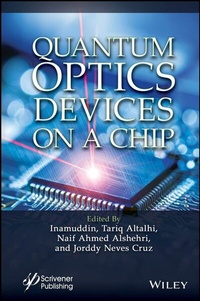
Quantum Optics Devices on a Chip
Description

Quantum Optics Devices on a Chip provides a comprehensive understanding of how the integration of advanced quantum technologies and photonics is revolutionizing multiple industries, making it essential for anyone interested in the future of quantum innovation.
Quantum Optics Devices on a Chip is situated at the intersection of several disciplines and industries, driving advancements in quantum technology and integrated photonics. The development of quantum optics devices on a chip represents a significant breakthrough. Chip-scale integration involves designing and fabricating optical devices, such as waveguides, modulators, detectors, and light sources, on a micro- or nanoscale chip. This miniaturization enables the integration of multiple components on a single chip, leading to compact, efficient, and scalable quantum optical systems. Quantum sensing applications, such as magnetometry, gyroscopy, and biosensing, can benefit from miniaturized, high-performance devices integrated on a chip, allowing for the seamless integration of quantum optical functionalities with existing photonic circuits. This integration holds promise for applications in telecommunications, data communication, and optical signal processing.
Overall, the development of quantum optics devices on a chip represents a significant step forward in the advancement of quantum technology. It brings together principles from physics, materials science, engineering, and computer science to enable the practical implementation of quantum phenomena for a wide range of applications across industries. Quantum Optics Devices on a Chip serves as a comprehensive guide to this rapidly evolving field, providing insights and knowledge, exploring the contributions it has made to the disciplinary and industrial development of quantum optics devices on a chip.
More details
Other editions
Additional editions
Persons
Inamuddin, PhD, is an assistant professor at the Department of Applied Chemistry, Zakir Husain College of Engineering and Technology, Faculty of Engineering and Technology, Aligarh Muslim University, Aligarh, India. He has extensive research experience in multidisciplinary fields of analytical chemistry, materials chemistry, electrochemistry, renewable energy, and environmental science. He has worked on different research projects funded by various government agencies and universities and is the recipient of awards, including the Department of Science and Technology, India, Fast-Track Young Scientist Award and Young Researcher of the Year Award 2020 from Aligarh Muslim University. He has published about 210 research articles in various international scientific journals, many book chapters, and dozens of edited books, many with Wiley-Scrivener.
Tariq Altalhi, PhD, is an associate professor in the Department of Chemistry at Taif University, Saudi Arabia. He received his doctorate degree from University of Adelaide, Australia in the year 2014 with Dean's Commendation for Doctoral Thesis Excellence. He has worked as head of the Chemistry Department at Taif university and Vice Dean of Science College. In 2015, one of his works was nominated for Green Tech awards from Germany, Europe's largest environmental
Naif Ahmed Alshehri, PhD, is an assistant professor of Nanotechnology at the Department of Physics, Faculty of Sciences at Al-Baha University. He is currently the vice-dean of postgraduate studies, research, innovation and quality. Prior to this position, he was the head of the Physics Department. His research interests include fabrication, characterization, and applications of nanomaterials and thin films.
Jorddy Neves Cruz is a researcher at the Federal University of Pará and the Emilio Goeldi Museum. He has experience in multidisciplinary research in the areas of medicinal chemistry, drug design, extraction of bioactive compounds, extraction of essential oils, food chemistry and biological testing. He has published several research articles in scientific journals and is an associate editor of the Journal of Medicine.
Content
Preface xvii
1 Quantum-Limited Microwave Amplifiers 1
Dnyandeo Pawar, Bhaskara Rao, Ajay Kumar, Rajesh Kanawade and Arul Kashmir Arulraj
1.1 Introduction 1
1.2 Why Microwave Amplifiers? 2
1.3 Quantum-Limited Amplifiers 3
1.4 Types of Microwave-Based Amplifiers 4
1.4.1 Conventional Electronic Amplifiers or High-Electron Mobility Transistor (HEMT) Amplifiers 5
1.4.2 Superconducting-Based Amplifiers 6
1.4.2.1 Josephson Junction 6
1.4.2.2 Concept of Parametric Amplifier 8
1.4.3 Microwave Amplification by Stimulated Emission of Radiation (MASER) 8
1.5 Discussion on Quantum-Limited Microwave Amplifiers 9
1.6 Conclusion and Outlook 16
References 18
2 Introduction to Quantum Optics 25
Jamie Vovrosh
2.1 How Is Quantum Optics Defined? 25
2.2 A Very Brief History of Quantum Optics 26
2.3 Modern-Day Quantum Optics 31
References 32
3 Carbon Nanotubes with Quantum Defects 35
Drisya G. Chandran, Loganathan Muruganandam and Rima Biswas
3.1 Introduction 35
3.2 Various Types of Defects in Carbon Nanotube 38
3.2.1 Capped Carbon Nanotube (Hemispherical Caps) 38
3.2.2 Intramolecular Nano-Junction (Bent Carbon Nanotube) 39
3.2.3 Irradiated Carbon Nanotube 41
3.2.4 Layered Carbon Nanotube 42
3.2.5 Coalescence of Carbon Nanotubes 44
3.2.6 Welding Carbon Nanotubes 45
3.2.7 Doping Carbon Nanotubes 45
3.2.8 sp 3 Quantum Defect (Organic Color-Center) 46
3.3 Conclusions 50
References 50
4 Quantum Dots to Medical Devices 55
Mohammad Harun-Ur-Rashid, Israt Jahan and Abu Bin Imran
4.1 Introduction 56
4.2 Synthesis and Characterization of QDs 57
4.2.1 Chemical Synthesis Methods 57
4.2.1.1 Colloidal Synthesis 57
4.2.1.2 Organometallic Synthesis 58
4.2.1.3 Sol-Gel Method 60
4.2.1.4 Microwave-Assisted Synthesis 61
4.2.2 Physical Properties and Characterization Techniques 62
4.2.2.1 Size and Shape 62
4.2.2.2 Optical Properties 65
4.2.2.3 Surface Chemistry 65
4.2.2.4 Electrical Properties 65
4.2.2.5 Toxicity and Biocompatibility 65
4.2.3 Surface Modification for Biocompatibility 65
4.2.3.1 Need for Surface Modification 66
4.2.3.2 Organic Coating Strategies 66
4.2.3.3 Inorganic Coating Techniques 66
4.2.3.4 Ligand Exchange Processes 67
4.2.3.5 Biocompatibility Testing 68
4.3 Quantum Dots in Biomedical Imaging 69
4.3.1 Fluorescent Properties and Their Use in Imaging 69
4.3.1.1 Unique Fluorescent Properties 69
4.3.1.2 Advantages in Imaging 70
4.3.1.3 Techniques Employing Quantum Dot Fluorescence 71
4.3.1.4 Biocompatibility and Targeting 71
4.3.1.5 Clinical and Research Applications 73
4.3.2 In Vivo vs. In Vitro Imaging Applications 73
4.3.2.1 In Vitro Imaging Applications 74
4.3.2.2 In Vivo Imaging Applications 75
4.3.2.3 Comparative Considerations 76
4.3.3 Advantages Over Traditional Imaging Agents 76
4.3.3.1 Enhanced Fluorescent Properties 76
4.3.3.2 Improved Targeting and Specificity 77
4.3.3.3 Versatility and Broad Application Range 77
4.3.3.4 Long-Term Tracking Capabilities 77
4.4 QDs in Drug Delivery Systems 78
4.4.1 Mechanism of Drug Delivery 79
4.4.1.1 Targeting and Cellular Uptake 79
4.4.1.2 Drug Release 79
4.4.1.3 Endosomal Escape 79
4.4.1.4 Real-Time Tracking 79
4.4.2 Current Advancements in QD-Mediated Therapies 81
4.4.2.1 Targeted Drug Delivery 81
4.4.2.2 Photodynamic and Photothermal Therapies 83
4.4.2.3 Gene Therapy 84
4.4.2.4 Immunotherapy 85
4.4.2.5 Overcoming Multidrug Resistance (MDR) 86
4.5 QDs in Diagnostic Applications 88
4.5.1 Bioimaging 88
4.5.2 Fluorescence Resonance Energy Transfer (FRET) 89
4.5.3 Diagnostic Assays 90
4.6 Ethical, Safety, and Regulatory Considerations 92
4.6.1 Ethical Considerations 92
4.6.2 Safety Concerns 94
4.6.3 Regulatory Considerations 95
4.6.4 Environmental Impact 96
4.6.5 Future Directions 97
4.7 Conclusion 98
Acknowledgments 99
References 99
5 The Quantum State of Light 111
Kamal Singh, Virender, Gurjaspreet Singh, Armando J.L. Pombeiro and Brij Mohan
5.1 Introduction 111
5.2 Quantum States of Light 112
5.2.1 Quantization of Optical Field 112
5.3 Quantum Superposition 114
5.4 Quantum Entanglement 115
5.5 Coherent Light 116
5.6 Photonic Integration 117
5.7 Photon Combs 119
5.8 Photonic-Chip-Based Frequency Combs 120
5.9 Double Photon Combs 121
5.10 Applications 122
5.10.1 Quantum Key Distribution (QKD) 122
5.11 Quantum Computing 124
5.12 Quantum Metrology 124
5.13 Quantum Imaging 125
5.14 Challenge 126
5.15 Conclusion and Outlooks 127
Acknowledgments 127
References 128
6 Quantum Computing with Chip-Scale Devices 133
P. Mallika, P. Ashok, N. Sathishkumar, Harishchander Anandaram, N.A. Natraj and Sarala Patchala
6.1 Quantum Computing: An Introduction to the Field 134
6.1.1 Overview of Quantum Computing 134
6.1.2 Historical Development 134
6.1.3 Topography of Quantum Technology 135
6.1.4 Quantum Chip Scale Devices 135
6.2 Fundamentals of Chip-Scale Quantum Devices 136
6.2.1 Benefits of Chip-Scale Devices in the Field of Quantum Communication 136
6.2.2 Principles of Quantum Superposition 137
6.2.3 Quantum Entanglement in Chip-Scale Systems 138
6.2.4 Quantum Bits (Qubits) and Chip Integration 139
6.3 Chip-Scale Quantum Architectures 140
6.3.1 Quantum Gates on a Chip 140
6.3.2 Quantum Circuits 141
6.3.3 Key Aspects Pertaining to Quantum Circuits 142
6.3.4 Challenges and Advances in Chip-Scale Architectures 143
6.4 Applications of Chip-Scale Quantum Computing 145
6.4.1 Materials Science and Drug Discovery 145
6.4.2 Financial Modeling and Risk Analysis 145
6.4.3 Artificial Intelligence and Machine Learning 147
6.4.4 Cryptography and Cybersecurity 148
6.4.5 Logistics and Optimization 149
6.5 Chip-Scale Quantum Computing: Challenges and Future Directions 150
6.5.1 Challenges and Opportunities 151
6.5.2 Future Opportunities of Quantum Computing Chip-Scale Devices 152
6.6 Conclusion 154
References 155
7 Quantum-Enhanced THz Spectroscopy: Bridging the Gap with On-Chip Devices 159
Driss Soubane and Tsuneyuki Ozaki
7.1 Introduction 160
7.2 T-Radiations Generation and Detection 163
7.2.1 Photo-Conductive Antenna 167
7.2.2 Semiconducting Materials Built-In Field 169
7.2.3 The Photo-Dember Effect 170
7.2.4 Optical Rectification for THz Generation 171
7.2.5 Electro-Optical Sampling 172
7.2.6 Wide Band Generation and Sensing 172
7.2.7 Quasi-Phase-Matching 173
7.2.8 Quantum Cascade Laser THz Source 174
7.3 Terahertz Spectroscopy and Imaging 174
7.3.1 Terahertz Time-Domain Spectroscopy 175
7.3.1.1 Principle 176
7.3.2 Time-Resolved THz Spectroscopy 177
7.3.3 THz Imaging 179
7.3.3.1 T-Ray Imaging 179
7.3.3.2 Reflection Imaging with T-Rays 180
7.3.3.3 THz Near-Field Imaging 181
7.4 Recent Developments in THz Technology 181
7.4.1 THz Spectroscopy 181
7.4.2 THz-TDS 182
7.4.3 Medical Applications 182
7.4.4 THz Near-Field Imaging 183
7.5 Future Outlooks in THz Technology 184
7.6 Conclusion 186
Acknowledgment 187
References 187
8 Plasmonics and Microfluidics for Developing Chip-Based Sensors 199
Akila Chithravel, Tulika Srivastava, Subhojyoti Sinha, Sandeep Munjal, Satish Lakkakula, Shailendra K. Saxena and Anand M. Shrivastav
8.1 Introduction 200
8.2 Microfluidics for Sensor Technologies 201
8.3 Plasmonic-Based Sensors 204
8.3.1 Surface Plasmon Resonance for Chip-Based Sensing 205
8.3.1.1 Prism-Based SPR Sensor 206
8.3.1.2 Fiber Optic-Based SPR Sensor Chip 210
8.3.1.3 Grating Coupled- SPR for Chip-Based Sensing 212
8.3.1.4 Waveguide-Based SPR Sensing 213
8.3.2 Localized Surface Plasmon Resonance (LSPR)-Based Sensor Chips 215
8.3.3 Surface Enhanced Raman Scattering for Chip-Based Sensor 217
8.4 Challenges and Future Scope 219
8.5 Summary 221
References 221
9 Silicon Photonics in Quantum Computing 227
M. Rizwan, A. Ayub, M.A. Waris, A. Manzoor, S. Ilyas and F. Waqas
9.1 Introduction 228
9.2 Overview of Quantum Computing 229
9.2.1 Quantum Physics and Qu-Bits 229
9.2.2 Quantum Gates 230
9.3 Significance of Photonics in Quantum Computing 230
9.3.1 Quantum-Light-Sources 231
9.3.2 Tunable Quantum-Photonic-Components 232
9.3.3 Single-Photon-Detectors (SPDs) 232
9.3.4 Chip Wrapping and System Amalgamation 232
9.4 Fundamentals of Silicon Photonics 233
9.4.1 Quantum Computing Technologies 234
9.4.2 Scalable Methods for Silicon Photonic Chips 234
9.5 Single-Photon Sources 236
9.6 Quantum Photon Detection 238
9.7 Mode-Division Multiplexing (MDM) and Wavelength- Division Multiplexing (WDM) 238
9.8 Cryogenic Practices 239
9.9 Chip Interconnects 240
9.10 Chip-Based Quantum Communication 241
9.11 QKD in Silicon Photonics 241
9.11.1 Entanglement-Based QKD 244
9.11.1.1 Entanglement-Based Protocols 245
9.11.1.2 Working on Entanglement-Based QKD 245
9.11.2 Superposition-Based QKD 246
9.11.3 CV-QKD (Continuous-Variable QKD) 247
9.11.4 Coherent State QKD 247
9.11.5 Multiplexing Quantum Key Distribution (QKD) 248
9.11.6 Types of Multiplexing QKD 248
9.11.6.1 FDM (Frequency-Division Multiplexing) 248
9.11.6.2 TDM (Time-Division Multiplexing) 249
9.11.6.3 PDM (Polarization-Division Multiplexing) 249
9.11.6.4 OAMM (Orbital Angular Momentum Multiplexing) 249
9.12 Application of Silicone Photonics in Quantum Computing 250
9.13 Multiphoton and High-Dimensional Applications 252
9.14 Quantum Error Correction 255
9.15 Quantum State Teleportation 257
9.16 Challenges and Outcomes 261
9.17 Low Loss Component 261
9.18 Photon Generation 262
9.19 Deterministic Quantum Operation 263
9.20 Frequency Conversion 264
9.21 Conclusion 264
References 265
10 Rare-Earth Ions in Solid-State Devices 273
M. Rizwan, K. Zaman, S. Ahmad, A. Ayub and M. Tanveer
10.1 Introduction 274
10.2 Basic Aspects of Rare Earth Ions in Solids 275
10.3 Role of Rare Earth Ions in Quantum Optics 276
10.4 Rare Earth Ion-Based Devices 277
10.4.1 Quantum Computer 278
10.5 Quantum Photonic Materials and Devices with Rare-Earth Elements 279
10.6 Recent Advancements in Low-Dimensional Rare-Earth Doped Material 280
10.7 Rare Earth Ions Insulator 281
10.8 Spectral Hole Burning (SHB) and Spectral Recording and Processing 283
10.8.1 Optical Communication and Processing 283
10.9 Spectroscopy and the Description of Materials 283
10.9.1 Overcoming Blazing Spectral Holes 284
10.10 Utilizing a SHB "Dynamic Optical Filter" for Laser Line Narrowing 284
10.11 Example of Ultrasonic-Optical Tissue Imaging 285
10.11.1 Elements of Ultrasound Optical Tissue (USO) Imaging System 287
10.12 Applications of Solid-State Optical Devices 288
Conclusion 289
References 290
11 Chip-Scale Quantum Memories 295
Uzma Hira and Muhammad Husnain
11.1 Introduction 296
11.1.1 Quantum Memories (QMs) 297
11.1.2 Journey from Classical RAM to Quantum RAM 297
11.1.3 Classical Memories (CMs) and Quantum Memories (QMs) 298
11.2 Scalable Quantum Memories (QMs) 299
11.2.1 Some Fruitful Properties of QMs on Chip 299
11.2.2 Performance Criteria 301
11.2.2.1 Fidelity 302
11.2.2.2 Efficiency 302
11.2.2.3 Storage Time 302
11.2.2.4 Bandwidth 302
11.2.2.5 Multimodality 303
11.2.2.6 Wavelength 303
11.2.2.7 Robustness and Scalability 303
11.3 Challenges in the Development of Scalable QMs 303
11.4 Experimental and Theoretical Approaches Towards QMs 304
11.5 Platforms for Chip-Scale QMs 306
11.5.1 Atomic Gases 306
11.5.2 Single Atom 307
11.5.3 Solid-State Candidate in the Progress of QMs on Chip 307
11.5.3.1 Trapped Ions in Solids 308
11.5.3.2 Material Stability and Coherence Time 308
11.5.3.3 Quantum Error Correction 308
11.5.3.4 Integration with Quantum Repeaters 309
11.5.3.5 Compatibility with Quantum Communication Protocols 309
11.6 Rare-Earth Ions Doped in Solids 309
11.7 Nitrogen Vacancy (NV) 310
11.8 Quantum Dots in the Development of QMs 311
11.9 III-V Groups Materials-Based Platform 312
11.10 Role Graphene in QM 313
11.11 Hybrid Quantum Memories 314
11.12 Chip-Based QMs in the Improvements of Quantum Key Distribution (QKD) 315
11.12.1 Enhancing QKD Performance 315
11.13 Role of Optics and Photonics in the Field of Chip-Scale QMs 316
11.14 Recent Development in QMs 318
References 319
12 Integrated Light Sources 323
Uzma Hira and Muhammad Nayab Ahmad
12.1 Introduction 324
12.2 Types of Integrated Light Sources 325
12.2.1 Semiconductor Diode Lasers and LEDs 325
12.2.2 White GaN LEDs 326
12.2.3 Quantum Dots and Nanowire Emitters 326
12.2.4 Path-Entangled Photon Sources on Nonlinear Chips 327
12.2.5 Silicon Photonics Light Sources 328
12.2.6 Heterogeneously Integrated III-V/Si Lasers 329
12.2.7 Single Photon Sources in Integrated Photonics 330
12.2.8 Tunable and Narrowband Light Sources 331
12.2.9 Micro-Cavity and Photonic Crystal Resonator Sources 332
12.2.10 Micro-Fabricated Solid-State Dye Laser 334
12.2.11 Rare-Earth Doped Waveguides for Integrated Light Generation 334
12.3 Integrated Light Sources for Quantum Information Processing 335
12.3.1 Photonic Quantum Chips 336
12.3.2 Photons as Good Quantum Hardware 336
12.3.3 Photonic Technologies 337
12.3.4 Protocols for Quantum Communication 337
12.4 Integration Techniques for Light Sources on Chips 337
12.4.1 Heterogeneous Integration 337
12.4.1.1 Components in Integration 338
12.4.1.2 Applications 339
12.4.2 Monolithic Integration 339
12.4.2.1 Components in Integration 339
12.4.2.2 Applications 339
12.4.3 On-Chip Waveguides 340
12.4.3.1 Applications 341
12.4.4 Hybrid Integration 341
12.4.4.1 Applications 342
12.4.5 Epitaxial Growth 342
12.4.5.1 Methods of Epitaxial Growth 343
12.4.5.2 Applications 343
12.4.6 Nanowire or Quantum Dot Integration 344
12.4.6.1 Applications 344
12.5 Challenges and Future Perspectives 345
12.5.1 Challenges 345
12.5.2 Future Perspectives 346
12.6 Conclusion 347
References 347
13 Integrated Optical Design Principles 351
Sharbari Deb and Santanu Mallik
Abbreviations 352
13.1 Introduction 352
13.2 Brief History of Optical Design Evolution 353
13.3 Role of Integrated Optical Design in Modern Technology 354
13.4 Fundamentals of Integrated Optics 355
13.4.1 Basic Concepts in Optical Physics Relevant to Integration 355
13.4.2 Waveguides: Types, Properties, and How They Guide Light 355
13.4.2.1 Types of Waveguides 356
13.4.2.2 Characteristics of Waveguides 356
13.4.2.3 Light Guidance Principles 357
13.5 Design Principles of Integrated Optical Devices 358
13.5.1 Beam Propagation Method for Integrated Optical Design 358
13.5.2 Couplers, Splitters, and Combiners: Design and Function 359
13.5.2.1 Optical Coupler 360
13.5.2.2 Optical Splitter 361
13.5.2.3 Optical Combiner 361
13.5.3 Integrated Lasers and Amplifiers: Principles and Applications 362
13.5.4 Modulators and Switches 363
13.5.4.1 Optical Modulators 363
13.5.4.2 Optical Switches: Mechanisms and Applications 364
13.6 Advanced Integrated Optical Systems 365
13.6.1 Photonic Crystals 365
13.6.2 Quantum Optics and Integration 365
13.6.3 Nonlinear Optical Devices 366
13.6.4 Integration of Optical Sensors 366
13.7 Fabrication Techniques for Integrated Optical Devices 367
13.7.1 Lithography and Etching 367
13.7.2 Wafer Bonding and Dielectric Deposition 368
13.7.3 Challenges in Fabrication 368
13.8 Testing and Characterization of Integrated Optical Systems 369
13.8.1 Measurement Techniques 369
13.8.2 Characterization of Waveguides, Resonators, and Active Devices 370
13.8.3 Reliability and Performance Testing 370
13.9 Conclusion 371
References 372
Index 379
Preface
The topic of the book, "Quantum Optics Devices on a Chip," is situated at the intersection of several disciplines and industries, driving advancements in quantum technology and integrated photonics. In the realm of disciplinary development, quantum optics is a branch of physics that focuses on the behavior and properties of light at the quantum level. It explores the fundamental principles of quantum mechanics applied to optics, including the wave-particle duality of light and the quantized nature of energy. Quantum optics plays a crucial role in understanding and harnessing phenomena such as entanglement, superposition, and quantum interference, which are essential for quantum information processing, communication, and sensing.
The development of quantum optics devices on a chip represents a significant breakthrough in the field. Chip-scale integration involves designing and fabricating optical devices, such as waveguides, modulators, detectors, and light sources, on a micro- or nanoscale chip. This miniaturization enables the integration of multiple components on a single chip, leading to compact, efficient, and scalable quantum optical systems. The impact of quantum optics devices on a chip extends beyond the realm of physics and has far-reaching implications across various industries. In quantum computing, the ability to manipulate and control quantum states of light on a chip paves the way for the development of quantum processors capable of solving complex problems at unprecedented speeds. Quantum communication benefits from chip-scale devices by enabling secure transmission of information through quantum key distribution protocols. Quantum sensing applications, such as magnetometry, gyroscopy, and biosensing, can benefit from miniaturized, high-performance devices integrated on a chip. Moreover, the integration of quantum optics on a chip has implications for the field of integrated photonics. It allows for the seamless integration of quantum optical functionalities with existing photonic circuits, enabling the development of hybrid systems that leverage the advantages of both classical and quantum technologies. This integration holds promise for applications in telecommunications, data communication, and optical signal processing.
Overall, the development of quantum optics devices on a chip represents a significant step forward in the advancement of quantum technology. It brings together principles from physics, materials science, engineering, and computer science to enable the practical implementation of quantum phenomena for a wide range of applications across industries. The book serves as a comprehensive guide to this rapidly evolving field, providing insights and knowledge to researchers, scientists, and industry professionals seeking to explore and contribute to the disciplinary and industrial development of quantum optics devices on a chip. The book's content is carefully structured to appeal to a wide audience, from graduate students and researchers entering the field of quantum optics to experienced scientists and engineers who want to expand their knowledge. The comprehensive and accessible approach will enable readers from diverse scientific backgrounds to understand fundamental concepts, explore cutting-edge research, and visualize the future prospects of on-chip quantum optics devices. The chapters included in the book are summarized below:
Chapter 1 reviews different quantum-limited microwave amplifiers for various quantum technological applications. The chapter details current progress related to quantum-limited microwave amplifiers, types of amplifiers, their design and structure, advantages and limitations, and future development. The outlook discusses controlling operating parameters, materials geometry, and fabrication techniques.
Chapter 2 provides a brief introduction to the field of quantum optics. It includes an overview of key scientific developments that led to the field of quantum optics and a discussion of the physical phenomena covered within the field.
Chapter 3 covers the significance of carbon nanotubes in molecular electronics. It emphasizes several intriguing ways to alter the fundamental properties of the carbon network by adding defects and examines their creation in depth.
Chapter 4 introduces quantum dots (QDs) and their medical applications, detailing synthesis methods, properties, and biocompatibility. It highlights their superior fluorescence for imaging, roles in drug delivery, and diagnostic uses. Ethical, safety, regulatory, and environmental issues are discussed, emphasizing QDs' potential in diagnostics and therapy while addressing associated challenges.
Chapter 5 describes fascinating areas in quantum optics and quantum information, revealing unique quantum properties with essential characteristics and principles governing the quantum state of light. The study discusses superposition, entanglement, and quantum coherence, techniques for generating and manipulating light quantum states, and applications in communication, computing, and metrology.
Chapter 6 details the historical development of quantum technology, the fundamentals of quantum chip-scale devices, and the revolution that these technologies bring to the fabrication of next-generation devices. Various quantum chip-scale architectures and circuits are discussed in detail to elaborate on their effectiveness in device fabrication. The benefits, challenges, and financial aspects of investing in quantum chip-scale devices have opened the market for innovation and research. With the latest technologies like artificial intelligence and machine learning, this industry is poised to deliver better and more customer-friendly products.
Chapter 7 delves into the cutting-edge realm of quantum-enhanced THz spectroscopy and the integration of on-chip devices. It explores the generation and detection of THz radiation, emphasizing the pivotal role of femtosecond lasers, photoconductive antennas, and quantum cascade lasers. Advanced THz spectroscopy techniques, including terahertz time-domain and time-resolved spectroscopy, are discussed in detail, showcasing their potential to unravel dynamic material properties. The chapter also highlights innovative THz imaging methodologies, particularly near-field imaging, and groundbreaking biomedical applications such as early-stage cancer detection. Concluding with a forward-looking perspective, the chapter provides insights into future breakthroughs and opportunities, inviting interdisciplinary collaboration to push the boundaries of this dynamic field.
Chapter 8 delves into the fascinating world of optical devices found on microchips incorporating plasmonics for sensor applications. The literature primarily focuses on plasmonic-based sensors, including SPR, LSPR, and SERS sensors. It explores their scope, advantages, and limitations.
Chapter 9 traces the evolution of quantum computing, highlighting silicon photonics' pivotal role in scalability and efficiency. Focusing on practical implementation, it explores scalable methods for silicon photonic chips and their advancements. In chip-based quantum communication, particularly quantum key distribution (QKD), integrated photonics enables real-world applications. The chapter discusses diverse QKD approaches, including entanglement-based and superposition-based methods, and introduces continuous-variable QKD for secure metropolitan communication. Addressing challenges, it covers quantum multiplexing techniques, emphasizing solutions to issues like spontaneous Raman scattering noise. Examining the intersection of silicon photonics and quantum computing, the narrative highlights applications in communication, imaging, and error correction. Persistent challenges like quantum noise and decoherence underscore the need for innovative solutions, showcasing silicon photonics' pivotal role in advancing secure communication and unlocking unprecedented computational power.
Chapter 10 navigates through the intricate landscape of quantum nanophotonics, with a spotlight on the indispensable role of rare earth ions. Key themes include the growth techniques and material topologies associated with rare earth-doped materials, the fundamental aspects of rare earth ions in solid-state materials, and their pivotal role in quantum optics. The chapter unveils applications spanning quantum devices, low-dimensional materials, insulators, and spectral hole burning. The convergence of ultrasound and optics in ultrasonic-optical tissue imaging and the transformative impact of solid-state optical devices in diverse industries further enrich the narrative.
Chapter 11 delves into the evolution of chip-scale quantum memories, highlighting their scalability, rapid communication, and low power consumption. It explores theoretical and experimental approaches, development challenges, and the significant roles of quantum dots and photonic methods in advancing chip-scale memories.
Chapter 12 discusses the integrated light sources that revolutionize applications with high efficiency. Several III-V-based inorganic semiconductor lasers, quantum dots, and germanium-on-silicon lasers are discussed, along with a tunable quantum light source, enabling on-demand tuning of spatial photon-pair correlations and entanglement in a nonlinear directional coupler for practical quantum information applications.
Chapter 13 delves into the progressive advancements of integrated optical systems, focusing on their significant influence on telecommunications,...
