

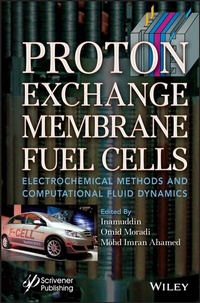
Proton Exchange Membrane Fuel Cells
Description

Edited by one of the most well-respected and prolific engineers in the world and his team, this book provides a comprehensive overview of hydrogen production, conversion, and storage, offering the scientific literature a comprehensive coverage of this important fuel.
Proton exchange membrane fuel cells (PEMFCs) are among the most anticipated stationary clean energy devices in renewable and alternative energy. Despite the appreciable improvement in their cost and durability, which are the two major commercialization barriers, their availability has not matched demand. This is mainly due to the use of expensive metal-catalyst, less durable membranes, and poor insight into the ongoing phenomena inside proton exchange membrane fuel cells. Efforts are being made to optimize the use of precious metals as catalyst layers or find alternatives that can be durable for more than 5000 hours.
Computational models are also being developed and studied to get an insight into the shortcomings and provide solutions. The announcement by various companies that they will be producing proton exchange membrane fuel cells-based cars by 2025 has accelerated the current research on proton exchange membrane fuel cells. The breakthrough is urgently needed. The membranes, catalysts, polymer electrolytes, and especially the understanding of diffusion layers, need thorough revision and improvement to achieve the target. This exciting breakthrough volume explores these challenges and offers solutions for the industry. Whether for the student, veteran engineer, new hire, or other industry professionals, this is a must-have for any library.
More details
Other editions
Additional editions
Persons
Inamuddin, PhD, is an assistant professor in the Department of Applied Chemistry, Aligarh Muslim University, Aligarh, India. He has extensive research experience in analytical chemistry, materials chemistry, electrochemistry, renewable energy, and environmental science. He has worked on different research projects funded by various government agencies and universities and is the recipient of multiple awards, including the Fast Track Young Scientist Award and the Young Researcher of the Year Award for 2020, from Aligarh Muslim University. He has published almost 200 research articles in various international scientific journals, 19 book chapters, and 145 edited books with multiple well-known publishers, including Scrivener Publishing.He is a member of various editorial boards for scientific and technical journals and is an editor on several of them in different capacities.
Omid Moradi, PhD, is an associate professor in the Department of Chemistry, Islamic Azad University, Shahre Qods Branch, Shahre-Qods, Tehran, Iran. He received his PhD in physical chemistry in 2009 from the Science and Research Branch, Islamic Azad University, Iran. He is ranked among the world's top 2% of scientists according to Stanford University rankings in 2020, and he is the director-in-chief of a technical journal in chemistry.
Mohd Imran Ahamed, PhD, has co-edited more than 20 books and has published numerous research and review articles in scientific and technical journals. He received his PhD from Aligarh Muslim University, Aligarh, India in 2019. His research work includes ion-exchange chromatography, wastewater treatment and analysis, bending actuators, and electrospinning.
Content
Preface xiii
1 Stationary and Portable Applications of Proton Exchange Membrane Fuel Cells 1
Shahram Mehdipour-Ataei and Maryam Mohammadi
1.1 Introduction 1
1.2 Proton Exchange Membrane Fuel Cells 3
1.2.1 Stationary Applications 3
1.2.2 Portable Applications 5
1.2.3 Hydrogen PEMFCs 6
1.2.4 Alcohol PEMFCs 6
1.2.4.1 Direct Methanol Fuel Cell 6
1.2.4.2 Direct Dimethyl Ether Fuel Cell 7
1.2.5 Microbial Fuel Cells 8
1.2.5.1 Electricity Generation 8
1.2.5.2 Microbial Desalination Cells 9
1.2.5.3 Removal of Metals From Industrial Waste 9
1.2.5.4 Wastewater Treatment 9
1.2.5.5 Microbial Solar Cells and Fuel Cells 10
1.2.5.6 Biosensors 11
1.2.5.7 Biohydrogen Production 11
1.2.6 Micro Fuel Cells 11
1.3 Conclusion and Future Perspective 12
References 13
2 Graphene-Based Membranes for Proton Exchange Membrane Fuel Cells 17
Beenish Saba
2.1 Introduction 18
2.2 Membranes 19
2.3 Graphene: A Proton Exchange Membrane 19
2.4 Synthesis of GO Composite Membranes 20
2.5 Graphene Oxide in Fuel Cells 21
2.5.1 Electrochemical Fuel Cells 22
2.5.1.1 Hydrogen Oxide Polymer Electrolyte Membrane Fuel Cells 22
2.5.1.2 Direct Methanol Fuel Cells 23
2.5.2 Bioelectrochemical Fuel Cells 24
2.6 Characterization Techniques of GO Composite Membranes 25
2.7 Conclusion 26
References 27
3 Graphene Nanocomposites as Promising Membranes for Proton Exchange Membrane Fuel Cells 33
Ranjit Debnath and Mitali Saha
3.1 Introduction 34
3.2 Recent Kinds of Fuel Cells 35
3.2.1 Proton Exchange Membrane Fuel Cells 36
3.3 Conclusion 45
Acknowledgements 45
References 45
4 Carbon Nanotube-Based Membranes for Proton Exchange Membrane Fuel Cells 51
Umesh Fegade and K. E. Suryawanshi
4.1 Introduction 52
4.2 Overview of Carbon Nanotube-Based Membranes PEM Cells 54
References 64
5 Nanocomposite Membranes for Proton Exchange Membrane Fuel Cells 73
P. Satishkumar, Arun M. Isloor and Ramin Farnood
5.1 Introduction 74
5.2 Nanocomposite Membranes for PEMFC 77
5.3 Evaluation Methods of Proton Exchange Membrane Properties 80
5.3.1 Proton Conductivity Measurement 80
5.3.2 Water Uptake Measurement 81
5.3.3 Oxidative Stability Measurement 81
5.3.4 Thermal and Mechanical Properties Measurement 81
5.4 Nafion-Based Membrane 82
5.5 Poly(Benzimidazole)-Based Membrane 86
5.6 Sulfonated Poly(Ether Ether Ketone)-Based Membranes 91
5.7 Poly(Vinyl Alcohol)-Based Membranes 95
5.8 Sulfonated Polysulfone-Based Membranes 98
5.9 Chitosan-Based Membranes 100
5.10 Conclusions 103
References 103
6 Organic-Inorganic Composite Membranes for Proton Exchange Membrane Fuel Cells 111
Guocai Tian
6.1 Introduction 111
6.2 Proton Exchange Membrane Fuel Cell 112
6.3 Proton Exchange Membrane 116
6.3.1 Perfluorosulfonic Acid PEM 117
6.3.2 Partial Fluorine-Containing PEM 117
6.3.3 Non-Fluorine PEM 118
6.3.4 Modification of Proton Exchange Membrane 118
6.4 Research Progress of Organic-Inorganic Composite PEM 120
6.4.1 Inorganic Oxide/Polymer Composite PEM 120
6.4.2 Two-Dimensional Inorganic Material/Polymer Composite PEM 122
6.4.3 Carbon Nanotube/Polymer Composite PEM 124
6.4.4 Inorganic Acid-Doped Composite Film 125
6.4.5 Heteropoly Acid-Doped Composite PEM 126
6.4.6 Zirconium Phosphate-Doped Composite PEM 127
6.4.7 Polyvinyl Alcohol/Inorganic Composite Membrane 127
6.5 Conclusion and Prospection 128
Acknowledgments 130
Conflict of Interest 130
References 130
7 Thermoset-Based Composite Bipolar Plates in Proton Exchange Membrane Fuel Cell: Recent Developments and Challenges 137
Salah M.S. Al-Mufti and S.J.A. Rizvi
7.1 Introduction 138
7.2 Theories of Electrical Conductivity in Polymer Composites 142
7.2.1 Percolation Theory 145
7.2.2 General Effective Media Model 146
7.2.3 McLachlan Model 147
7.2.4 Mamunya Model 148
7.2.5 Taherian Model 149
7.3 Matrix and Fillers 151
7.3.1 Thermoset Resins 151
7.3.1.1 Epoxy 152
7.3.1.2 Unsaturated Polyester Resin 152
7.3.1.3 Vinyl Ester Resins 152
7.3.1.4 Phenolic Resins 153
7.3.1.5 Polybenzoxazine Resins 153
7.3.2 Fillers 153
7.3.2.1 Graphite 156
7.3.2.2 Graphene 157
7.3.2.3 Expanded Graphite 158
7.3.2.4 Carbon Black 158
7.3.2.5 Carbon Nanotube 159
7.3.2.6 Carbon Fiber 160
7.4 The Manufacturing Process of Thermoset-Based Composite BPs 162
7.4.1 Compression Molding 162
7.4.2 The Selective Laser Sintering Process 163
7.4.3 Wet and Dry Method 164
7.4.4 Resin Vacuum Impregnation Method 164
7.5 Effect of Processing Parameters on the Properties Thermoset-Based Composite BPs 166
7.5.1 Compression Molding Parameters 166
7.5.1.1 Pressure 166
7.5.1.2 Temperature 168
7.5.1.3 Time 169
7.5.2 The Mixing Time Effect on the Properties of Composite Bipolar Plates 170
7.6 Effect of Polymer Type, Filler Type, and Composition on Properties of Thermoset Composite BPs 170
7.6.1 Electrical Properties 171
7.6.2 Mechanical Properties 173
7.6.3 Thermal Properties 174
7.7 Testing and Characterization of Polymer Composite-Based BPs 176
7.7.1 Electrical Analysis 176
7.7.1.1 In-Plane Electrical Conductivity 176
7.7.1.2 Through-Plane Electrical Conductivity 189
7.7.2 Thermal Analysis 190
7.7.2.1 Thermal Gravimetric Analysis 190
7.7.2.2 Differential Scanning Calorimetry 190
7.7.2.3 Thermal Conductivity 191
7.7.3 Mechanical Analysis 192
7.7.3.1 Flexural Strength 192
7.7.3.2 Tensile Strength 192
7.7.3.3 Compressive Strength 193
7.8 Conclusions 193
Abbreviations 194
References 195
8 Metal-Organic Framework Membranes for Proton Exchange Membrane Fuel Cells 213
Yashmeen, Gitanjali Jindal and Navneet Kaur
8.1 Introduction 213
8.2 Aluminium Containing MOFs for PEMFCs 216
8.3 Chromium Containing MOFs for PEMFCs 217
8.4 Copper Containing MOFs for PEMFCs 224
8.5 Cobalt Containing MOFs for PEMFCs 225
8.6 Iron Containing MOFs for PEMFCs 227
8.7 Nickel Containing MOFs for PEMFCs 230
8.8 Platinum Containing MOFs for PEMFCs 230
8.9 Zinc Containing MOFs for PEMFCs 232
8.10 Zirconium Containing MOFs for PEMFCs 234
8.11 Conclusions and Future Prospects 239
References 240
9 Fluorinated Membrane Materials for Proton Exchange Membrane Fuel Cells 245
Pavitra Rajendran, Valmiki Aruna, Gangadhara Angajala and Pulikanti Guruprasad Reddy
Abbreviations 246
9.1 Introduction 247
9.2 Fluorinated Polymeric Materials for PEMFCs 250
9.3 Poly(Bibenzimidazole)/Silica Hybrid Membrane 250
9.4 Poly(Bibenzimidazole) Copolymers Containing Fluorine-Siloxane Membrane 252
9.5 Sulfonated Fluorinated Poly(Arylene Ethers) 253
9.6 Fluorinated Sulfonated Polytriazoles 255
9.7 Fluorinated Polybenzoxazole (6F-PBO) 257
9.8 Poly(Bibenzimidazole) With Poly(Vinylidene Fluoride-Co-Hexafluoro Propylene) 258
9.9 Fluorinated Poly(Arylene Ether Ketones) 259
9.10 Fluorinated Sulfonated Poly(Arylene Ether Sulfone) (6fbpaqsh-xx) 260
9.11 Fluorinated Poly(Aryl Ether Sulfone) Membranes Cross-Linked Sulfonated Oligomer (c-SPFAES) 261
9.12 Sulfonated Poly(Arylene Biphenylether Sulfone)- Poly(Arylene Ether) (SPABES-PAE) 261
9.13 Conclusion 266
Conflicts of Interest 266
Acknowledgements 267
References 267
10 Membrane Materials in Proton Exchange Membrane Fuel Cells (PEMFCs) 271
Foad Monemian and Ali Kargari
10.1 Introduction 271
10.2 Fuel Cell: Definition and Classification 272
10.3 Historical Background of Fuel Cell 273
10.4 Fuel Cell Applications 274
10.4.1 Transportation 275
10.4.2 Stationary Power 275
10.4.3 Portable Applications 275
10.5 Comparison between Fuel Cells and Other Methods 278
10.6 PEMFCs: Description and Characterization 280
10.6.1 Ion Exchange Capacity-Conductivity 281
10.6.2 Durability 281
10.6.3 Water Management 282
10.6.4 Cost 282
10.7 Membrane Materials for PEMFC 282
10.7.1 Statistical Copolymer PEMs 283
10.7.2 Block and Graft Copolymers 286
10.7.3 Polymer Blending and Other PEM Compounds 289
10.8 Conclusions 296
References 296
11 Nafion-Based Membranes for Proton Exchange Membrane Fuel Cells 299
Santiago Pablo Fernandez Bordín, Janet de los Angeles Chinellato Díaz and Marcelo Ricardo Romero
11.1 Introduction: Background 300
11.2 Physical Properties 302
11.3 Nafion Structure 304
11.4 Water Uptake 307
11.5 Protonic Conductivity 310
11.6 Water Transport 316
11.7 Gas Permeation 319
11.8 Final Comments 324
Acknowledgements 324
References 325
12 Solid Polymer Electrolytes for Proton Exchange Membrane Fuel Cells 331
Nitin Srivastava and Rajendra Kumar Singh
12.1 Introduction 331
12.2 Type of Fuel Cells 334
12.2.1 Alkaline Fuel Cells 334
12.2.2 Polymer Electrolyte Fuel Cells 335
12.2.3 Phosphoric Acid Fuel Cells 337
12.2.4 Molten Carbonate Fuel Cells 338
12.2.5 Solid Oxide Fuel Cells 338
12.3 Basic Properties of PEMFC 339
12.4 Classification of Solid Polymer Electrolyte Membranes for PEMFC 341
12.4.1 Perfluorosulfonic Membrane 341
12.4.2 Partially Fluorinated Polymers 343
12.4.3 Non-Fluorinated Hydrocarbon Membrane 344
12.4.4 Nonfluorinated Acid Membranes With Aromatic Backbone 344
12.4.5 Acid Base Blend 344
12.5 Applications 345
12.5.1 Application in Transportation 346
12.6 Conclusions 347
References 347
13 Computational Fluid Dynamics Simulation of Transport Phenomena in Proton Exchange Membrane Fuel Cells 353
Maryam Mirzaie and Mohamadreza Esmaeilpour
13.1 Introduction 354
13.2 PEMFC Simulation and Mathematical Modeling 356
13.2.1 Governing Equations 359
13.2.1.1 Continuity Equation 359
13.2.1.2 Momentum Equation 360
13.2.1.3 Mass Transfer Equation 360
13.2.1.4 Energy Transfer Equation 362
13.2.1.5 Equation of Charge Conservation 362
13.2.1.6 Formation and Transfer of Liquid Water 362
13.3 The Solution Procedures 363
13.3.1 CFD Simulations 363
13.3.2 OpenFOAM 374
13.3.3 Lattice Boltzmann 381
13.4 Conclusions 389
References 390
Index 395
1
Stationary and Portable Applications of Proton Exchange Membrane Fuel Cells
Shahram Mehdipour-Ataei* and Maryam Mohammadi
Faculty of Polymer Science, Iran Polymer and Petrochemical Institute, Tehran, Iran
Abstract
Proton exchange membrane fuel cells (PEMFCs) have been extensively evaluated for transportation applications due to the advantages such as lightweight, fast start-up, and zero emission. Some commercial products are also now being used worldwide. Moreover, because of the increasing advancement of technology and the integration of human life with new electronic technologies as well as the Internet, there is a growing trend for alternative or auxiliary sources of power for battery systems and portable devices. In addition, the requisite sources of power in areas that are remote and suffer from energy shortages are the other challenge. PEMFCs are the future vision for powering stationary and portable resources from massive power plants to cell phones. This chapter presents a variety of stationary and portable applications of PEMFCs, including hydrogen, alcohol, microbial, and micro fuel cells. Each section presents applications, achievements, and challenges. Finally, the prospects for the development of these technologies as reliable and applicable sources in the real world are presented.
Keywords: PEM fuel cell, applications, portable, stationary, hydrogen fuel cell, methanol fuel cell, microbial fuel cell, micro fuel cell
1.1 Introduction
Because of the zero or very low emission, proton exchange membrane fuel cells (PEMFCs) are promising in transportation. The first commercial application of these technologies in transportation may be urban buses. The Scania hybrid bus is an example of this technology. In addition, fuel cells are applicable in any energy-driving device. The power of less than 1 W to several megawatts can be supplied by this technology due to the modularity, static nature, and variety. These features make a fuel cell a substitute for conventional heat engines used for transportation and power generation. Fuel cells are also an integral part of future technologies for energy conversion and storage, along with electrolyzers, batteries, flow systems, and renewable energy technologies. Lack of global market, high capital, high cost of components, and durability are the limiting factors of the mass market. However, Toyota, Hyundai, Honda, and others have commercialized their own products. Thus, the widespread usage of this technology has been made possible bypassing fossil fuel-powered to fuel cell-powered vehicles. Moreover, the use of fuel cells in US space programs continues, and PEMFCs are also considered for this purpose [1-11].
Fuel cell applications can be considered into three groups: portable, stationary, and transportation.
Low-temperature fuel cells are fit for portable and emergency power due to the short heating time. Portable fuel cells perform in the power range of 5-500 watts. Some examples of portable applications of PEMFCs in real-world include portable power generators for light personal usage in camping, continuous power systems, portable power sources as a replacement for batteries in laptops, computers, cell phones, radios, cameras, military electronics, boats, scooters, toys, kits, home lighting, emergency lights, and chargers.
Fuel cells can also regareded for stationary power generation including in the residential, commercial, and industrial sectors. In addition, by using fuel cells that operate in the range of medium to high temperature, the use of excess generated heat increases the overall efficiency and offers useful power for heating domestic water and space. A static power range of 1-50 MW can be supplied by PEMFCs. In telecommunication applications as an example of small-scale stationary power, the power range is 1-100 kW. Some applications of PEMFCs for stationary power supply include emergency backup (EPS) or uninterruptible power supply (UPS) for telecommunication networks, airports, hospitals, and training centers; remote or local power supply for small villages, buildings, and military camps; micro fuel cells, combined heat and power generation (CHP), and power regulation systems, in which surplus electricity is stored to hydrogen by electrolysis of water and converted into electricity when needed.
Transportation applications of PEMFCs include diverse types of trucks, buses, automobiles, motorcycles, bicycles, golf vehicles, service vehicles, boats, submarines, aircraft, and locomotives [3, 11-18].
Fuel cell applications can be also classified on the basis of a special need or removing a problem. High reliable power (computer equipment, communication facilities, and call as well as data processing centers), emission reduction or elimination (vehicles, industrial facilities, airports, and areas with severe emission standards for greenhouses), limited access to the electricity grid (rural or remote areas), and the availability of biogas (waste treatment plants and conversion of waste gases into electricity and heat with slight environmental impact by fuel cells) are in this classification [19].
The leading countries in the development of fuel cells include United States, Germany, Japan, Canada, and South Korea [18].
1.2 Proton Exchange Membrane Fuel Cells
PEMFCs are the most common types of fuel cell technology that are the focus of studies. The high power density, fast start-up, low manufacturing cost, long lifetime, flexibility, and widespread use in portable devices, transportation, and stationary applications are the superior characteristics of these types of cells compared to other types of fuel cells. About 90% of research studies and developments in fuel cells are in the field of PEMFCs; low operating temperatures and, therefore, reduced heat loss, small size, and lightweight make them suitable for automotive and transportation applications. They are a good choice for powering buses and commercial hydrogen vehicles as well. Polymer electrolyte membrane fuel cells have also been developed as a suitable replacement for existing batteries.
One of the most well-known research centers of PEMFCs is Los Alamos National Laboratory (LANL), which has released valuable achievements. In addition, renewable energy laboratories all over the world are representing their new successes every day [11, 17, 20-24].
1.2.1 Stationary Applications
In the early 1990s, according to the attained results from the performance and cost of PEMFCs for transportation applications, these types of cells were considered stationary, albeit with limited heat output.
Polymer electrolyte membrane fuel cells are capable of producing power in the range of a few watts to hundreds of kilowatts. Thus, these cells are applicable in almost any application that requires local power, including backup, remote, and uninterruptible power supply. The stationary application of PEMFCs includes decentralized power generation at the scale of 50-250 kW or less than 10 kW. However, it is required to focus on the small power range of 1-5 kW in the UPS or auxiliary power unit systems to be used for medium or large appliances for stationary applications [14, 24-27].
The distributed power of PEMFCs is usable for stationary applications in a variety of locations. Some of the applications include the main power source for areas where there is no access by the grid, supplementary power supply that operates in parallel with the power grid, supplementary power supply in renewable energy systems like photovoltaic and wind turbines, and emergency generators to remove power grid faults. Initial ages of stationary PEMFCs were designed for the residential power supply to use the generated heat for domestic, which significantly increases efficiency. A 250-kW stationary unit developed by Ballard Generation that runs on natural gas; other types that work with propane, hydrogen, or anaerobic digestion gas have also been designed and fully established. Besides, prototype units have been successfully achieved in the United States, Japan, and Europe [11, 13, 14, 16, 24, 25, 28, 29].
The backup power market for banks, hospitals, and telecommunications, in which there is a need for reliable power sources to prevent unexpected power downfall that causes very high cost, has attracted a lot of attention. Nonetheless, the high cost of PEMFCs is still an obstacle limits the global usage of stationary applications. Nonetheless, several commercial units such as CHP GenSysTM Blue Plug Power, Ballard FCgenTM 1020 ACS, and Ballard FCgen 10 -1030V3 fuel cell systems have been established in several places [11, 12, 14, 15].
The CHP GenSysTM fuel cell system has been installed in New York State for domestic. Ballard Power System is also available for use on telecommunication tower sites in India and Denmark to provide backup power. Besides, a model project was carried out in 2008 in Japan for the installation of ENE FARM class residential fuel cell. Small stationary units with a power of less than 10 kW were also installed for domestic usage, uninterruptible power supply, and backup power in commercial and remote locations [11, 16, 28].
Among the numerous successful projects, the Ballard Generation system is the largest plant to date. The output power of this plant is 250 kW. This PEMFC system is powered by natural gas and can be efficiently used as...
