

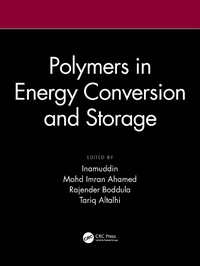
Polymers in Energy Conversion and Storage
1st Edition
Published on 28. June 2022
362 pages
978-1-000-59121-7 (ISBN)
Description

The research and development activities in energy conversion and storage are playing a significant role in our daily lives owing to the rising interest in clean energy technologies to alleviate the fossil-fuel crisis. Polymers are used in energy conversion and storage technology due to their low-cost, softness, ductility and flexibility compared to carbon and inorganic materials. Polymers in Energy Conversion and Storage provides in-depth literature on the applicability of polymers in energy conversion and storage, history and progress, fabrication techniques, and potential applications.
Highly accomplished experts review current and potential applications including hydrogen production, solar cells, photovoltaics, water splitting, fuel cells, supercapacitors and batteries. Chapters address the history and progress, fabrication techniques, and many applications within a framework of basic studies, novel research, and energy applications.
Additional Features Include:
Explores all types of energy applications based on polymers and its composites
Provides an introduction and essential concepts tailored for the industrial and research community
Details historical developments in the use of polymers in energy applications
Discusses the advantages of polymers as electrolytes in batteries and fuel cells
This book is an invaluable guide for students, professors, scientists and R&D industrial experts working in the field.
Highly accomplished experts review current and potential applications including hydrogen production, solar cells, photovoltaics, water splitting, fuel cells, supercapacitors and batteries. Chapters address the history and progress, fabrication techniques, and many applications within a framework of basic studies, novel research, and energy applications.
Additional Features Include:
Explores all types of energy applications based on polymers and its composites
Provides an introduction and essential concepts tailored for the industrial and research community
Details historical developments in the use of polymers in energy applications
Discusses the advantages of polymers as electrolytes in batteries and fuel cells
This book is an invaluable guide for students, professors, scientists and R&D industrial experts working in the field.
More details
Edition
1. Auflage
Language
English
Place of publication
London
United Kingdom
Publishing group
Taylor & Francis Ltd
Target group
Professional and scholarly
Illustrations
47 Tables, black and white; 111 Line drawings, color; 44 Line drawings, black and white; 38 Halftones, color; 9 Halftones, black and white; 149 Illustrations, color; 53 Illustrations, black and white
ISBN-13
978-1-000-59121-7 (9781000591217)
Copyright in bibliographic data and cover images is held by Nielsen Book Services Limited or by the publishers or by their respective licensors: all rights reserved.
Schweitzer Classification
Other editions
Additional editions
Inamuddin | Mohd Imran Ahamed | Rajender Boddula
Polymers in Energy Conversion and Storage
Book
10/2024
1st Edition
CRC Press
€96.60
Shipment within 15-20 days
Inamuddin | Mohd Imran Ahamed | Rajender Boddula
Polymers in Energy Conversion and Storage
Book
06/2022
1st Edition
CRC Press
€235.61
Shipment within 15-20 days
Persons
Dr. Inamuddin is working as Assistant Professor at the Department of Applied Chemistry, Aligarh Muslim University, Aligarh, India. He obtained Master of Science degree in Organic Chemistry from Chaudhary Charan Singh (CCS) University, Meerut, India, in 2002. He received his Master of Philosophy and Doctor of Philosophy degrees in Applied Chemistry from Aligarh Muslim University (AMU), India, in 2004 and 2007, respectively. He has extensive research experience in multidisciplinary fields of Analytical Chemistry, Materials Chemistry, and Electrochemistry and, more specifically, Renewable Energy and Environment. He has worked on different research projects as project fellow and senior research fellow funded by University Grants Commission (UGC), Government of India, and Council of Scientific and Industrial Research (CSIR), Government of India. He has received Fast Track Young Scientist Award from the Department of Science and Technology, India, to work in the area of bending actuators and artificial muscles. He has completed four major research projects sanctioned by University Grant Commission, Department of Science and Technology, Council of Scientific and Industrial Research, and Council of Science and Technology, India. He has published 190 research articles in international journals of repute and nineteen book chapters in knowledge-based book editions published by renowned international publishers. He has published 145 edited books with Springer (U.K.), Elsevier, Nova Science Publishers, Inc. (U.S.A.), CRC Press Taylor & Francis Asia Pacific, Trans Tech Publications Ltd. (Switzerland), IntechOpen Limited (U.K.), Wiley-Scrivener, (U.S.A.) and Materials Research Forum LLC (U.S.A). He is a member of various journals' editorial boards. He is also serving as Associate Editor for journals (Environmental Chemistry Letter, Applied Water Science and Euro-Mediterranean Journal for Environmental Integration, Springer-Nature), Frontiers Section Editor (Current Analytical Chemistry, Bentham Science Publishers), Editorial Board Member (Scientific Reports-Nature), Editor (Eurasian Journal of Analytical Chemistry), and Review Editor (Frontiers in Chemistry, Frontiers, U.K.) He is also guest-editing various special thematic special issues to the journals of Elsevier, Bentham Science Publishers, and John Wiley & Sons, Inc. He has attended as well as chaired sessions in various international and national conferences. He has worked as a Postdoctoral Fellow, leading a research team at the Creative Research Initiative Center for Bio-Artificial Muscle, Hanyang University, South Korea, in the field of renewable energy, especially biofuel cells. He has also worked as a Postdoctoral Fellow at the Center of Research Excellence in Renewable Energy, King Fahd University of Petroleum and Minerals, Saudi Arabia, in the field of polymer electrolyte membrane fuel cells and computational fluid dynamics of polymer electrolyte membrane fuel cells. He is a life member of the Journal of the Indian Chemical Society. His research interest includes ion exchange materials, a sensor for heavy metal ions, biofuel cells, supercapacitors and bending actuators.
Dr. Mohd Imran Ahamed received his Ph.D degree on the topic "Synthesis and characterization of inorganic-organic composite heavy metals selective cation-exchangers and their analytical applications", from Aligarh Muslim University, Aligarh, India in 2019. He has published several research and review articles in the journals of international recognition. Springer (U.K.), Elsevier, CRC Press Taylor & Francis Asia Pacific and Materials Research Forum LLC (U.S.A). He has completed his B.Sc. (Hons) Chemistry from Aligarh Muslim University, Aligarh, India, and M.Sc. (Organic Chemistry) from Dr. Bhimrao Ambedkar University, Agra, India. He has co-edited more than 20 books with Springer (U.K.), Elsevier, CRC Press Taylor & Francis Asia Pacific, Materials Research Forum LLC (U.S.A) and Wiley-Scrivener, (U.S.A.). His research work includes ion-exchange chromatography, wastewater treatment, and analysis, bending actuator and electrospinning.
Dr. Rajender Boddula is currently working with Chinese Academy of Sciences-President's International Fellowship Initiative (CAS-PIFI) at National Center for Nanoscience and Technology (NCNST, Beijing). He obtained Master of Science in Organic Chemistry from Kakatiya University, Warangal, India, in 2008. He received his Doctor of Philosophy in Chemistry with the highest honours in 2014 for the work entitled "Synthesis and Characterization of Polyanilines for Supercapacitor and Catalytic Applications" at the CSIR-Indian Institute of Chemical Technology (CSIR-IICT) and Kakatiya University (India). Before joining National Center for Nanoscience and Technology (NCNST) as CAS-PIFI research fellow, China, worked as senior research associate and Postdoc at National Tsing-Hua University (NTHU, Taiwan) respectively in the fields of bio-fuel and CO2 reduction applications. His academic honors include University Grants Commission National Fellowship and many merit scholarships, study-abroad fellowships from Australian Endeavour Research Fellowship, and CAS-PIFI. He has published many scientific articles in international peer-reviewed journals and has authored around twenty book chapters, and he is also serving as an editorial board member and a referee for reputed international peer-reviewed journals. He has published edited books with Springer (UK), Elsevier, Materials Science Forum LLC (USA), Wiley-Scrivener, (U.S.A.) and CRC Press Taylor & Francis group. His specialized areas of research are energy conversion and storage, which include sustainable nanomaterials, graphene, polymer composites, heterogeneous catalysis for organic transformations, environmental remediation technologies, photoelectrochemical water-splitting devices, biofuel cells, batteries and supercapacitors.
Dr. Mohd Imran Ahamed received his Ph.D degree on the topic "Synthesis and characterization of inorganic-organic composite heavy metals selective cation-exchangers and their analytical applications", from Aligarh Muslim University, Aligarh, India in 2019. He has published several research and review articles in the journals of international recognition. Springer (U.K.), Elsevier, CRC Press Taylor & Francis Asia Pacific and Materials Research Forum LLC (U.S.A). He has completed his B.Sc. (Hons) Chemistry from Aligarh Muslim University, Aligarh, India, and M.Sc. (Organic Chemistry) from Dr. Bhimrao Ambedkar University, Agra, India. He has co-edited more than 20 books with Springer (U.K.), Elsevier, CRC Press Taylor & Francis Asia Pacific, Materials Research Forum LLC (U.S.A) and Wiley-Scrivener, (U.S.A.). His research work includes ion-exchange chromatography, wastewater treatment, and analysis, bending actuator and electrospinning.
Dr. Rajender Boddula is currently working with Chinese Academy of Sciences-President's International Fellowship Initiative (CAS-PIFI) at National Center for Nanoscience and Technology (NCNST, Beijing). He obtained Master of Science in Organic Chemistry from Kakatiya University, Warangal, India, in 2008. He received his Doctor of Philosophy in Chemistry with the highest honours in 2014 for the work entitled "Synthesis and Characterization of Polyanilines for Supercapacitor and Catalytic Applications" at the CSIR-Indian Institute of Chemical Technology (CSIR-IICT) and Kakatiya University (India). Before joining National Center for Nanoscience and Technology (NCNST) as CAS-PIFI research fellow, China, worked as senior research associate and Postdoc at National Tsing-Hua University (NTHU, Taiwan) respectively in the fields of bio-fuel and CO2 reduction applications. His academic honors include University Grants Commission National Fellowship and many merit scholarships, study-abroad fellowships from Australian Endeavour Research Fellowship, and CAS-PIFI. He has published many scientific articles in international peer-reviewed journals and has authored around twenty book chapters, and he is also serving as an editorial board member and a referee for reputed international peer-reviewed journals. He has published edited books with Springer (UK), Elsevier, Materials Science Forum LLC (USA), Wiley-Scrivener, (U.S.A.) and CRC Press Taylor & Francis group. His specialized areas of research are energy conversion and storage, which include sustainable nanomaterials, graphene, polymer composites, heterogeneous catalysis for organic transformations, environmental remediation technologies, photoelectrochemical water-splitting devices, biofuel cells, batteries and supercapacitors.
Content
Chapter 01
History and Progress of Polymers for Energy Applications
Chapter 02
Polymer Electrolytes for Supercapacitor Applications
Chapter 03
Polyaniline-Based Ternary Composites for Energy Accumulation in Electrochemical Capacitors
Chapter 04
Self-healing Gel Electrolytes for Flexible Supercapacitors
Chapter 05
Polymer nanogenerators
Chapter 06
Pyroelectric and piezoelectric polymers
Chapter 07
Polymer and Composites for Solar Cell Applications
Chapter 08
Polymers and composites for fuel cell applications
Chapter 09
Solid Polymer Electrolytes for Solid State Batteries
Chapter 10
Polymer batteries
Chapter 11
Polymer semiconductors
Chapter 12
Polymer organic photovoltaics
Chapter 13
Polymers and their composites for wearable electronics
Chapter 14
Polymer-based organic electronics
Chapter 15
Polymers and their Composites for Thermoelectric Applications
Chapter 16
Polymeric materials for hydrogen storage
Chapter 17
Polymers and their composites for water-splitting applications
History and Progress of Polymers for Energy Applications
Chapter 02
Polymer Electrolytes for Supercapacitor Applications
Chapter 03
Polyaniline-Based Ternary Composites for Energy Accumulation in Electrochemical Capacitors
Chapter 04
Self-healing Gel Electrolytes for Flexible Supercapacitors
Chapter 05
Polymer nanogenerators
Chapter 06
Pyroelectric and piezoelectric polymers
Chapter 07
Polymer and Composites for Solar Cell Applications
Chapter 08
Polymers and composites for fuel cell applications
Chapter 09
Solid Polymer Electrolytes for Solid State Batteries
Chapter 10
Polymer batteries
Chapter 11
Polymer semiconductors
Chapter 12
Polymer organic photovoltaics
Chapter 13
Polymers and their composites for wearable electronics
Chapter 14
Polymer-based organic electronics
Chapter 15
Polymers and their Composites for Thermoelectric Applications
Chapter 16
Polymeric materials for hydrogen storage
Chapter 17
Polymers and their composites for water-splitting applications
