

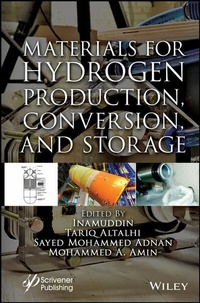
Materials for Hydrogen Production, Conversion, and Storage
Description

Edited by one of the most well-respected and prolific engineers in the world and his team, this book provides a comprehensive overview of hydrogen production, conversion, and storage, offering the scientific literature a comprehensive coverage of this important fuel.
Continually growing environmental concerns are driving every, or almost every, country on the planet towards cleaner and greener energy production. This ultimately leaves no option other than using hydrogen as a fuel that has almost no adverse environmental impact. But hydrogen poses several hazards in terms of human safety as its mixture of air is prone to potential detonations and fires. In addition, the permeability of cryogenic storage can induce frostbite as it leaks through metal pipes. In short, there are many challenges at every step to strive for emission-free fuel. In addition to these challenges, there are many emerging technologies in this area. For example, as the density of hydrogen is very low, efficient methods are being developed and engineered to store it in small volumes.
This groundbreaking new volume describes the production of hydrogen from various sources along with the protagonist materials involved. Further, the extensive and novel materials involved in conversion technologies are discussed. Also covered here are the details of the storage materials of hydrogen for both physical and chemical systems. Both renewal and non-renewal sources are examined as feedstocks for the production of hydrogen. The non-renewal feedstocks, mainly petroleum, are the major contributor to date but there is a future perspective in a renewal source comprising mainly of water splitting via electrolysis, radiolysis, thermolysis, photocatalytic water splitting, and biohydrogen routes. Whether for the student, veteran engineer, new hire, or other industry professionals, this is a must-have for any library.
More details
Other editions
Additional editions
Persons
Inamuddin, PhD, is an assistant professor in the Department of Applied Chemistry, Aligarh Muslim University, Aligarh, India. He has extensive research experience in analytical chemistry, materials chemistry, electrochemistry, renewable energy, and environmental science. He has worked on different research projects funded by various government agencies and universities and is the recipient of multiple awards, including the Fast Track Young Scientist Award and the Young Researcher of the Year Award for 2020, from Aligarh Muslim University. He has published almost 200 research articles in various international scientific journals, 19 book chapters, and 145 edited books with multiple well-known publishers, including Scrivener Publishing. He is a member of various editorial boards for scientific and technical journals and is an editor on several of them in different capacities.
Tariq Altalhi, PhD, is an assistant professor and department head in the Department of Chemistry at Taif University, Saudi Arabia. He is also the Vice Dean of the College of Science, and he leads a group involved in fundamental interdisciplinary research across numerous fields.
Sayed Mohammed Adnan, PhD, is a research scholar in the Department of Chemical Engineering, Aligarh Muslim University, India. He is actively involved in research and has published several articles in reputed journals. His research areas are very broad, encompassing a multitude of scientific areas.
Mohammed A. Amin, PhD, is a professor of physical chemistry at Taif University, Saudi Arabia, and a professor of physical chemistry at Ain Shams University, Cairo, Egypt. He has won numerous scholarly awards and has been a guest editor for a reputable scientific journal.
Content
Preface xxi
1 Transition Metal Oxides in Solar-to-Hydrogen Conversion 1
Zuzanna Bielan and Katarzyna Siuzdak
1.1 Introduction 2
1.2 Solar-to-Hydrogen Conversion Processes Utilizing Transition Metal Oxides 3
1.2.1 Photocatalysis 3
1.2.2 Photoelectrocatalysis 5
1.2.3 Thermochemical Water Splitting 6
1.3 Transition Metal Oxides in Solar-to-Hydrogen Conversion Processes 7
1.3.1 Photocatalysis and Photoelectrocatalysis 7
1.3.1.1 TiO 2 8
1.3.1.2 a-Fe 2 O 3 16
1.3.1.3 CuO/Cu 2 O 20
1.3.2 Thermochemical Water Splitting 23
1.3.2.1 Fe 3 O 4 /FeO Redox Pair 24
1.3.2.2 CeO 2 /Ce 2 O 3 and CeO/CeO 2-d Redox Pairs 25
1.3.2.3 ZnO/Zn Redox Pair 27
1.4 Conclusions and Future Perspectives 28
References 29
2 Catalytic Conversion Involving Hydrogen from Lignin 41
Satabdi Misra and Atul Kumar Varma
List of Abbreviations 41
2.1 Introduction 42
2.1.1 Background of Bio-Refinery and Lignin 42
2.1.2 Lignin as an Alternate Source of Energy 44
2.1.3 Lignin Isolation Process 45
2.2 Catalytic Conversion of Lignin 45
2.2.1 Lignin Reductive Depolymerization into Aromatic Monomers 47
2.2.2 Catalytic Hydrodeoxydation (HDO) of Lignin 48
2.2.3 Hydrodeoxydation (HDO) of Lignin-Derived-Bio-Oil 51
Summary and Outlook 52
References 53
3 Solar-Hydrogen Coupling Hybrid Systems for Green Energy 65
Bilge Coskuner Filiz, Esra Balkanli Unlu, Hülya Civelek Yörüklü, Meltem Karaismailoglu Elibol, Yagmur Akar, Ali Turgay San, Halit Eren Figen and Aysel Kantürk Figen
3.1 Concept of Green Sources and Green Storage 66
3.2 Coupling of Green to Green 67
3.3 Solar Energy-Hydrogen System 67
3.3.1 Photoelectrochemical Hydrogen Production 68
3.3.1.1 PEC Materials 70
3.3.1.2 Photoelectrochemical Systems 73
3.3.2 Electrochemical Hydrogen Production 74
3.3.2.1 Polymer Electrolyte Membrane Electrolysis Cell (PEMEC) 75
3.3.2.2 Alkaline Electrolysis Cell (AEC) 76
3.3.2.3 Solid Oxide Electrolysis Cell (SOEC) 77
3.3.3 Fuel Cell 78
3.3.4 Photovoltaic 79
3.4 Thermochemical Systems 80
3.5 Photobiological Hydrogen Production 82
3.6 Conclusion 84
References 85
4 Green Sources to Green Storage on Solar-Hydrogen Coupling 97
A. Mohan Kumar, R. Rajasekar, P. Sathish Kumar, S. Santhosh and B. Premkumar
4.1 Introduction 98
4.1.1 Hybrid System 99
4.2 Concentrated Solar Thermal H 2 Production 101
4.3 Thermochemical Aqua Splitting Technology for Solar-H 2 Generation 103
4.4 Solar to Hydrogen Through Decarbonization of Fossil Fuels 105
4.4.1 Solar Cracking 106
4.5 Solar Thermal-Based Hydrogen Generation Through Electrolysis 107
4.6 Photovoltaics-Based Hydrogen Production 107
4.7 Conclusion 109
References 110
5 Electrocatalysts for Hydrogen Evolution Reaction 115
R. Shilpa, K. S. Sibi, S. R. Sarath Kumar, R. K. Pai and R.B. Rakhi
5.1 Introduction 116
5.2 Parameters to Evaluate Efficient HER Catalysts 117
5.2.1 Overpotential (o.p) 117
5.2.2 Tafel Plot 118
5.2.3 Stability 119
5.2.4 Faradaic Efficiency and Turnover Frequency 119
5.2.5 Hydrogen Bonding Energy (HBE) 120
5.3 Categories of HER Catalysts 121
5.3.1 Noble Metal-Based Catalysts 121
5.3.2 Non-Noble Metal-Based Catalysts 125
5.3.3 Metal-Free 2D Nanomaterials 126
5.3.4 Transition Metal Dichalcogenides 129
5.3.5 Transition Metal Oxides and Hydroxides 130
5.3.6 Transition Metal Phosphides 132
5.3.7 MXenes (Transition Metal Carbides and Nitrides) 132
Conclusion 134
References 134
6 Recent Progress on Metal Catalysts for Electrochemical Hydrogen Evolution 147
Tejaswi Jella and Ravi Arukula
6.1 Introduction 148
6.1.1 Type of Water Electrolysis Technologies 148
6.1.1.1 Alkaline Electrolysis (AE) 149
6.1.1.2 Proton Exchange Membrane Electrolysis (peme) 149
6.1.1.3 Solid Oxide Electrolysis (SOE) 149
6.2 Mechanism of Hydrogen Evolution Reaction (HER) 149
6.2.1 Performance Evaluation of Catalyst 151
6.3 Various Electrocatalysts for Hydrogen Evolution Reaction (her) 153
6.3.1 Noble Metal Catalysts for HER 153
6.3.1.1 Platinum-Based Catalysts 153
6.3.1.2 Palladium Based Catalysts 155
6.3.1.3 Ruthenium Based Catalysts 157
6.3.2 Non-Noble Metal Catalysts 158
6.3.2.1 Transition Metal Phosphides (TMP) 158
6.3.2.2 Transition Metal Chalcogenides 162
6.3.2.3 Transition Metal Carbides (TMC) 163
6.4 Conclusion and Future Aspects 164
References 165
7 Dark Fermentation and Principal Routes to Produce Hydrogen 181
Luana C. Grangeiro, Bruna S. de Mello, Brenda C. G. Rodrigues, Caroline Varella Rodrigues, Danieli Fernanda Canaver Marin, Romario Pereira de Carvalho Junior, Lorena Oliveira Pires, Sandra Imaculada Maintinguer, Arnaldo Sarti and Kelly J. Dussán
7.1 Introduction 182
7.2 Biohydrogen Production from Organic Waste 183
7.2.1 Crude Glycerol 186
7.2.1.1 Dark Fermentation of Crude Glycerol to Biohydrogen and Bio Products 187
7.2.2 Dairy Waste 189
7.2.2.1 Dark Fermentation of Dairy Waste to Biohydrogen and Bioproducts 190
7.2.3 Fruit Waste 193
7.2.3.1 Dark Fermentation of Fruit Waste to Hydrogen and Bioproducts 194
7.3 Anaerobic Systems 198
7.3.1 Continuous Multiple Tube Reactor 206
7.4 Conclusion and Future Perspectives 209
Acknowledgements 210
References 210
8 Catalysts for Electrochemical Water Splitting for Hydrogen Production 225
Zaib Ullah Khan, Mabkhoot Alsaiari, Muhammad Ashfaq Ahmed, Nawshad Muhammad, Muhammad Tariq, Abdur Rahim and Abdul Niaz
8.1 Introduction 226
8.2 Water Splitting and Their Products 229
8.3 Different Methods Used for Water Splitting 229
8.3.1 Setup for Water Splitting Systems at a Basic Level 229
8.3.2 Photocatalysis 230
8.3.3 Electrolysis 232
8.4 Principles of PEC and Photocatalytic H 2 Generation 232
8.5 Electrochemical Process for Water Splitting Application 233
8.5.1 Water Splitting Through Electrochemistry 233
8.6 Different Materials Used in Water Splitting 233
8.6.1 Water Oxidation (OER) Materials 233
8.6.2 Developing Materials for Hydrogen Synthesis 235
8.6.3 Material Stability for Water Splitting 235
8.7 Mechanism of Electrochemical Catalysis in Water Splitting and Hydrogen Production 235
8.7.1 Electrochemical Water Splitting with Cheap Metal-Based Catalysts 236
8.7.2 Catalysts with Only One Atom 236
8.7.3 Electrochemical Water Splitting Using Low-Cost Metal-Free Catalysts 237
8.8 Water Splitting and Hydrogen Production Materials Used in Electrochemical Catalysis 238
8.8.1 Metal and Alloys 238
8.8.2 Metal Oxides/Hydroxides and Chalogenides 239
8.8.3 Metal Carbides, Borides, Nitrides, and Phosphides 239
8.9 Uses of Hydrogen Produced from Water Splitting 240
8.9.1 Water Splitting Generates Hydrogen Energy 240
8.9.2 Photoelectrochemical (PEC) Water Splitting 241
8.9.3 Thermochemical Water Splitting 241
8.9.4 Biological Water Splitting 241
8.9.5 Fermentation 241
8.9.6 Biomass and Waste Conversions 242
8.9.7 Solar Thermal Water Splitting 242
8.9.8 Renewable Electrolysis 242
8.9.9 Hydrogen Dispenser Hose Reliability 242
8.10 Conclusion 243
References 243
9 Challenges and Mitigation Strategies Related to Biohydrogen Production 249
Mohd Nur Ikhmal Salehmin, Ibdal Satar and Mohamad Azuwa Mohamed
9.1 Introduction 249
9.2 Limitation and Mitigation Approaches of Biohydrogen Production 252
9.2.1 Physical Issues and Their Mitigation Approaches 252
9.2.1.1 Operating Temperature Issue and Its Control 252
9.2.1.2 Hydraulic Retention Time (HRT) and Optimization 252
9.2.1.3 High Hydrogen Partial Pressure - Implication and Overcoming the Issue 253
9.2.1.4 Membrane Fouling Issues and Solutions 254
9.2.2 Biological Issues and Their Mitigation Approaches 256
9.2.2.1 Start-Up Issue and Improvement Through Bioaugmentation 256
9.2.2.2 Biomass Washout Issue and Solution Through Cell Immobilization 256
9.2.3 Chemical Issues and Their Mitigation Approaches 257
9.2.3.1 pH Variation and Its Regulation 257
9.2.3.2 Limiting Nutrient Loading and Optimization 257
9.2.3.3 Inhibitor Secretion and Its Control 258
9.2.3.4 Byproduct Formation and Its Exploitation 260
9.2.4 Economic Issues and Ways to Optimize Cost 260
9.3 Conclusion and Future Direction 265
Acknowledgements 266
References 266
10 Continuous Production of Clean Hydrogen from Wastewater by Microbial Usage 277
P. Satishkumar, Arun M. Isloor and Ramin Farnood
10.1 Introduction 278
10.2 Wastewater for Biohydrogen Production 279
10.3 Photofermentation 281
10.3.1 Continuous Photofermentation 283
10.3.2 Factors Affecting Photofermentation Hydrogen Production 286
10.3.2.1 Inoculum Condition and Substrate Concentration 286
10.3.2.2 Carbon and Nitrogen Source 287
10.3.2.3 Temperature 288
10.3.2.4 pH 288
10.3.2.5 Light Intensity 288
10.3.2.6 Immobilization 290
10.4 Dark Fermentation 291
10.4.1 Continuous Dark Fermentation 292
10.4.2 Factors Affecting Hydrogen Production in Continuous Dark Fermentation 296
10.4.2.1 Start-Up Time 296
10.4.2.2 Organic Loading Rate 296
10.4.2.3 Hydraulic Retention Time 297
10.4.2.4 Temperature 301
10.4.2.5 pH 302
10.4.2.6 Immobilization 302
10.5 Microbial Electrolysis Cell 304
10.5.1 Mechanism of Microbial Electrolysis Cell 304
10.5.2 Wastewater Treatment and Hydrogen Production 305
10.5.3 Factors Affecting Microbial Electrolysis Cell Performance 308
10.5.3.1 Inoculum 308
10.5.3.2 pH 308
10.5.3.3 Temperature 308
10.5.3.4 Hydraulic Retention Time 308
10.5.3.5 Applied Voltage 310
10.6 Conclusions 310
References 311
11 Conversion Techniques for Hydrogen Production and Recovery Using Membrane Separation 319
Nor Azureen Mohamad Nor, Nur Shamimie Nadzwin Hasnan, Nurul Atikah Nordin, Nornastasha Azida Anuar, Muhamad Firdaus Abdul Sukur and Mohamad Azuwa Mohamed
11.1 Introduction 320
11.2 Conversion Technique for Hydrogen Production 321
11.2.1 Photocatalytic Hydrogen Generation via Particulate System 321
11.2.2 Photoelectrochemical Cell (PEC) 324
11.2.3 Photovoltaic-Photoelectrochemical Cell (PV-PEC) 325
11.2.4 Electrolysis 327
11.3 Hydrogen Recovery Using Membrane Separation (h 2 /o 2 Membrane Separation) 329
11.3.1 Polymeric Membranes 330
11.3.2 Porous Membranes 331
11.3.3 Dense Metal Membranes 332
11.3.4 Ion-Conductive Membranes 333
11.4 Conclusion 335
Acknowledgements 336
References 336
12 Geothermal Energy-Driven Hydrogen Production Systems 343
Santanu Ghosh and Atul Kumar Varma
Abbreviations 344
12.1 Introduction 345
12.2 Hydrogen - A Green Fuel and an Energy Carrier 347
12.3 Production of Hydrogen 348
12.3.1 Fossil Fuel-Based 348
12.3.2 Non-Fossil Fuel-Based 349
12.4 Geothermal Energy 353
12.4.1 Introductory View 353
12.4.2 Types and Occurrences 354
12.5 Hydrogen Production From Geothermal Energy 355
12.5.1 Hydrogen Production Systems 355
12.5.2 Working Fluids 369
12.5.3 Assimilation of Solar and Geothermal Energy 370
12.5.4 Chlor-Alkali Cell and Abatement of Mercury and Hydrogen Sulfide (AMIS) Unit 372
12.5.5 Hydrogen Liquefaction 374
12.5.6 Hydrogen Storage 375
12.6 Economics of Hydrogen Production 377
12.6.1 A General Overview 377
12.6.2 Economy of Hydrogen Yield Using Geothermal Energy 379
12.7 Environmental Impressions of Geothermal Energy-Driven Hydrogen Yield 381
12.8 Conclusions 382
References 384
13 Heterogeneous Photocatalysis by Graphitic Carbon Nitride for Effective Hydrogen Production 397
Kiran Kumar B., B. Venkateswar Rao, Sashivinay Kumar Gaddam, Ravi Arukula and Vishnu Shanker
13.1 Introduction 398
13.1.1 Typical Heterogeneous Photocatalysis Mechanism 399
13.1.2 Necessity of the Photocatalytic Water Splitting 400
13.2 g-C 3 N 4 -Based Photocatalytic Water Splitting 401
13.2.1 Influence of the g-C 3 N 4 Morphology on Photocatalytic Water Splitting 402
13.2.1a g-C 3 N 4 Thin Nanosheets-Based Photocatalytic Water Splitting 402
13.2.1b Porous g-C 3 N 4 -Based Photocatalytic Water Splitting 404
13.2.1c Crystalline g-C 3 N 4 -Based Photocatalytic Water Splitting 405
13.2.2 Metal Doped Photocatalytic Water Splitting 406
13.2.3 Semiconductor/g-C 3 N 4 Heterojunction for Photocatalytic Water Splitting 407
13.3 Future Remarks and Conclusion 408
References 409
14 Graphitic Carbon Nitride (g-CN) for Sustainable Hydrogen Production 417
Zaib Ullah Khan, Mabkhoot Alsaiari, Saleh Alsayari, Nawshad Muhmmad and Abdur Rahim
14.1 Introduction 418
14.2 Various Methods for Hydrogen Production 421
14.3 Production of Hydrogen from Fossil Fuels 422
14.3.1 Steam Reforming 422
14.3.2 Gasification 422
14.4 Hydrogen Production from Nuclear Energy 422
14.4.1 Water Splitting by Thermochemistry 422
14.5 Hydrogen Production from Renewable Energies 423
14.5.1 Electrolysis 423
14.5.2 Photovoltaic Solar 423
14.5.3 Wind Method for Producing Hydrogen 423
14.5.4 Biomass Gasification Use for Hydrogen Production 424
14.5.5 Agricultural or Food-Processing Waste that Contains Starch and Cellulose 424
14.6 Preparation of g-C 3 N 4 Materials 425
14.6.1 Sol-Gel Method for Making Graphitic Carbon Nitride 426
14.6.2 Hard and Soft-Template Method 426
14.6.3 Template-Free Method for Making Graphitic Carbon Nitride 428
14.7 Properties of g-C 3 N 4 Materials 429
14.7.1 Stability 429
14.7.1.1 Thermal Stability 429
14.7.1.2 Chemical Stability 430
14.7.1.3 Electrochemical Properties 430
14.8 The Advantages of Sustainable Hydrogen Production and Their Applications 430
14.8.1 Hydrogen Applications 430
14.9 Hydro Processing in Petroleum Refineries and Their Usage 431
14.9.1 Hydrocracking 431
14.9.2 Hydrofining 431
14.9.3 Ammonia Synthesis 432
14.9.4 Synthesis of Methanol 433
14.9.5 Electricity Generation from Hydrogen 433
14.9.6 Applications for Green Hydrogen 434
14.9.7 Replacing Existing Hydrogen 434
14.9.8 Heating 435
14.9.9 Energy Storage 435
14.9.10 Alternative Fuels 435
14.9.11 Fuel-Cell Vehicles 436
14.10 Conclusion 436
References 436
15 Hydrogen Production from Anaerobic Digestion 441
Muhammad Farhan Hil Me, Mohd Nur Ikhmal Salehmin, Hau Seung Jeremy Wong and Mohamad Azuwa Mohamed
15.1 Introduction 441
15.2 Basic Overview of Anaerobic Digestion 443
15.3 How to Obtain Hydrogen from Anaerobic Digestion 445
15.3.1 Single-Stage Reactor 445
15.3.2 Two-Stage Reactor 445
15.3.3 Feedstock and Resulting Hydrogen 446
15.4 Challenges and Mitigation Strategies in Biohydrogen Production 447
15.4.1 Combating Microbial Competition 447
15.4.2 Enhancing Biohydrogen Production Yield by Technical and Operational Adjustments 448
15.4.3 Minimizing Inhibition by Byproducts from Pretreatments 450
15.4.4 Minimizing Inhibition by Metal Ions 451
15.4.5 Minimizing In-Process Inhibition 452
15.4.5.1 Volatile Fatty Acids and Alcohols 452
15.4.5.2 Ammonia 453
15.4.5.3 Hydrogen 453
15.5 Practicality of Technologies at Industrial Scale 453
15.6 Conclusion 456
Acknowledgements 456
References 456
16 Impact of Treatment Strategies on Biohydrogen Production from Waste-Activated Sludge Fermentation 465
Rajeswari M. Kulkarni, Dhanyashree J.K., Esha Varma, Sirivibha S.P. and Shantha M.P.
16.1 Introduction 466
16.2 Methods of Production of Hydrogen Using WAS 467
16.2.1 Dark Fermentation 468
16.2.2 Photofermentation 469
16.2.3 Microbial Electrolysis Cell 470
16.3 Physical Treatment Methods 471
16.4 Chemical Treatment Methods 486
16.5 Conclusions 504
References 505
17 Microbial Production of Biohydrogen (BioH 2) from Waste-Activated Sludge: Processes, Challenges, and Future Approaches 511
Abhispa Bora, T. Angelin Swetha, K. Mohanrasu, G. Sivaprakash, P. Balaji and A. Arun
17.1 Introduction 512
17.2 Hydrogen and Waste-Activated Sludge 513
17.2.1 Hydrogen 513
17.2.2 Waste-Activated Sludge 514
17.3 Mechanisms of Hydrogen Production 514
17.3.1 H 2 Production by Dark Fermentation Process 515
17.3.2 H 2 Production by Photofermentation Process 516
17.3.3 Using Microbial Electrolysis Cell 518
17.4 H 2 Production by Microalgae Using Waste 520
17.4.1 Bottlenecks of H 2 Production 520
17.4.2 Key Factors Influencing H 2 Production 521
17.5 Recent Endeavors to Enhance H 2 Production 522
17.5.1 Recent Advancements in Dark Fermentation 522
17.5.2 Recent Advances in Photofermentation 526
17.5.3 Recent Advances in Microbial Electrolysis Cell 527
17.6 Future Approaches 528
17.7 Conclusion 528
References 529
18 Perovskite Materials for Hydrogen Production 539
Surawut Chuangchote and Kamonchanok Roongraung
18.1 Current Problems of Technology for Hydrogen Production 540
18.2 Principle of Perovskite Materials 540
18.2.1 Oxide Perovskite 542
18.2.1.1 Titanate-Based Oxide Perovskite (ATiO 3) 542
18.2.1.2 Tantalate-Based Oxide Perovskite (ATaO 3) 544
18.2.1.3 Niobate-Based Oxide Perovskite 545
18.2.2 Halide Perovskite 547
18.2.2.1 Conventional Halide Perovskite 547
18.2.2.2 Lead-Free Halide Perovskites 548
18.3 Synthesis Process for Perovskite Materials 549
18.3.1 Microwaves 550
18.3.2 Sol-Gel 550
18.3.3 Hydrothermal/Solvothermal 551
18.3.4 Precipitation 553
18.3.5 Hot-Injection 553
18.4 Hydrogen Production from Solar Water Splitting 554
18.4.1 Photocatalytic System 555
18.4.2 Photoelectrochemical System 556
18.4.3 Photovoltaic-Electrocatalytic System 559
18.5 Conclusion and Future Perspectives 562
References 563
19 Progress on Ni-Based as Co-Catalysts for Water Splitting 575
Arti Maurya, Kartick Chandra Majhi and Mahendra Yadav
19.1 Introduction 576
19.1.1 Thermodynamic Aspects of Hydrogen Production 577
19.1.2 Different Processes for the Photocatalytic Hydrogen Evolution by Water Splitting 578
19.1.3 Photocatalyst 578
19.1.3.1 Homogeneous Photocatalysis 578
19.1.3.2 Heterogeneous Photocatalysis 579
19.2 Photocatalytic Hydrogen Generation System 581
19.2.1 Electron Donor and Electrolyte/Sacrificial Reagent 581
19.2.2 Loading of Co-Catalyst 581
19.2.3 Photocatalytic Activity Efficiency 583
19.3 Semiconductor Materials 584
19.3.1 Oxide-Based Semiconductor and Their Composites 584
19.3.2 Non-Oxide-Based Semiconductor and Their Composites 586
19.3.3 Polymer/Carbon Dots/Graphene-Based and Carbon Nitride-Based Photocatalyst and Their Composites 588
19.4 State of Art for the Nickel Used as Photocatalyst 591
19.5 Progress of Ni-Based Photocatalyst for Hydrogen Evolution 592
19.5.1 Metallic Form of Ni Used as Co-Catalyst 592
19.5.2 Ni-Based Oxide and Hydroxide Used as Co-Catalyst for Hydrogen Production 594
19.5.3 Ni-Based Sulfides Used as Co-Catalyst and Photocatalyst 596
19.5.4 Ni-Based Phosphides Used as Co-Catalyst Towards Hydrogen Production 598
19.5.5 Ni-Based Complex Act as Co-Catalyst for Hydrogen Production 600
19.5.6 Other Ni-Based Co-Catalyst for Hydrogen Production 602
19.6 Conclusion and Future Perspective 608
Author Declaration 609
Acknowledgment 609
References 609
20 Use of Waste-Activated Sludge for the Production of Hydrogen 625
Hülya Civelek Yörüklü, Bilge Coskuner Filiz and Aysel Kantürk Figen
20.1 Introduction 626
20.2 WAS to Hydrogen Production 629
20.2.1 Biohydrogen Production 629
20.2.1.1 Dark Fermentation 629
20.2.1.2 Photofermentation 632
20.2.1.3 Microbial Electrolysis Cell 634
20.2.2 Thermochemical Hydrogen Production 635
20.2.2.1 Pyrolysis 636
20.2.2.2 Gasification 639
20.2.2.3 Super Critical Water Gasification 643
20.3 Conclusion Remarks 645
References 646
21 Current Trends in the Potential Use of the Metal-Organic Framework for Hydrogen Storage 655
Maryam Yousaf, Muhammad Ahmad, Zhi-Ping Zhao, Tehmeena Ishaq and Nasir Mahmood
21.1 Introduction 656
21.2 Structure of MOFs 657
21.3 Mechanism of H 2 Storage by MOFs 659
21.4 Strategies to Modify the Structure of MOFs for Enhanced H 2 Storage 661
21.4.1 Tuning the Surface Area, Pore Size, and Volume of MOFs 661
21.4.2 Enhancement in Unsaturated Open Metal Sites 663
21.4.3 MOFs with Interpenetration 665
21.4.4 Linker Functionalization of MOFs 667
21.4.5 Hybrid and Doping of MOFs 668
21.5 Conclusions and Future Recommendations 674
Acknowledgement 675
References 675
22 High-Density Solids as Hydrogen Storage Materials 681
Zeeshan Abid, Huma Naeem, Faiza Wahad, Sughra Gulzar, Tabassum Shahzad, Munazza Shahid, Muhammad Altaf and Raja Shahid Ashraf
22.1 Introduction 682
22.2 Metal Borohydrides 683
22.2.1 Lithium Borohydride 683
22.2.2 Sodium Borohydride 685
22.2.3 Potassium Borohydride 687
22.3 Metal Alanates 688
22.3.1 Lithium Alanate 688
22.3.2 Sodium Alanate 690
22.4 Ammonia Boranes 691
22.5 Metal Amides 693
22.5.1 Lithium Amide 693
22.5.2 Sodium Amide 694
22.6 Amine Metal Borohydrides 696
22.6.1 Amine Lithium Borohydrides 696
22.6.2 Amine Magnesium Borohydrides 697
22.6.3 Amine Calcium Borohydrides 698
22.6.4 Amine Aluminium Borohydrides 699
22.7 Conclusion 699
References 699
Index 707
Preface
The extensive awareness and environmental concern are driving the global civilization towards cleaner and green energy production. This ultimately leaves no option other than using hydrogen as a fuel that has almost no adverse environmental impact. But hydrogen poses several hazards in terms of human safety as its mixture of air is prone to potential detonations and invisible fires. The permeability of cryogenic storage can induce frostbite as it leaks through metal pipes. In short, there are a lot of challenges at every step to strive for emission-free fuel. As the density of hydrogen is very low, efficient methods are being developed and engineered to store it in a small volume. Hydrogen can leak at a rate as low as 4 µg/sec to catch fire hazards and thus its detection poses a serious challenge both in terms of safety and expense. Both renewal and non-renewal sources are targeted as feedstocks for the production of hydrogen. The non-renewal feedstocks mainly of petroleum are the major contributor to date but there is a future perspective in renewal source comprising mainly of water splitting via electrolysis, radiolysis, thermolysis, photocatalytic water splitting, and biohydrogen routes which are being extensively worked out. When American physicist Richard Feynman said, "There is plenty of room at the bottom", material science filled plenty of scope for improved properties that can be exploited to overcome the enormous challenge of harnessing energy from hydrogen.This book edition mainly targets the current and future material for the production, conversion, and storage of the cleaner fuel - hydrogen. The scope and limitations both in terms of engineering and cost have been discussed.
Materials for Hydrogen Production, Conversion, and Storage describes mainly the production of hydrogen from various sources along with the protagonist materials involved. Further, the extensive and novel material involved in conversion technologies is discussed. The book also covered the details of storage materials of hydrogen for both physical and chemical systems. This book should be useful for engineers, environmentalists, governmental policy planners, non-governmental organizations, faculty, researchers, students from academics, and laboratories that are linked to various functional materials related to hydrogen production, conversion, and storage capacity. Based on the book's objective, this issue edition is divided into 22 chapters:
Chapter 1 summarizes the possibility of hydrogen production from water in the solar-driven processes in the presence of transition metal oxides. Photo(electro)catalytic and thermochemical paths are described, with detailed characteristics, challenges, and problems. Lastly, future possibilities of the most popular metal oxide-based semiconductors are covered.
Chapter 2 discusses the role of lignin as a renewable and sustainable energy source and its valorization through feasible methods. This chapter mainly focuses on the catalytic conversion of lignin into value-added fuels which has the potential to meet the energy gap between the demand and supply of conventional fossil fuels.
Chapter 3 details various solar-hydrogen coupling hybrid systems for green energy applications. Photo-, electro-, thermo-, and bio-chemical solar systems to hydrogen production are also discussed. The classification of these systems, their fundamentals, and their components is presented as well, in addition to the future perspective for green energy applications.
Chapter 4 includes various methods of conversion of solar energy into hydrogen. This includes concentrated solar thermal H production; thermo-chemical aqua splitting technology for solar-H22 production; solar-H2 through de-carbonization of fossil fuels; solar cracking; and solar thermal-based hydrogen generation through electrolysis and photovoltaic based hydrogen production.
Chapter 5 encompasses the role of electrocatalysts in electrocatalytic water splitting hydrogen evolution reaction. The basic mechanism of hydrogen evolution reaction and the significant parameters that qualify an efficient electrocatalyst are discussed. Various state-of-art catalysts for electrocatalytic generation of hydrogen through water splitting are also discussed.
Chapter 6 mainly focuses on the modern advancements in the composition and formulating of nanostructured catalysts of noble/non-noble metal-based materials for hydrogen evolution reactions (HER). The key challenges, perspectives, and opportunities for developing new catalysts for efficient electrochemical water splitting are also discussed.
Chapter 7 presents the biohydrogen production associated with the generation of secondary metabolites through dark fermentation. Details of principal metabolic pathways from specific organic wastes and principal microbiota involved are discussed. Additionally, it shows bioreactor projects' main advances in biomass and operational optimization in wastewater-fed bioH2-producing systems.
Chapter 8 describes the process of electrocatalytic water splitting for hydrogen production. The electrocatalyst foundations for water splitting, as well as the characteristics of a good electrocatalyst for hydrogen, are also discussed.
Chapter 9 highlights the prevailing issues associated with bioreactor operation and the recent advancement in alleviating the challenges of biohydrogen production. Four challenges are identified and discussed, namely physical, biological, chemical, and economical.
Chapter 10 addresses various microbes used in continuous hydrogen production from a large array of wastewaters. Photo-fermentation, dark fermentation, and microbial electrolytic cells are discussed in detail. Continuous hydrogen production is emphasized. Factors that affect hydrogen yield and hydrogen production rate are also discussed.
Chapter 11 reviews several conversion techniques for hydrogen evolution by water splitting using photocatalysis, photoelectrocatalysis, and photovoltaic-photoelectrochemical systems. On top of that, several types of membrane separation for hydrogen recovery are also discussed.
Chapter 12 emphasizes the applications of geothermal energy for hydrogen production that can be used as the principal energy carrier in the upcoming hydrogen era. The methods of hydrogen synthesis, thermodynamic efficiencies, economy, and environmental impacts are elaborated. Hence, this chapter brushes a portrait of a hydrogen-based greener sustainable future.
Chapter 13 provides the current advancements in design and morphology changes of g-C3N4 including porous, crystalline, thin-nanosheets, metal-doping/g-C3N4, and semiconductor/g-C3N4 heterogeneous photocatalysts for improving the H2 production by photocatalytic water splitting. Moreover, the fundamental challenges and future outlooks herein photocatalytic water splitting for the evolution of H2 energy are highlighted.
Chapter 14 elaborates the sustainable production of hydrogen by using graphitic carbon nitride (g-C3N4), as the utilization of g-CN in H2 with high specific surface area transformations, power modules, sun-oriented cells, supercapacitors, and lithium batteries offers new freedoms. This record gives an examination of the effect of ecological testing on hydrogen-producing innovation from sustainable and non-renewable sources, with an accentuation on its utilization.
Chapter 15 recapitulates the fundamentals behind anaerobic digestion to produce hydrogen and highlighted the challenges and mitigation strategies in biohydrogen production. Finally, the practicality of anaerobic digestion technologies at an industrial scale is discussed.
Chapter 16 presents information about the synthesis of hydrogen as an alternative to fossil fuel from abundantly available waste-activated sludge. Dark fermentation, photo fermentation, and microbial electrolysis cell methods used for hydrogen production are also discussed. Moreover, this chapter also explains various physical, chemical, and physicochemical treatments adopted to produce hydrogen along with the process conditions maintained.
Chapter 17 briefly describes the disadvantages of using fossil fuels. Recently, BioH2 is considered as an alternative for fossil fuels as it can be generated from renewable sources like biomass and wastes. This chapter concentrates on the prospective use of waste-activated sludge as raw material for H2 generation.
Chapter 18 enumerates the basic principle of perovskite materials, including the structure of oxide and halide perovskites with the synthesis processes. Various modifications of the perovskite materials are discussed. The recent developments in solar water splitting for hydrogen production, including photocatalysis, photoelectrochemical, and photovoltaic-electro-catalysis are reviewed in this chapter.
Chapter 19 briefly discusses the mechanism involved in hydrogen production with the help of a photocatalyst. Additionally, the role of co-catalyst and sacrificial reagent are discussed. Also, previously reported different nickel/ nickel-based photocatalysts for hydrogen production are discussed in detail.
Chapter 20 explains the concept of waste-activated sludge used for the production of hydrogen-based on thermochemical and biological processes. The potential strategies and prospects of thermochemical and biological processes for hydrogen energy systems are well compared and presented based on their...
