

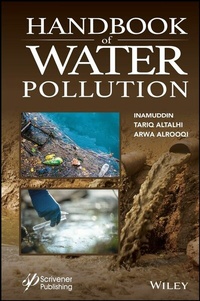
Handbook of Water Pollution
Description

Handbook of Water Pollution discusses a wide range of contaminants heavily affecting our environment and water bodies. The chapters discuss heavy metals, metalloids, pesticides, explosives, toxic chemicals, dyes, plastics, e-wastes, fertilizers, detergents, nitrates/nitrites, phosphates, hydrocarbons, and fecal wastes, along with their sources of action against our environment, their methods of analysis, and finally, their treatments are all presented in detail.
Our environment is heavily affected due to extreme human activities. Environmental pollution is a major concern worldwide. Within this, water pollution is one of the major challenges that puts the total ecology at risk. Water pollution is alarming everywhere; many governing authorities believe it is also an unavoidable result of human activity. However, the economic cost of water pollution far outweighs the benefits of skimping on its cause. Water pollution is not just merely related to financial cost but related to all living beings. Toxic waste is getting into the water bodies in various regions, causing many illnesses in humans and poisoning other living things. The destruction of any single component of our ecosystem can have a devastating effect on our biodiversity. Therefore, it is necessary to understand the causes of pollution, their nature and mechanism, and, at the same time, study the remedies.
The major causes of water pollution are industrial waste, sewage, plastics, oil leakage, biological organisms, toxic chemicals and radioactive waste, and so on. A tremendous amount of research work is going on around the world to understand the causes, their mechanism, and solutions. Many new works are published every day, therefore it's important to gather some of the most relevant findings in one place. This will serve as a link between collected knowledge and current advancements, while also facilitating future thinking.
More details
Other editions
Additional editions

Persons
Inamuddin, PhD, is an assistant professor at the Department of Applied Chemistry, Zakir Husain College of Engineering and Technology, Faculty of Engineering and Technology, Aligarh Muslim University, Aligarh, India. He has extensive research experience in multidisciplinary fields of analytical chemistry, materials chemistry, electrochemistry, renewable energy, and environmental science. He has worked on different research projects funded by various government agencies and universities and is the recipient of awards, including the Department of Science and Technology, India, Fast-Track Young Scientist Award and Young Researcher of the Year Award 2020 from Aligarh Muslim University. He has published about 210 research articles in various international scientific journals, 18 book chapters, and 170 edited books with multiple well-known publishers. His current research interests include ion exchange materials, a sensor for heavy metal ions, biofuel cells, supercapacitors, and bending actuators.
Tariq Altalhi, PhD, is working as an associate professor in the Department of Chemistry at Taif University, Saudi Arabia, where he has served as the head of the chemistry department and vice dean of the science college. He has co-edited various scientific books and established key contacts in major industries in Saudi Arabia. His group is involved in fundamental multidisciplinary research in nanomaterial synthesis and engineering, characterization, and application in molecular separation, desalination, membrane systems, drug delivery, and biosensing.
Arwa Alrooqi is pursuing her PhD in appplied chemistry and working as lecturer at the Department of Chemistry, Faculty of Science, Al Baha University, Saudi Arabia. Her thesis title is "Smart Organic Semiconductors Materials". She has published several research articles in the journals of international repute. She is actively involved in fundamental multidisciplinary research in the area of organic semiconductors and nanomaterials synthesis and engineering, characterization, and their application in smart windows.
Content
- Cover
- Title Page
- Copyright Page
- Contents
- Chapter 1 Introduction to Water Pollution
- 1.1 Pollution
- 1.2 What is Water Pollution?
- 1.3 Prevalence of Water Pollution
- 1.4 Categories of Water Pollution
- 1.4.1 Point Sources
- 1.4.2 Non-Point Sources
- 1.4.3 Transboundary Pollution
- 1.4.4 Problems Caused by Point and Non-Point Sources
- 1.5 Water Pollutants
- 1.5.1 Organic Pollutants
- 1.5.2 Inorganic Pollutants
- 1.5.3 Biological Pollutants
- 1.5.4 Radiological Pollutants
- 1.6 Kinds of Water Pollution
- 1.6.1 Groundwater Pollution
- 1.6.2 Domestic Water Pollution
- 1.6.3 River Water Pollution
- 1.6.4 Surface Water Pollution
- 1.7 Determination of Water Quality Parameters
- 1.7.1 pH
- 1.7.2 Color
- 1.7.3 Turbidity
- 1.7.4 Hardness
- 1.7.5 BOD
- 1.7.6 TDS
- 1.8 Sources of Water Pollution
- 1.8.1 Urbanization
- 1.8.2 Agriculture
- 1.8.3 Industrialization
- 1.8.4 Population Growth
- 1.8.5 Oil Spillage
- 1.9 Effects of Water Pollution on Humans and Animals
- 1.9.1 Diarrheal Diseases
- 1.9.2 Cholera
- 1.9.3 Microcystins
- 1.9.4 Sound Effects of Contamination of Water on Aquatic Animals
- 1.10 Prevention of Water Pollution
- 1.10.1 Strategies
- 1.10.1.1 Water Maintenance
- 1.10.1.2 Wastewater Treatment
- 1.10.1.3 Devices
- 1.10.1.4 Air Pollution Prevention
- 1.10.1.5 Organic Farming
- 1.10.1.6 Stormwater Management
- 1.10.1.7 Plastic Waste Reduction
- 1.10.1.8 Environmental Education
- 1.11 Control and Prevention of Water Pollution by Biotechnology
- 1.12 Conclusion
- References
- Chapter 2 Impact of Water Pollution & Perspective Techniques to Mitigate It: An Overview
- Graphical Abstract
- 2.1 Introduction
- 2.2 Causes of Water Pollution
- 2.2.1 Discharge
- 2.2.2 Oil Spill
- 2.2.3 Littering
- 2.2.4 Ship Demolition Waste
- 2.3 Effects of Water Pollution on Plant Growth
- 2.4 Techniques of Treating Water Pollution
- 2.4.1 Techniques
- 2.4.1.1 Biofiltration
- 2.4.1.2 Rapid Sand Filter
- 2.4.1.3 Adsorption
- 2.4.1.4 Magnetic Extraction
- 2.4.1.5 Membrane Filtration
- 2.4.1.6 Electrocoagulation
- 2.4.1.7 Activated Sludge
- 2.4.2 Oil Spillage
- 2.4.2.1 Skimming
- 2.4.2.2 Organoclays
- 2.4.2.3 Grease Traps
- 2.4.2.4 Chemical Dispersant/Emulsifier
- 2.4.2.5 In Situ Burning (ISB)
- 2.4.2.6 Magnetic-Nanomaterials
- 2.4.3 Halogenated Aromatic Hydrocarbon
- 2.4.3.1 Bioremediation
- 2.4.3.2 Photocatalytic Degradation
- 2.4.3.3 Electrokinetic Remediation
- 2.4.3.4 Green Nano Remediation
- 2.5 Removal of Pollutants Through Different Nanomaterial
- 2.5.1 Disinfection
- 2.5.1.1 Silver Nanoparticles
- 2.5.1.2 TiO2 Nanoparticles
- 2.5.1.3 Carbon Nano Tubes
- 2.5.2 Desalination
- 2.5.3 Heavy Metal and Ion Removal
- 2.5.4 Organic Pollutant Removal
- 2.5.5 CNTs
- 2.5.6 TiO2 Nanoparticles
- 2.5.7 Zero-Valent Iron
- 2.5.8 Other Nanomaterials
- 2.6 Discussion and Conclusion
- References
- Chapter 3 Pollution of Ground and Surface Waters with Agrochemicals
- 3.1 Introduction
- 3.2 A Recounting of the Global Production and Consumption of Agrochemicals
- 3.2.1 Pesticides
- 3.2.2 Fertilizers
- 3.3 Characteristics of Agrochemicals
- 3.4 Occurrences and Levels of Pollution
- 3.4.1 Pollution of Groundwater
- 3.4.2 Pollution of Surface Waters
- 3.5 Fates of Agrochemicals in Ground and Surface Waters
- 3.6 Emerging Views and Perspectives
- 3.7 Concluding Remarks
- References
- Chapter 4 Fecal Waste Drives Antimicrobial Resistance: Source Tracking, Wastewater Discriminant Analysis and Management
- 4.1 Introduction
- 4.2 Antibiotics/ARB/ARGs: Source Tracking
- 4.3 Fecal Pollution and the Public Health Risks
- 4.3.1 Public Health Risks and Environmental Impacts
- 4.4 Fecal Indicator Bacteria and Discriminant Analysis
- 4.5 Management Strategies to Combat Antibiotic Resistance
- 4.5.1 Technologies Towards ARB/ARGs Removal from Wastewater
- 4.6 Conclusion
- Acknowledgments
- References
- Chapter 5 Harmful Effects of Water Pollution
- 5.1 Introduction
- 5.2 Physical Factors
- 5.2.1 Temperature
- 5.2.2 Heat
- 5.2.3 Suspended Solids
- 5.2.4 Colour
- 5.3 Chemical Factors
- 5.3.1 Lowering of Dissolved Oxygen
- 5.3.2 Oxygen Demanding Material in Water Bodies
- 5.3.2.1 Biochemical Oxygen Demand (BOD)
- 5.3.2.2 Chemical Oxygen Demand (COD)
- 5.3.3 Eutrophication
- 5.3.4 Chemicals Affecting Human Health
- 5.3.4.1 Fluoride
- 5.3.4.2 Nitrate
- 5.3.4.3 Petrochemicals and Chlorinated Solvents
- 5.3.4.4 Pesticides
- 5.3.5 Acidity (pH)
- 5.3.6 Nitrification
- 5.3.7 Acid Rain
- 5.3.8 Characteristics of Pollutants in Stationary Water Bodies
- 5.3.9 Nanoparticles
- 5.3.10 Pharmaceuticals and Personal Care Products (PPCPs)
- 5.3.11 Heavy Metals
- 5.3.11.1 Mercury
- 5.3.11.2 Arsenic
- 5.3.11.3 Lead
- 5.3.12 Salts
- 5.3.13 Radioactive Materials
- 5.3.14 Oils and Grease
- 5.3.15 Endocrine Disrupting Chemicals (EDC)
- 5.4 Biological Factors
- 5.4.1 Ecology of Stationary Water Bodies
- 5.4.2 Algal Blooms
- 5.4.3 Pathogenic Organisms
- 5.5 Conclusion
- References
- Chapter 6 Parasites: Sources, Method of Analysis and Treatment
- 6.1 Introduction
- 6.1.1 Pathogens
- 6.2 Method of Analysis
- 6.2.1 Sampling Preparations and Procedures
- 6.2.2 Sampling for Parasites
- 6.3 Methods to Find Concentration of Parasites
- 6.3.1 Sedgwick Rafter Method
- 6.3.2 Method of Centrifuge
- 6.3.3 Method of Using Millipore Filter
- 6.4 Procedures for Enumeration of Parasites
- 6.4.1 Standardizing of Tiles Whipple Micron Meter
- 6.4.1.1 Reporting in Cubic Standard Units
- 6.4.2 Drop Method for Counting
- 6.5 Waterborne Protozoan Parasites
- 6.6 Protozoan Parasite Testing in Water
- 6.7 Waterborne Helminths
- 6.8 Water Treatment
- 6.8.1 Chemical Treatment
- 6.8.1.1 Chlorination
- 6.8.1.2 Method of Chloramination
- 6.8.1.3 Method of Applying Chlorine Dioxide
- 6.8.1.4 Ozonation
- 6.8.2 Physical Treatment
- 6.8.2.1 Treatment Using the Ultraviolet (UV) Radiation
- 6.8.3 Treatment Using Mechanical Method
- 6.8.3.1 Method of Membrane Filter
- 6.8.3.2 Radiation
- 6.9 Nanotechnology
- 6.9.1 Silver (Ag)
- 6.9.2 Chitosan
- 6.9.3 Titanium Dioxide (TiO2)
- 6.9.4 Zinc Oxide (ZnO)
- 6.9.5 Fullerenes
- 6.9.6 Nanotubes of Carbon
- 6.10 Conclusions
- References
- Chapter 7 Oils: Source, Method of Analysis and Treatment
- 7.1 Introduction
- 7.2 Oils Causing Pollution and Their Sources
- 7.3 Method of Analysis
- 7.4 Treatment
- 7.4.1 Treatment Requirements
- 7.4.2 Waste Reduction
- 7.4.3 Management of Cutting Fluids
- 7.4.4 Overview of Treatment Methods
- 7.4.5 Physical Treatment
- 7.4.5.1 Gravity Separation Systems (Separators)
- 7.4.5.2 Hydrocyclones
- 7.4.5.3 Air Flotation
- 7.4.5.4 Membrane Filtration
- 7.4.5.5 Activated Carbon Adsorption
- 7.4.5.6 Filtration (Membranes, Meshes, and Fibers)
- 7.4.5.7 Evaporation
- 7.4.6 Chemical Treatment
- 7.4.6.1 Coagulation and Flocculation
- 7.4.6.2 Electrocoagulation
- 7.4.6.3 Oxidation Technologies
- 7.4.7 Biological Treatments
- 7.4.8 Latest Treatment Trends
- 7.4.8.1 Biological Treatment
- 7.4.8.2 Advanced Oxidation Processes (AOPs)
- 7.4.8.3 Membrane Separation Technology
- 7.4.8.4 Coagulation/Flocculation Technology
- 7.4.8.5 Sorption Technology
- 7.4.9 Treatment Costs
- 7.5 Conclusion
- References
- Chapter 8 Phosphate: Sources, Method of Analysis and Treatment
- 8.1 Introduction
- 8.2 Sources of Phosphate Pollution in Water
- 8.3 Method of Analysis
- 8.4 Phosphate Removal Treatment
- 8.4.1 Phosphate Removal through Lanthanum and Lanthanum Composite
- 8.4.2 Phosphate Removal by Nanomaterial and Nano Composite
- 8.4.3 Phosphate Removal through Iron and Iron Composite
- 8.4.4 Phosphate Removal by Metal Composite
- 8.4.5 Phosphate Removal by Zirconium and Its Composite
- 8.4.6 Phosphate Removal by Biochar and Biochar-Based Composite
- 8.4.7 Phosphate Removal by Aluminum Oxide Its Composite-Based Absorbent
- 8.4.8 Phosphate Removal by Calcium
- 8.4.9 Phosphate Removal by Organic Metal Framework
- 8.4.10 Phosphate Removal by Waste-Based Adsorbent
- 8.4.11 Phosphate Removal by Clay and Clay Composites
- 8.4.12 Phosphate Removal by Bioremediation
- 8.4.13 Phosphate Removal by Natural Polymer and Its Composite
- 8.4.14 Phosphate Removal by Advanced Methods
- 8.5 Conclusion
- References
- Chapter 9 Endocrine Disruptors: Sources, Method of Analysis and Treatment
- 9.1 Introduction
- 9.1.1 Definition of Endocrine Disruptors
- 9.1.2 Main Endocrine Disruptors
- 9.1.2.1 Classification Based on the EU Regulations for REACH
- 9.1.2.2 Other Classifications
- 9.1.3 Human Exposure to EDCs
- 9.1.4 Impact of EDCs on Human Health
- 9.2 Parabens: Sources, Method of Analysis and Treatment
- 9.2.1 Sources
- 9.2.2 Method of Analysis
- 9.2.3 Treatment of Parabens
- 9.3 Alkylphenol Ethoxylates: Sources, Method of Analysis and Treatment
- 9.3.1 Sources
- 9.3.2 Method of Analysis
- 9.3.3 Treatment
- 9.4 Bisphenols: Sources, Method of Analysis and Treatment
- 9.4.1 Sources
- 9.4.2 Method of Analysis
- 9.4.3 Treatment
- 9.5 Phthalates: Sources, Method of Analysis and Treatment
- 9.5.1 Sources
- 9.5.2 Analysis
- 9.5.3 Treatment of Phthalates
- 9.6 Conclusions
- References
- Chapter 10 Water Pollution by Heavy Metals and Their Impact on Human Health
- Abbreviations
- 10.1 Introduction
- 10.2 Sources of Heavy Metals
- 10.2.1 Natural Source
- 10.2.2 Anthropogenic Source
- 10.3 Heavy Metals in Water and Their Toxic Effect on Human Health
- 10.3.1 Zinc (Zn)
- 10.3.2 Manganese (Mn)
- 10.3.3 Iron (Fe)
- 10.3.4 Cadmium (Cd)
- 10.3.5 Nickel (Ni)
- 10.3.6 Lead (Pb)
- 10.3.7 Mercury (Hg)
- 10.3.8 Arsenic (As)
- 10.3.9 Chromium (Cr)
- 10.4 Different Water Treatment Techniques for Removal of Heavy Metal from Polluted Water
- 10.4.1 Flocculation/Coagulation
- 10.4.2 Ion Exchange Separation
- 10.4.3 Flotation Technique
- 10.4.4 Membrane Technologies
- 10.4.5 Chemical Precipitation
- 10.4.6 Electrochemical Technologies
- 10.4.7 Adsorption Technique
- 10.5 Conclusion
- References
- Chapter 11 Dyes: Sources, Method of Analysis and Treatment
- 11.1 Introduction
- 11.2 Classification of Dyes
- 11.3 Analysis of Dye Pollution
- 11.4 Treatments for Removing Dye Pollution from Water
- 11.4.1 Physical Methods
- 11.4.2 Chemical Methods
- 11.4.3 Biological Methods
- 11.5 Conclusions
- References
- Chapter 12 Pharmaceutical Pollution of Water Bodies: Sources, Impacts, and Mitigation
- 12.1 Introduction
- 12.2 Pharmaceutical Pollution: The Global Scenario
- 12.3 Sources of Pharmaceutical Pollution
- 12.3.1 Pharmaceutical Manufacturing Plants and Health-Care Centers
- 12.3.2 Anthropogenic Use and Disposal of Pharmaceuticals
- 12.3.3 Farming Practice and Veterinary Medications
- 12.4 Factors Affecting Pharmaceutical Pollution
- 12.4.1 Urbanization
- 12.4.2 Seasonal Variation
- 12.4.3 Soil Texture and Vegetation
- 12.5 Impacts of Pharmaceutical Pollution
- 12.5.1 Impacts on Aquatic Life
- 12.5.2 Impacts on Humans
- 12.5.3 Impacts on Microorganisms
- 12.6 Mitigation and Surveillance
- 12.6.1 Interventions in Wastewater Treatment to Contain Pharmaceuticals
- 12.6.1.1 Conventional Wastewater Treatment Processes
- 12.6.1.2 Advanced Wastewater Treatment Processes
- 12.6.2 Regulatory Policies
- 12.6.3 Analytical Methods to Detect Pharmaceutical Pollution
- 12.6.3.1 Solid Phase-Extraction (SPE)
- 12.6.3.2 Liquid Chromatography-Tandem Mass Spectrometry (LC-MS/MS)
- 12.6.3.3 High-Performance Liquid Chromatography-Tandem Mass Spectrometry (HPLC-MS/MS)
- 12.6.3.4 High-Resolution Mass Spectrometry (HRMS)
- 12.6.3.5 Ultra-High Performance Liquid Chromatography (UHPLC)-Tandem Mass Spectrometry (MS/MS)
- 12.7 Conclusions and Perspectives
- References
- Chapter 13 Instrumental Testing of Quality of Water
- 13.1 Introduction
- 13.1.1 Water Sources
- 13.1.2 Broad Categories of Water Testing
- 13.1.2.1 Physical Components
- 13.1.2.2 Chemical Components
- 13.1.2.3 Biological Components
- 13.1.3 Water Quality Index
- 13.1.4 Analytical Methods for Testing Water Quality
- 13.1.4.1 Titration Methods
- 13.1.4.2 Photometric Methods
- 13.1.4.3 Colorimetric Methods
- 13.1.5 Instrumental Techniques
- 13.1.5.1 Electroanalytical Methods
- 13.1.5.2 Spectral Methods
- 13.1.5.3 Separation Methods
- 13.2 Conclusion
- References
- Chapter 14 Catalytic Membranes for Water Pollution
- 14.1 Introduction
- 14.2 Configuration of Reactors
- 14.2.1 MRs Acts as Extractor
- 14.2.2 Membrane as Distributor
- 14.2.3 MR as Contactor
- 14.3 Membrane Reactor for Water Treatment
- 14.4 Conclusions
- References
- Chapter 15 LDH-Based Materials for Photocatalytic Dye Degradation
- 15.1 Introduction
- 15.2 Dye Degradation
- 15.2.1 Photocatalytic Dye Degradation
- 15.3 Factors Affecting Efficient Degradation
- 15.4 Layered Double Hydroxide Materials (LDH)
- 15.5 Polyoxometalates Metal-Based LDH Composite
- 15.6 Carbon-Based LDH Composite
- 15.7 Semiconductor-Based LDH Composite
- 15.8 Conclusion and Future Perspectives
- References
- Chapter 16 Biomineralization as a Strategy for the Bioremediation of Toxic Metals-Contaminated Water
- 16.1 Introduction
- 16.2 Minerals Commonly Found in Water and their Effects
- 16.3 Justification for Toxic Metal Detoxification
- 16.4 Water-Based Metal Detoxification through Biomineralisation
- 16.4.1 The Science Behind Biomineralisation
- 16.4.1.1 Carbonate Precipitation Mediated Biomineralisation
- 16.4.1.2 Phosphorous Mediated Biomineralisation
- 16.4.1.3 Metal Bioprecipitation Based on Other Anions
- 16.4.2 Other Microorganisms that Participate in Biomineralisation
- 16.4.2.1 Other Biomineralising Microorganisms
- 16.4.3 Comparison of Biominerilisation to Other Metal Removal/Detoxification Approaches
- 16.5 Concluding Remarks and Future Outlook
- References
- Chapter 17 Phytoremediation of Radioactive Pollutants
- 17.1 Introduction
- 17.2 Advancement in Methodologies for Phytoremediation of Radionuclides: From Conventional to Novel Approaches
- 17.2.1 Novel and Cost-Effective "Green" Technology: A Rational Alternative
- 17.3 Preliminary Assessment of the Contaminated Site for Phytoremediation
- 17.4 Screening of Plants for Effective Uptake of Radionuclides
- 17.5 Augmentation for Radionuclide Bioavailability
- 17.6 Post-Phytoremediation Management of Radionuclides
- 17.6.1 Pre-Treatment of Biomass
- 17.6.2 Final Disposal Methods
- 17.7 Conclusion
- Acknowledgment
- References
- Index
