

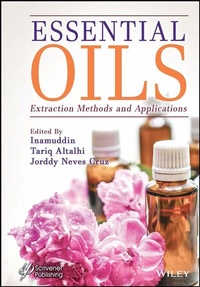
Essential Oils
Description

This exciting new volume, written and edited by some of the world's foremost experts in the field, provides up-to-date information about the chemical structure of essential oils, as well as their therapeutic and biological actions. It defines their functional uses while evaluating the advantages and disadvantages of their application in various sectors.
Essential oils have been used by global communities for centuries, for different purposes such as medicinal, flavoring, preservatives, perfumery, aromatherapy, dentistry, cosmetics, insecticide, fungicide, and bactericide, among others. Essential oils are natural and biodegradable substances, usually non-toxic or with low toxicity to humans. Essential oils are botanical products that have volatile nature, known for their special odor, and found to be effective in the treatment of oxidative stress, cancer, epilepsy, skin allergies, indigestion, headache, insomnia, muscular pain, respiratory problems, etc. Essential oils principally enhance resistance to abiotic stress and protection against aquatic herbivores. They possess antimicrobial, antifungal, antitumor, and antioxidant properties.
Essential oils are known to be volatile and susceptible to degradation from various ambient conditions, including temperature, air, light, and humidity, which limits their applications. Encapsulation is a proven technique that can protect essential oils and enable their use in various applications. This book aims to provide current knowledge on the chemical structure, therapeutic, and biological activities of essential oils, as well as to describe their functional uses and assess the benefits and drawbacks of their usage in various fields. By exploring the latest research on essential oils and their encapsulation, this book offers valuable insights and practical guidance for anyone interested in the science and application of these fascinating compounds.
More details
Other editions
Additional editions
Persons
Inamuddin, PhD, is an assistant professor in the Department of Applied Chemistry, Aligarh Muslim University, Aligarh, India. He received his masters and PhD in applied chemistry from Aligarh Muslim University (AMU), India. He has published 165 books with various publishers, including Wiley-Scrivener, and he has 210 research articles to his credit. He has years of research experience and has received numerous awards and grants throughout his illustrious career. He also is an associate editor for several scientific and technical peer-reviewed journals and has been a guest editor as well. He has also worked as a postdoctoral fellow at the Center of Research Excellence in Renewable Energy, King Fahd University of Petroleum and Minerals, Saudi Arabia, and is a life member of the Journal of the Indian Chemical Society.
Tariq Altalhi, PhD, is an assistant professor in the Department of Chemistry at Taif University, Saudi Arabia. He received his doctorate degree from University of Adelaide, Australia in the year 2014 with Dean's Commendation for Doctoral Thesis Excellence. He has worked as head of Chemistry Department at Taif university and Vice Dean of Science College. His group is involved in fundamental multidisciplinary research in nanomaterial synthesis and engineering, characterization, and their application in molecular separation, desalination, membrane systems, drug delivery, and biosensing, and, in 2015, one of his works was nominated for a Green Tech Award from Germany, Europe's largest environmental and business prize, amongst top 10 entries.
Jorddy Neves Cruz is a researcher at the Federal University of Pará and the Emilio Goeldi Museum. He has experience in multidisciplinary research in the areas of medicinal chemistry, drug design, extraction of bioactive compounds, extraction of essential oils, food chemistry, and biological testing. He has published several research articles in scientific journals and is an associate editor of the Journal of Medicine.
Content
Preface xxvii
1 A Methodological Approach of Plant Essential Oils and their Isolated Bioactive Components for Antiviral Activities 1 Kunal Sharma, Vivek Mishra, Kumar Rakesh Ranjan, Nisha Yadav and Mansi Sharma
2 Essential Oils Used to Inhibit Bacterial Growth in Food 31 Luiza Helena da Silva Martins, Sabrina Baleixo da Silva, Adilson Ferreira Filho, Andrea Komesu, Johnatt Allan Rocha de Oliveira and Debora Kono Taketa Moreira
3 Industrial Application of Essential Oils 49 S. Kiruthika and S. Vishali
4 Influence of Biotic and Abiotic Factors on the Production and Composition of Essential Oils 69 Sandra Gonçalves, Inês Mansinhos and Anabela Romano
5 Investigation of Antiviral Effects of Essential Oils 99 Ahmad Mustafa, Dina H. El-Kashef, Miada F. Abdelwahab, Alshymaa Abdel-Rahman Gomaa, Muhamad Mustafa, Nada M. Abdel-Wahab and Alyaa H. Ibrahim
6 Mentha sp. Essential Oil and Its Applicability in Brazil 125 Daniele de Araujo Moysés, Hanna Patricia dos Santos Martins, Margoula Soares Ribeiro, Natasha Costa da Rocha Galucio, Raquel Ribeiro de Souza, Regianne Maciel dos Santos Correa, José de Arimateia Rodrigues do Rego, Maria Fani Dolabela and Valdicley Vieira Vale
7 Microbial Influence on Plants for Enhanced Production of Active Secondary Metabolites 157 Naushin Bano, Mohammad Amir, S. Nabilah Jawed and Roohi
8 Valorization of Limonene Over Acid Solid Catalysts 173 José E. Castanheiro
9 Elucidating the Role of Essential Oils in Pharmaceutical and Industrial Applications 185 Sundaresan Bhavaniramya, Selvaraju Vishnupriya, Kumanan Vijayarani and Ramar Vanajothi
10 Uses of Essential Oils in Different Sectors 207 Sumeyra Gurkok and Selma Sezen
11 Chemical Composition and Pharmacological Activities of Essential Oils 229 V. Chandrakala, Valmiki Aruna, Gangadhara Angajala and Pulikanti Guruprasad Reddy
12 Augmented Stability and Efficacy of Essential Oils Through Encapsulation Approach 269 Poonam Parashar and Kamla Pathak
13 Antimicrobial Effect of Essential Oils for Food Application 291 Larissa Morais Ribeiro da Silva, Jorge Alberto Sanchos-Burgos, Eveline de Alencar Costa, Maria Jaiana Gomes Ferreira, Cicero C. Pola, Carmen Luiza Gomes and Celli Rodrigues Muniz
14 Antioxidant or Antimicrobial Nature of Essential Oils to Minimize Food Waste 315 Dipak Subhash Sali, Vishal Gokul Beldar, Alok Kumar Panda and Manojkumar Jadhao
15 Application of Essential Oils to Biofilms 339 Sumeyra Gurkok and Selma Sezen
16 Biological Applications of Essential Oil 361 D. Jini
17 Current Status and Advancement of Biopesticides from Essential Oil for Agriculture, Food Storage, and Household Applications 381 Masrina Mohd Nadzir, Salfarina Ramli, Farhana Nazira Idris and Faiznur Mohd Fuad
18 Essential Oil Used as Larvicides and Ovicides 427 Gurleen Kaur, Rajinder Kaur and Sukhminderjit Kaur
19 Essential Oil-Based Biopesticides 443 Nishant Sharma, Kunal Sharma, Sachchidanand Soaham Gupta, Kumar Rakesh Ranjan, Vivek Mishra and Maumita Das Mukherjee
20 Essential Oils Obtained from Algae: Biodiversity and Ecological Importance 465 Deprá, M. C., Dias, R. R., Nascimento, T. C., Silva, P. A., Zepka, L. Q. and Jacob-Lopes, E.
21 Gas Chromatography-Olfactometry (GC-O) of Essential Oils and Volatile Extracts 477 Eduardo Dellacassa and Manuel A. Minteguiaga
22 In Vitro and In Vivo Methods Used to Assess the Biological Potential of Essential Oils 501 Syed Ali Raza Naqvi, Sadaf Ul Hassan, Tauqir A. Sherazi, Amjad Hussain, Muhammad Rehan Hasan Shah Gilani and Tanvir Hussain
23 Biological Potential of Essential Oils: Evaluation Strategies 521 Santanu Chakraborty, Manami Dhibar, Aliviya Das, Kalpana Swain and Satyanarayan Pattnaik
24 Algal Essential Oils and Their Importance in the Ecosystem 551 S.Z.Z. Cobongela
25 Classical Methods for Obtaining Essential Oils 565 Syed Raza Ali Naqvi, Hiba Shahid, Ameer Fawad Zahoor, Muhammad Saeed, Muhammad Usman, Ali Abbas, Mamoon Ur Rasheed and Tanvir Hussain
26 A Comprehensive Guide to Essential Oil Determination Methods 583 Payel Dhar, Urbashi Neog, Biplab Roy, Nishithendu Bikash Nandi, Sankar Chandra Deka and Pinku Chandra Nath
27 Encapsulation of Essential Oils 603 Ádina L. Santana and M. Angela A. Meireles
28 Encapsulated Essential Oils: Main Techniques to Increase Shelf-Life 619 Fernanda Wariss Figueiredo Bezerra, Lucas Cantão Freitas, Vânia Maria Borges Cunha, Giselle Cristine Melo Aires, Rafael Henrique Holanda Pinto and Raul Nunes de Carvalho Junior
29 Encapsulation Technologies of Essential Oils for Various Industrial Applications 635 Tuyen C. Kha and Phuong H. Le
30 Extraction of Essential Oils with Supercritical Fluid 671 Ádina L. Santana and M. Angela A. Meireles
31 Advantages of Essential Oil Extraction Using Supercritical Fluid: Process Optimization and Effect of Different Processing Parameters on Extraction Efficiency 685 Shaziya Manzoor, Rubiya Rashid, Mudasir Ahmad, F.A. Masoodi, Pir Mohammad Junaid and Sadaf Parvez
32 Supercritical Fluid Extraction of Essential Oils from Natural Sources: Mathematical Modeling and Applications 707 Carina Contini Triques, Edson Antônio da Silva, Kátia Andressa Santos, Elissandro Jair Klein, Veronice Slusarski-Santana, Márcia Regina Fagundes-Klen and Mônica Lady Fiorese
33 Fundamentals, Mathematical Models, and Extraction Processes with Supercritical Fluids 741 Facundo Mattea, Nicolás Gañán and Marcelo Ricardo Romero
33.1 Introduction: Background 741
34 Supercritical CO2 Extraction as a Clean Technology Tool for Isolation of Essential Oils 767 T. P. Krishna Murthy, R. Hari Krishna, M. N. Chandra Prabha, Priyadarshini Dey, Blessy Baby Mathew and C. Manjunatha
35 Classical Techniques for Extracting Essential Oils from Plants 795 Yogesh Murti, Sonia Singh and Kamla Pathak
36 Acquisition of Essential Oils Through Traditional Techniques 859 Lucas Cantão Freitas, Vinicius Sidonio Vale Moraes, Sabrina Baleixo da Silva and Raul Nunes de Carvalho Junior
37 Essential Oils: Chemical Composition and Methods of Extraction 871 Arshi Gupta, Kumar Rakesh Ranjan, Nisha Yadav, Deeksha and Vivek Mishra
38 Dental Applications of Essential Oils 891 Aarati Panchbhai
39 Essential Oil-Based Therapies 903 Syed Ali Raza Naqvi, Vaneeza Javed, Naseem Abbas, Muhammad Rehan Hasan Shah Gilani, Sadaf Ul Hassan, Muhammad Rizwan Javed and Mazhar Hussain
40 Clinical Applications of Essential Oils 933 Laxmi Tripathi, Praveen Kumar, Kalpana Swain and Satyanarayan Pattnaik
41 Therapeutic Role of Essential Oils 953 S. Vishali, E. Kavitha and S. Selvalakshmi
42 Plant Essential Oils and Their Constituents for Therapeutic Benefits 977 Monika Rani, Simran Jindal, Ritesh Anand, Niharika Sharma, Kumar Rakesh Ranjan, Maumita Das Mukherjee and Vivek Mishra
43 Essential Oils Used in Packaging: Perspectives and Limitations 1009 Khadija El Bourakadi, Abou El Kacem Qaiss and Rachid Bouhfid
Index 1025
Preface
Essential oils have been used by global communities for centuries, for different purposes such as medicinal, flavoring, preservatives, perfumery, aromatherapy, dentistry, cosmetics, insecticide, fungicide, bactericide, among others. Essential oils are natural and biodegradable substances, usually non-toxic or with low toxicity to humans. Essential oils are botanical products with having volatile nature and are known for their special odor and are found effective in the treatment of oxidative stress, cancer, epilepsy, skin allergies, indigestion, headache, insomnia, muscular pain, and respiratory problems, etc. Essential oils principally enhance resistance to abiotic stress and protection against aquatic herbivores. They possess antimicrobial, antifungal, antitumor, and antioxidant activities. However, essential oils are easily lost or degraded under ambient conditions (temperature, air, light, and humidity), resulting in limited applications. So, their encapsulation is one of the proven techniques to successfully protect essential oils and enable various applications. The purpose of this book is to offer current knowledge on essential oils' chemical structure, therapeutic, and biological activities, to describe their functional uses, and to assess the benefits and drawbacks of their usage in many fields.
Essential Oils: Extraction Methods and Applications addresses the topics related to methods of extracting essential oils, biological and therapeutic applications, their uses in different sectors of the industry, and will also address methods and applications of encapsulated essential oils. In addition, we cover issues such as the latest biological applications of essential oils, as well as traditional and modern methods for extracting essential oils. This book should be useful for different industries like pharma, perfumery, flavoring, perfumery, aromatherapy, cosmetics, others and also useful for faculty, researchers, students from academics, and laboratories which are linked to essential oils and their useful properties, applications of the different paradigms. The summaries of the work reported in the following 43 chapters are as follows:
Chapter 1 discusses the plant essential oils and their isolated bioactive components for their potential antiviral activities in detail. The fundamental knowledge of antiviral properties of essential oil along with their mechanisms of actions, efficacy, and safety is needed for their targeted drug delivery systems, which are consequential to their further research, new drug design, and further applications.
Chapter 2 covers the use of essential oils derived from aromatic plants as a safer and more nutritious alternative to artificial preservatives. Essential oils' natural properties, extraction procedures, and activity against pathogenic and deteriorating microorganisms, as well as their uses in food preservation, are discussed.
Chapter 3 reviews the sources and composition of various essential oils and the variety of extraction methods. Primarily, it focuses on applying essential oils in different industrial sectors like chemicals, food preservation, pharmaceutical, and pesticides, etc.
Chapter 4 focuses on the effect of various abiotic and biotic factors (drought, temperature, salt, heavy metals, UV light, living organisms, etc.) on essential oils production and composition. The importance of these factors to adequate agricultural practices for aromatic plants cultivation and to obtain high-quality essential oils is also discussed.
Chapter 5 emphasizes the potential antiviral effect of essential oils by reviewing some recent literature. It illustrates the different methods implemented to investigate the in vitro antiviral activity of EOs and their components along with their mechanisms of action. Furthermore, the effectiveness of EOs against several viral illnesses that impact human body systems, as well as some plants and animals, are also highlighted.
Chapter 6 discusses Mentha species and their chemical compositions on account of their biological activity as reported by the scientists, with a focus on microbiological activity. Mentha piperita L. is judged to be the most promising of the species offered to be used as an herbal medication.
Chapter 7 describes the plant secondary metabolites that play a significant role as anti-oxidants, anti-cancerous, anti-microbial, and have medicinal properties. The influence of microbes on plants is elaborated in the context of the enhanced production of these secondary metabolites in various stress conditions, with mechanisms of contact briefly elaborated.
Chapter 8 details the valorization of limonene (an essential oil) into compounds with high commercial value by different reactions, such as alkoxylation, hydration, and acetalization over heterogeneous catalysts. Also, the conversion of limonene into p-cymene is studied. Different solid materials, like clays, zeolites, heteropolyacids, and silica with sulfonic groups towards the valorization of limonene are discussed.
Chapter 9 discusses the role of essential oils in various industrial applications, focusing on pharmaceutical, cosmetic manufacturing, food processing, and preservation industry. The major focus dealt with volatile bioactive compounds in essential oils that are responsible for altering synthetic additives with natural composites in food, cosmetics, and medicines.
Chapter 10 discusses the most common uses of essential oils in various sectors. It focuses on the increased use of essential oils in the food, beverage, packaging, cosmetics, perfumery, medical, agriculture, textile, and cleaning industries in line with the increasing awareness and demand of consumers for natural ingredients.
Chapter 11 deals with various pharmacological activities of essential oils and their major chemical components. The mechanism of action and pharmacological targets of various essential oils particularly anti-inflammatory, anticancer, antiviral, antifungal, larvicidal, antidiabetic, and antibacterial activities are discussed in the present chapter. Additionally, the potential efficacy of terpenoids and phenylpropanoids in the treatment of cancer, inflammation, and viral infections are illustrated in this chapter.
Chapter 12 reveals the stability and efficacy associated challenges that are often encountered by essential oils that led to compromised efficiency. Further, the chapter gives insight to overcome these challenges through various encapsulation techniques, their formulation aspect, and the advantages as per the reported literature.
Chapter 13 discusses the antimicrobial effect of essential oils and their food application. Additionally, the biotechnological strategies for extracting essential oils for food application and the methods for evaluating the essential oil's inhibitory activity are discussed. Moreover, the influence of extraction methods on the antimicrobial compounds in essential oils is also presented.
Chapter 14 epitomizes the application of essential oils in food packaging and food products. Essential oils sources such as plants, fruit, and flowers and their chemical composition are presented in this chapter. The main focus of this chapter is to highlight the potential application of essential oils as an antimicrobial, antifungal, and antioxidant agent in different food packaging and products.
Chapter 15 discusses the use of essential oils against biofilm-forming bacteria. The formation and organization of biofilms and their role in acquiring antibiotic resistance are presented. The main focus is given to provide information on the nature of essential oils, their antimicrobial and antibiofilm activities, and their mechanism of action.
Chapter 16 discusses the biological applications of essential oils such as antibacterial, antifungal, antiviral, antioxidant, and anti-inflammatory activities and their usage in the treatment of various ailments such as cancer, respiratory tract diseases, cardiovascular diseases, obesity, and diabetes. Additionally, the sources and extraction process of essential oil are also discussed.
Chapter 17 details the various essential oils used as biopesticides in agriculture, food storage, and the household. The delivery and the pesticidal modes of action of biopesticides are discussed in detail. The target pest and the active ingredients responsible for the pesticidal action are also presented.
Chapter 18 explicitly describes the larvicidal and ovicidal potential of essential oils with special reference to potent larvicidal activity against mosquito vectors including Aedes aegypti, Anopheles stephensi, A. Albopictus, and the ovicidal activity against human head lice (Pediculus humanus), domestic animal gastrointestinal nematode (Haemonchus contortus) and American bollworm (Armigera Helicoverpa Hubner).
Chapter 19 discusses the primary applications of essential oils as pesticides and their biological activity with a different class of organisms and discusses potential directions for the use of essential oils as pesticides of the future. Additionally, the role of essential oils synergistic compositions and toxic effects of essential oils on non-target organisms are also studied. The main aim of this chapter is to explain the present state of knowledge and recent advances in the phytochemistry of plant essential oils, their biological activity in a variety of species, and their potential as...
