

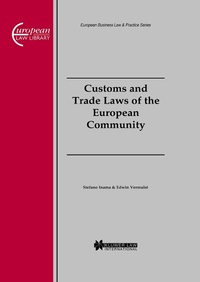
Customs and Trade Laws of the European Community
Customs and Trade Laws of the European Community
Published on 1. January 1999
384 pages
978-90-411-7623-3 (ISBN)
Description

This book offers a detailed and practical overview of the main instruments of the EC's commercial policy as well as trade agreements concluded between the EC and third countries. The main focus is on the practical aspects and the application of those laws with regard to the EC's major trading partners. The book makes reference to the rulings of the European Court of Justice (ECJ) and also to the legislation regulating market access conditions. As a result it provides a basic picture of EC trade policy together with the necessary tools and knowledge for entering into or improving bilateral or multilateral trade relations with the EC.
The book is divided into six chapters. Chapter One contains an overview of the determinants of EC trade policy and its constitutional framework. Chapter Two examines the EC's various preferential and non-preferential trade regimes with third countries. Chapter Three is devoted to customs laws, with special emphasis on preferential and non-preferential rules of origin. Chapter Four discusses specific trade laws such as the anti-subsidy law and the Trade Barriers Regulation. Chapter Five covers the EC's most important trade protection law, the anti-dumping law. Finally, Chapter Six contains an overview of judicial remedies available to private parties.
The book will be an invaluable, practical handbook for legal practitioners, in-house counsel, government officials and academics who wish to gain an insight into the scope and breadth of the EC's common commercial policy.
The book is divided into six chapters. Chapter One contains an overview of the determinants of EC trade policy and its constitutional framework. Chapter Two examines the EC's various preferential and non-preferential trade regimes with third countries. Chapter Three is devoted to customs laws, with special emphasis on preferential and non-preferential rules of origin. Chapter Four discusses specific trade laws such as the anti-subsidy law and the Trade Barriers Regulation. Chapter Five covers the EC's most important trade protection law, the anti-dumping law. Finally, Chapter Six contains an overview of judicial remedies available to private parties.
The book will be an invaluable, practical handbook for legal practitioners, in-house counsel, government officials and academics who wish to gain an insight into the scope and breadth of the EC's common commercial policy.
More details
Other editions
Additional editions
Stefano Inama
Customs and Trade Laws of the European Community
Customs and Trade Laws of the European Community
Book
02/1999
1st Edition
Kluwer Law International
€135.89
Shipment within 10-20 days
Content
- Cover
- Half Title Page
- Title Page
- Copyright Page
- Table of Contents
- List of Tables
- Table of Legislation
- Preface
- Acknowledgements
- List of Abbreviations
- Chapter 1 The European Community's Trade Policy and Its Determinants
- Introduction
- 1.1 The European Community in the Field of Trade
- 1.2 The Voting System for Matters of Common Commercial Policy
- 1.3 The Determinants of EC Trade Policy
- 1.3.1 The Customs Union
- 1.3.2 The Internal Market: Free Circulation of Goods Originating in EC Member States
- 1.3.3 The Internal Market: Free Circulation of Goods Originating in Third Countries put into Free Circulation in the Community
- 1.3.4 The External Dimension of the Customs Union: the Common Commercial Policy
- 1.3.5 Goods Originating in Third Countries Put into Free Circulation in the Community: the Need for an Effective Common Commercial Policy
- 1.4 Instruments and Secondary Legislation Regulating the Common Commercial Policy: Autonomous Regime
- 1.4.1 Non-preferential Tariffs
- 1.4.2 The Import Regime
- 1.4.2.1 Common rules for imports
- 1.4.2.2 Imports from state-trading countries and China
- 1.4.2.3 Imports of textile products
- Chapter 2 Trade Agreements
- Introduction
- 2.1 The Europe Agreements, and Partnership and Cooperation Agreements with CIS countries
- 2.1.1 The Europe Agreements
- 2.1.2 Free Movement of Goods
- 2.1.3 Movement of Workers, Establishment and Supply of Services
- 2.1.3.1 Movement of workers
- 2.1.3.2 Establishment
- 2.1.3.3 Supply of services
- 2.1.4 Competition
- 2.1.4.1 The Partnership and Cooperation Agreements with the CIS countries
- 2.2 The Mediterranean Agreements
- 2.2.1 The General Framework of the Agreements
- 2.2.2 Major Common Amendments to the Mediterranean Agreements (1978-1994)
- 2.3 The New European Union Mediterranean Policy
- 2.4 The Framework of the New Partnership
- 2.4.1 General
- 2.4.2 The Standard Format
- 2.4.2.1 Industrial products
- 2.4.2.2 Agricultural products
- 2.4.2.3 Safeguard clause and common provisions
- 2.4.2.4 The Association Council
- 2.4.2.5 Services
- 2.5 The Lomé IV Convention
- 2.5.1 Institutions
- 2.5.2 Trade Provisions
- 2.5.2.1 Agricultural products
- 2.5.2.2 Depth of tariff cut for products covered by the Common Agricultural Policy
- 2.5.2.3 Products not covered by the Common Agricultural Policy
- 2.5.2.4 Industrial products
- 2.5.2.5 Safeguards and a priori limitations, and their mechanisms
- 2.5.2.6 The protocols
- 2.5.3 Recent Negotiations
- 2.5.4 The Future of the Lomé Convention IV in the WTO Context
- 2.5.4.1 First option (status quo)
- 2.5.4.2 Second option (GSP of the EC)
- 2.5.4.3 Third option (uniform reciprocity)
- 2.5.4.4 Fourth option (differentiated reciprocity)
- 2.5.4.5 Fifth option (differentiation under a single framework)
- 2.5.4.6 Sixth option (differentiation leading to a variety of arrangements)
- 2.5.5 Conclusion
- 2.6 The EC GSP: the Unilateral Approach
- 2.6.1 The EC's New GSP Scheme
- 2.7 EC Rules of Origin under Trade Agreements with Third Countries and the EC GSP
- 2.7.1 General
- 2.7.2 Origin Criterion
- 2.7.2.1 Products wholly obtained
- 2.7.2.2 Products manufactured wholly or partly from imported materials, parts or components
- 2.7.2.3 Insufficient working or processing
- 2.7.3 Consignment Conditions
- 2.7.4 Documentary Evidence
- 2.7.4.1 Retrospective EUR.1 form
- 2.7.4.2 Duplicate EUR.1 form
- 2.7.4.3 Validity of form EUR.1
- 2.7.4.4 Exemptions from proof of origin
- 2.7.4.5 Verifications of movement certificate EUR.1
- 2.8 Differences in the Specific Requirements of the Working or Processing to Confer Originating Status on Non-originating Inputs among the Various Trade Agreements
- 2.9 Differences in Cumulative Rules of Origin Granted under the Different Trade Arrangements
- 2.9.1 The GSP Rules of Origin for Regional Cumulation
- 2.9.2 Lomé IV Convention
- 2.9.3 The Derogation Procedure under the Lomé Convention and the GSP Scheme
- 2.9.4 Regional Cumulation in the First and Second Generation of Mediterranean Agreements and in the Europe Agreements, Including Changes Introduced by the Pan-European Rules of Origin
- 2.9.5 Differences in Explanatory Notes, Issuance of Certificate of Origin and Methods of Administrative Cooperation
- 2.9.5.1 Explanatory notes
- 2.9.5.2 Issuance of certificate of origin and methods of administrative cooperation
- 2.9.5.3 Issuance of certificate of origin for cumulation
- 2.9.5.4 Simplified procedures for issuance of the certificate of origin
- 2.9.5.5 The new EC policy on preferential roles of origin: the progress of the pan-European roles of origin
- Chapter 3 Major Customs Laws
- Introduction
- 3.1 Customs Classification
- 3.1.1 Combined Nomenclature
- 3.1.2 TARIC
- 3.1.3 General Rules for Interpretation of the CN
- 3.1.3.1 Rule 1 of the general rules for the interpretation of the CN
- 3.1.3.2 Taste
- visibility to the naked eye
- 3.1.3.3 (Intended) use
- 3.1.3.4 Method of production
- 3.1.3.5 Precedence of rule lover other roles
- 3.1.3.6 Objective criteria
- 3.1.3.7 Subjective and indeterminate criteria
- 3.1.3.8 Technological or similar developments
- 3.1.3.9 Heading involving duty-free importation
- 3.1.3.10 Chapter 99 exemptions
- 3.1.3.11 Temporary duty suspensions
- 3.1.3.12 GSP
- 3.1.3.13 Rule 2 of the general rules for the interpretation of the CN
- 3.1.3.14 Rule 3 of the general rules for the interpretation of the CN
- 3.1.3.15 Rule 4 of the general rules for the interpretation of the CN
- 3.1.3.16 Rule 5 of the general rules for the interpretation of the CN
- 3.1.3.17 Rule 6 of the general rules for the interpretation of the CN
- 3.1.3.18 Advance ruling procedure
- 3.2 Customs Valuation
- 3.2.1 Transaction Value
- 3.2.2 Rejection of Transaction Value
- 3.2.3 Alternative Methods
- 3.3 Declaration of Particulars
- 3.4 Transfer Pricing
- 3.5 Non-preferential Rules of Origin
- 3.5.1 Non-preferential Origin Rules
- 3.5.1.1 Assembly products
- 3.5.2 Textiles
- 3.6 Preferential Rules of Origin (GSP)
- 3.7 GSP and Non-preferential Origin Compared
- 3.8 Advance Ruling Procedure
- 3.9 Sanctions for Violations of Customs Laws
- Chapter 4 EC Contingency Protection Laws: TBR and Countervailing Duties
- Introduction
- 4.1 Trade Barriers Regulation
- 4.2 Anti-subsidy Action
- 4.2.1 Definition of a Subsidy
- 4.2.2 Specificity and Countervailability
- 4.2.3 Green Light Subsidies
- 4.2.4 Calculation of the Amount of Countervailable Subsidy
- 4.2.5 Slightly Different Procedures
- 4.2.6 Developing Countries
- 4.2.7 EC Practice
- 4.2.8 SCM Agreement
- Chapter 5 Anti-dumping
- Introduction
- 5.1 Procedural Anti-dumping Law
- 5.1.1 Administering Authorities
- 5.1.1.1 Commission
- 5.1.1.2 Advisory Committee
- 5.1.1.3 Council of Ministers
- 5.2 Complaint and Initiation
- 5.2.1 On Behalf of a Community Industry/Standing
- 5.2.1.1 Complaint
- 5.2.1.2 Community industry
- 5.2.1.3 Standing determination
- 5.2.2 Confidentiality of the Complaint
- 5.2.3 Initiation
- 5.2.4 Self-initiation
- 5.2.5 Proceeding versus Investigation
- 5.2.6 Deadlines
- 5.3 Investigation Techniques
- 5.3.1 Interested Parties
- 5.3.2 Questionnaires
- 5.3.2.1 Non-confidential version of the questionnaire response
- 5.3.2.2 Deadline for the questionnaire response
- 5.3.2.3 Related parties
- 5.3.3 Investigation Periods
- 5.3.4 Verifications
- 5.3.5 Best Information Available
- 5.3.6 Procedural Safeguards
- 5.3.6.1 Confidentiality of information
- 5.3.6.2 Access to the file and possibility of commenting
- 5.3.6.3 Hearings
- 5.3.6.4 Confrontation meetings
- 5.3.6.5 Explanation of essential facts and considerations: pre-disclosure, provisional disclosure and final disclosure
- 5.3.7 Sampling of Producers
- 5.4 No Protective Action
- 5.5 Community Interests
- 5.5.1 Suspension of Protective Measures
- 5.6 Review Possibilities
- 5.6.1 Interim Review
- 5.6.2 Newcomer Review
- 5.6.3 Expiry Review
- 5.7 Refunds
- 5.8 Determination of Dumping
- 5.8.1 Export Price
- 5.8.1.1 Middlemen/trading houses
- 5.8.1.2 Construction of the export price
- 5.8.1.3 When will the export price be constructed?
- 5.8.1.4 Which costs will be deducted?
- 5.8.1.5 Which profit will be deducted?
- 5.8.2 Normal Value
- 5.8.2.1 Home market sales
- 5.8.3 No, Insufficient or Unreliable Sales in the Horne Market
- 5.8.3.1 Third country exports
- 5.8.3.2 Constructed value
- 5.8.4 Sales below Cost of Production
- 5.8.4.1 Conditions
- 5.8.4.2 Calculation of normal value
- 5.8.5 NME Normal Value
- 5.8.5.1 NME one country-one duty rule
- 5.9 Adjustments (Netting Back)
- 5.9.1 Differences in Physical Characteristics
- 5.9.2 Import Charges and Indirect Taxes
- 5.9.3 Discounts, Rebates and Quantities
- 5.9.4 Level of Trade
- 5.9.4.1 Original equipment manufacturer sales
- 5.9.5 Transport, Insurance, Handling, Loading and Ancillary Costs
- 5.9.6 Packing
- 5.9.7 Credit
- 5.9.8 After-sales Costs
- 5.9.9 Commissions
- 5.9.10 Other Factors
- 5.10 Comparison
- 5.10.1 Currency Conversions
- 5.10.2 Negative Dumping
- 5.10.3 Sale and Date of Sale
- 5.11 Dumping Margin
- 5.11.1 Examples of Dumping Margin Calculations
- 5.12 Sampling of Types of Products or Transactions
- 5.13 The Determination of Injury
- 5.13.1 Like Product
- 5.13.2 Domestic Industry
- 5.13.2.1 The standard situation
- 5.14 Material Injury
- 5.14.1 Material Injury Sensu Stricto
- 5.14.1.1 Volume of dumped imports
- 5.14.1.2 Prices of dumped imports
- 5.14.1.3 Impact of dumped imports on the Community industry
- 5.14.2 Threat of Material Injury
- 5.15 Causation
- 5.15.1 General
- 5.15.2 Cumulation
- 5.15.3 Decumulation
- 5.16 Injury Margins
- 5.16.1 Price Undercutting Method
- 5.16.2 Price Underselling Method: Target Prices
- 5.16.3 Which Cost of Production?
- 5.16.4 Which Profit?
- 5.16.5 Global, Individual or Semi-Individual Injury Margins
- 5.17 Protective Measures
- 5.17.1 Undertakings
- 5.17.1.1 General
- 5.17.1.2 Refusal to accept undertakings
- 5.17.2 Main Contents of Price Undertakings
- 5.17.3 Quantitative Restrictions
- 5.17.4 Other Forms of Export Restraints
- 5.17.5 Newcomers
- 5.17.6 Violation of or Withdrawal from Undertakings
- 5.18 Anti-dumping Duties
- 5.18.1 General
- 5.18.2 Scope
- Product Definition
- 5.18.3 Cumulation, Anti-dumping Duties and Quantitative Restrictions
- 5.18.4 Form of the Duty
- 5.18.5 Residual Duty
- 5.18.6 Collection of Anti-dumping Duties
- 5.18.7 Inward Processing
- 5.18.8 Product Exclusion after Publication
- 5.18.9 Provisional Anti-dumping Duties
- 5.18.10 Definitive Anti-Dumping Duties
- 5.18.11 Definitive Collection of Provision al Duties
- 5.19 Retroactive Application of Anti-dumping Duties
- Registration Procedure
- 5.20 Anti-circumvention Rules
- 5.20.1 Importing and Third Country Circumvention
- 5.20.1.1 Procedure
- 5.20.1.2 Substantive concepts
- 5.21 Input Dumping
- 5.22 Slightly Altered Merchandise
- 5.23 Obligation to Pass on Anti-dumping Duties to Customers
- Anti-absorption Duties
- Chapter 6 Judicial Review Available to Private Parties
- Introduction
- 6.1 Actions Available to Importers
- 6.2 Direct Imports
- 6.2.1 Actions Brought under EC Treaty Provisions
- 6.2.2 Actions Relying on Multilateral and Bilateral Agreements
- 6.3 Intra-Community Trade
- 6.4 Customs Classification
- 6.5 Customs Valuation
- 6.6 Rules of Origin
- 6.7 Action on Import Licence
- Index
- Back Cover
