

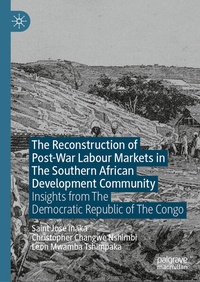
The Reconstruction of Post-War Labour Markets in The Southern African Development Community
Description

This book provides a comprehensive overview of post-war labour market reconstructions, in the context of a regional bloc whose member states have experienced conflict. Focusing on the Southern African Development Community (SADC) region, the book explores how major conflicts often expose shortcomings in affected countries particularly on their post-war labour market reconstruction processes. The authors discuss how countries in the SADC region in particular are equipped to navigate such processes. This key question drives the overview of relationships between labour market issues and wars of liberation from colonial rule and apartheid, rights to self-determination and racial (in)equality and the need to succinctly explain how labour market issues shaped civil wars in some post-independent SADC member states. The book examines the role of the state in reconstruction processes of post-war labour markets and the contribution of labour market institutions to these reconstructions. It further analyses private sector participation in remaking labour markets and workers' experiences in finding employment in labour markets under reconstruction. The book provides specific insights from experiences in the Democratic Republic of the Congo (DRC).
More details
Other editions
Additional editions
Persons
Dr Saint José Inaka completed his PhD in Sociology at the University of Pretoria, South Africa, and is a Postdoctoral Research Fellow at WISER (Wits Institute for Social and Economic Research), University of the Witwatersrand (Wits). He researches and publishes on labour markets, regionalism, transnationalism, African migration, and Congolese politics.
Christopher Changwe Nshimbi is Director of GovInn (Centre for the Study of Governance Innovation), SARChI (South African Research Chairs Initiative) Research Chair in the Political Economy of Migration in the SADC Region and Professor in the Department of Political Sciences, University of Pretoria, South Africa. He teaches and researches migration, borders, regional integration, informal economy and governance.
Dr Leon Mwamba Tshimpaka is a Postdoctoral Research Fellow at GovInn (Centre for the Study of Governance Innovation) and the SARChI Research Chair in the Political Economy of Migration in the SADC Region, Department of Political Sciences, University of Pretoria, South Africa. He is also Adjunct Professor, School of Liberal Arts and Humanities at Woxsen University, India, and Visiting Scholar at Luxembourg University, Luxembourg. He researches regional integration, EU-Africa Relations, migration and borders, political transnationalism, civil society and consolidation of democracy, anti-corruption Initiatives, and sustainable development.
