

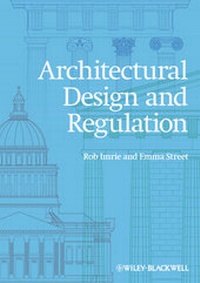
Architectural Design and Regulation
Published on 2. February 2011
272 pages
978-1-4443-9313-2 (ISBN)
Description

From the earliest periods of architecture and building,architects' actions have been conditioned by rules,regulations, standards, and governance practices. These range fromsocio-cultural and religious codes seeking to influence the formalstructure of settlement patterns, to prescriptive buildingregulations specifying detailed elements of design in relation tothe safety of building structures. In Architectural Design andRegulation the authors argue that the rule and regulatory basis ofarchitecture is part of a broader field of socio-institutional andpolitical interventions in the design and development process thatserve to delimit, and define, the scope of the activities ofarchitects.
The book explores how the practices of architects are embeddedin complex systems of rules and regulations. The authors developthe understanding that the rules and regulations of building formand performance ought not to be counterpoised as external tocreative processes and practices, but as integral to the creationof well-designed places. The contribution of Architectural Designand Regulation is to show that far from the rule and regulatorybasis of architecture undermining the capacities of architects todesign, they are the basis for new and challenging activities thatopen up possibilities for reinventing the actions ofarchitects.
Reviews / Votes
"These are minor points about an excellent andground-breaking book, which will be essential reading for thoseresearching architectural practice, regulation, design professionsand planning, and also for those with an interest in discourses ofcreativity and cultural production. Architectural design andregulation contributes much to our understanding of the practicesand situated knowledges of architects vis-à-vis regulation andso in turn about the ways in which the urban fabric isshaped." (Area, 15 August 2013)'Our discipline has [in this book] received a gift fromoutside the tacit values embodied in what we architects refer to as'studio culture'. We can, of course, dismiss thecritique and ignore the opportunity presented by the authors if weso choose. But if the entrenched architects of my generation do, Iam confident that the next generation of city-makers will notbecause, like Imrie and Street, they already glimpse the creativepotential of interdisciplinary invention.' - Steven A.Moore, Bartlett Cocke Regents Professor of Architecture andPlanning, School of Architecture, The University of Texas atAustin 'It often takes outsiders to point out what insiders havemissed or chosen to ignore about themselves. Such revelations areexactly what geographers Imrie and Street bring to the disciplineof architecture. The book is an assiduously researcheddocumentation of the way the architects have responded to theincreasing regulatory frameworks with a mixture of denial, boredom,resignation and fury - when in fact, the authors show, theway forward is to work with rather than against the frameworks in amanner that is at the same time creative and realist.' -Professor Jeremy Till, Dean of the School of Architecture andthe Built Environment, University of Westminster Imrie and Street have produced a vital text that opens up a newperspective on architectural practice and regulation as aco-evolutionary process of code-making that is reshaping the citieswe inhabit. By highlighting the complex social organisation ofthese processes, the book opens up a new window on the materialityof design creativity and the politics enacted through regulatoryinterventions.' - Professor Simon Guy, Director ofManchester Architecture Research Centre (MARC), Head of School ofEnvironment and Development, The University of Manchester Architectural Design and Regulation is an insightful tourde force. It provides a much needed critical examination of theexiting regulatory paradigm while bringing together theory,practice and a vision for change. The implications ofregulations on urban development are little appreciated and rarelydiscussed. Yet, across the globe, communities are shaped bycodes and regulations that virtually dictate all aspects of urbandevelopment. Regulations define how places can andcan't be developed, and how controls shape thephysical space and buildings where we live and work. Bycritically assessing the impacts of design regulations on thespatial and social quality of our built environment Rob Imrie andEmma Street offer a unique analysis and practicalsuggestions. It is a must-read for anyone who is seriousabout understanding current urban development and architecturepractice. - Eran Ben-Joseph, Professor at the MassachusettsInstitute of Technology and the author of the Code of the City:Standards and the Hidden Language of Place MakingMore details
Other editions
Additional editions
Rob Imrie | Emma Street
Architectural Design and Regulation
Software
04/2011
Wiley-Blackwell
€116.37
No shipping information available
Rob Imrie | Emma Street
Architectural Design and Regulation
Book
02/2011
Wiley
€137.50
Article not available at the moment
Persons
Rob Imrie is Professor of Geography at King's CollegeLondon. He is author and co-author of five books, and has writtenwidely in international journals on issues ranging from urbanpolicy and regeneration to disability and the built environment.His background is in geography, sociology, and planning studies andhe has a doctorate in industrial sociology.
Emma Street has recently completed a doctorate in urban geographyat King's College London. Her background is in geography, andshe has a masters' degree in public policy. Her researchinterests include, urban planning and politics, the role of theprivate sector in place-shaping, and architecture and the builtenvironment.
Content
Illustrations.
Tables.
The Authors.
Foreword.
Preface.
Illustration Credits.
PART I THE CONTEXT OF REGULATION.
1 Regulation, Rule, and Architecture: Introductory Comments.
1.1 Introduction.
1.2 The autonomy of architecture and the design process.
1.3 The study of regulation and the practices of architects.
1.4 Conclusions.
2 The Rule and Regulation of Building Form and Performance.
2.1 Introduction.
2.2 Early settlement and the codification of designpractice.
2.3 Spatial codes and the regularisation of design anddevelopment.
2.4 Hygienic spaces and the efficiency of design.
2.5 From the regulatory society to the regulatory state.
2.6 Conclusions.
3 Urban Design and the Rise of the (De)Regulatory Society.
3.1 Introduction.
3.2 Self-activation and the (re-)regulation of designactivities.
3.3 Regulating design: an evaluation of leading assumptions.
3.4 Conclusions.
PART II THE PRACTICES OF REGULATION.
4 Learning about Regulation.
4.1 Introduction.
4.2 Discipline, education, and the creation of thearchitect-subject.
4.3 Pedagogy and the acculturation of architects: evidence fromthe field.
4.4 Conclusions: towards relational pedagogies.
Case Study A: Rethinking Education: Evidence from a FocusGroup.
5 Working with Regulation.
5.1 Introduction.
5.2 Systems of control and the management of the designprocess.
5.3 The interrelationships between regulations and the practicesof architects.
5.4 Conclusions.
Case Study B: Straw-Bale Building in the USA: Negotiating theCodes.
6 Risk and the Regulation of the Design Process.
6.1 Introduction.
6.2 Building form, performance and the regulation of risk.
6.3 Risk, regulation, and architecture: some evidence from theUK.
6.4 Conclusions.
Case Study C: Regulating the Design Process: a RiskyBusiness?
PART III THE SCOPE OF REGULATION.
7 The Role of Project Actors in Influencing Design.
7.1 Introduction.
7.2 Redefining roles in the UK design and constructionindustry.
7.3 Contemporary project teams and the rise of the newprofessional.
7.4 Responding to change: architects' experiences of achanging profession.
7.5 Conclusions.
Case Study D: Traces of Regulation: the School of Sport,Exercise and Health Sciences, Loughborough University.
8 The Coding of Design and Architecture.
8.1 Introduction.
8.2 Modernity, urbanism and the revival of urban character.
8.3 The influence of design coding on the practices ofarchitects.
8.4 Conclusions.
Case Study E: The Use of Design Codes in Two English Towns.
9 Regulation and the Practices of Architects: ConcludingThoughts.
Endnotes.
Appendix: Research Design and Methods.
References.
Index.
