

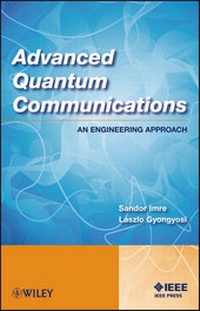
Advanced Quantum Communications
Description

More details
Other editions
Additional editions
Persons
Content
CHAPTER 1 INTRODUCTION 1
1.1 Emerging Quantum Infl uences 2
1.2 Quantum Information Theory 2
1.3 Different Capacities of Quantum Channels 3
1.4 Challenges Related to Quantum Channel Capacities 5
1.5 Secret and Private Quantum Communication 6
1.6 Quantum Communications Networks 8
1.7 Recent Developments and Future Directions 9
CHAPTER 2 INTRODUCTION TO QUANTUM INFORMATION THEORY 11
2.1 Introduction 12
2.2 Basic Definitions and Formulas 15
2.3 Geometrical Interpretation of the Density Matrices 25
2.4 Quantum Entanglement 31
2.5 Entropy of Quantum States 34
2.6 Measurement of the Amount of Entanglement 43
2.7 Encoding Classical Information to Quantum States 49
2.8 Quantum Noiseless Channel Coding 54
2.9 Brief Summary 57
2.10 Further Reading 57
CHAPTER 3 THE CLASSICAL CAPACITIES OF QUANTUM CHANNELS 65
3.1 Introduction 65
3.2 From Classical to Quantum Communication Channels 73
3.3 Transmission of Classical Information over Quantum Channels 77
3.4 The Holevo-Schumacher-Westmoreland Theorem 84
3.5 Classical Communication over Quantum Channels 89
3.6 Brief Summary of Classical Capacities 98
3.7 Multilevel Quantum Systems and Qudit Channels 98
3.8 The Zero-Error Capacity of a Quantum Channel 100
3.9 Further Reading 117
CHAPTER 4 THE QUANTUM CAPACITY OF QUANTUM CHANNELS 126
4.1 Introduction 126
4.2 Transmission of Quantum Information 128
4.3 Quantum Coherent Information 136
4.4 The Asymptotic Quantum Capacity 146
4.5 Relation between Classical and Quantum Capacities of Quantum Channels 149
4.6 Further Reading 151
CHAPTER 5 GEOMETRIC INTERPRETATION OF QUANTUM CHANNELS 156
5.1 Introduction 156
5.2 Geometric Interpretation of the Quantum Channels 157
5.3 Geometric Interpretation of the Quantum Informational Distance 162
5.4 Computation of Smallest Quantum Ball to Derive the HSW Capacity 182
5.5 Illustrative Example 190
5.6 Geometry of Basic Quantum Channel Models 191
5.7 Geometric Interpretation of HSW Capacities of Different Quantum Channel Models 197
5.8 Further Reading 213
CHAPTER 6 ADDITIVITY OF QUANTUM CHANNEL CAPACITIES 218
6.1 Introduction 218
6.2 Additivity of Classical Capacity 223
6.3 Additivity of Quantum Capacity 225
6.4 Additivity of Holevo Information 232
6.5 Geometric Interpretation of Additivity of HSW Capacity 245
6.6 Classical and Quantum Capacities of some Channels 260
6.7 The Classical Zero-Error Capacities of some Quantum Channels 264
6.8 Further Reading 265
CHAPTER 7 SUPERACTIVATION OF QUANTUM CHANNELS 269
7.1 Introduction 270
7.2 The Non-Additivity of Private Information 270
7.3 Channel Combination for Superadditivity of Private Information 274
7.4 Superactivation of Quantum Capacity of Zero-Capacity Quantum Channels 282
7.5 Behind Superactivation: The Information Theoretic Description 295
7.6 Geometrical Interpretation of Quantum Capacity 302
7.7 Example of Geometric Interpretation of Superactivation 305
7.8 Extension of Superactivation for More General Classes 310
7.9 Superactivation of Zero-Error Capacities 315
7.10 Further Reading 322
CHAPTER 8 QUANTUM SECURITY AND PRIVACY 325
8.1 Introduction 326
8.2 Quantum Key Distribution 330
8.3 Private Communication over the Quantum Channel 333
8.4 Quantum Cryptographic Primitives 336
8.5 Further Reading 354
CHAPTER 9 QUANTUM COMMUNICATION NETWORKS 362
9.1 Long-Distance Quantum Communications 362
9.2 Levels of Entanglement Swapping 368
9.3 Scheduling Techniques of Purifi cation 371
9.4 Hybrid Quantum Repeater 375
9.5 Probabilistic Quantum Networks 382
9.6 Conclusions 384
9.7 Further Reading 384
CHAPTER 10 RECENT DEVELOPMENTS AND FUTURE DIRECTIONS 388
10.1 Introduction 388
10.2 Qubit Implementations 391
10.3 Quantum CPUs 396
10.4 Quantum Memories 400
10.5 Further Reading 411
NOTATIONS AND ABBREVIATIONS 413
REFERENCES 420
INDEX 455
