

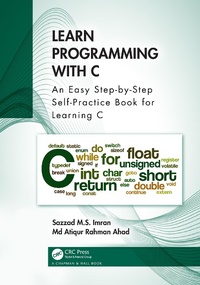
Learn Programming with C
An Easy Step-by-Step Self-Practice Book for Learning C
1st Edition
Published on 29. January 2024
580 pages
978-1-003-82766-5 (ISBN)
Description

Authored by two standout professors in the field of Computer Science and Technology with extensive experience in instructing, Learn Programming with C: An Easy Step-by Step Self-Practice Book for Learning C is a comprehensive and accessible guide to programming with one of the most popular languages.
Meticulously illustrated with figures and examples, this book is a comprehensive guide to writing, editing, and executing C programs on different operating systems and platforms, as well as how to embed C programs into other applications and how to create one's own library. A variety of questions and exercises are included in each chapter to test the readers' knowledge.
Written for the novice C programmer, especially undergraduate and graduate students, this book's line-by-line explanation of code and succinct writing style makes it an excellent companion for classroom teaching, learning, and programming labs.
Meticulously illustrated with figures and examples, this book is a comprehensive guide to writing, editing, and executing C programs on different operating systems and platforms, as well as how to embed C programs into other applications and how to create one's own library. A variety of questions and exercises are included in each chapter to test the readers' knowledge.
Written for the novice C programmer, especially undergraduate and graduate students, this book's line-by-line explanation of code and succinct writing style makes it an excellent companion for classroom teaching, learning, and programming labs.
More details
Edition
1. Auflage
Language
English
Place of publication
London
United Kingdom
Publishing group
Taylor & Francis Ebooks
Target group
College/higher education
Adult education
Product notice
Reflowable
Illustrations
158 Line drawings, color; 303 Line drawings, black and white; 158 Illustrations, color; 303 Illustrations, black and white
ISBN-13
978-1-003-82766-5 (9781003827665)
Copyright in bibliographic data and cover images is held by Nielsen Book Services Limited or by the publishers or by their respective licensors: all rights reserved.
Schweitzer Classification
Other editions
Additional editions
Sazzad M.S. Imran | Md Atiqur Rahman Ahad
Learn Programming with C
An Easy Step-by-Step Self-Practice Book for Learning C
Book
01/2024
1st Edition
Chapman & Hall/CRC
€89.20
Shipment within 10-20 days
Sazzad M.S. Imran | Md Atiqur Rahman Ahad
Learn Programming with C
An Easy Step-by-Step Self-Practice Book for Learning C
Book
01/2024
1st Edition
Chapman & Hall/CRC
€239.90
Shipment within 10-20 days
Persons
Sazzad M.S. Imran, Ph.D. is a Professor in the Dept. of Electrical and Electronic Engineering, University of Dhaka, Bangladesh. He completed his B.Sc. and M.S. degrees in Applied Physics, Electronics & Communication Engineering from the University of Dhaka and received his Ph.D. degree from the Optical Communication Lab of the Kanazawa University, Japan. Dr. Imran has vast experience in teaching C/C++, Assembly Language, MATLAB, PSpice, AutoCAD, etc. at the university level.
Md Atiqur Rahman Ahad, Ph.D., SMIEEE, SMOPTICA is an Associate Professor of Artificial Intelligence and Machine Learning, University of East London, UK; and a Visiting Professor of Kyushu Institute of Technology, Japan. He worked as a Professor at University of Dhaka and Specially Appointed Associate Professor at Osaka University. He has authored/edited 14+ books and published 200+ peer-reviewed papers (More at http://ahadvisionlab.com).
Md Atiqur Rahman Ahad, Ph.D., SMIEEE, SMOPTICA is an Associate Professor of Artificial Intelligence and Machine Learning, University of East London, UK; and a Visiting Professor of Kyushu Institute of Technology, Japan. He worked as a Professor at University of Dhaka and Specially Appointed Associate Professor at Osaka University. He has authored/edited 14+ books and published 200+ peer-reviewed papers (More at http://ahadvisionlab.com).
Content
Preface
Chapter 1: Introduction
History of Programming Language
Different Types of Programming Language
Importance of Programming
C Program Structure
Step-by-Step Tutorial to Run a C Program
Keywords
Identifiers
Operators
Operator Precedence in C
Variables
Constants
Escape Sequences
Data Types
Type Casting
Examples
Exercises
MCQ with Answers
Questions with Short Answers
Problems to Practice
Chapter 2: Flow-Control
if Statement
if..else Statement
Nested if..else Statement
Conditional Operator
for Loop
while Loop
do..while Loop
continue Statement
break Statement
switch..case Statement
goto Statement
Examples
Exercises
MCQ with Answers
Questions with Short Answers
Problems to Practice
Chapter 3: Arrays and Pointers
Arrays
2-D arrays
Multidimensional arrays
String
String Function
Pointers
Memory Allocation
Examples
Exercises
MCQ with Answers
Questions with Short Answers
Problems to Practice
Chapter 4: Functions
Function Types
Function Structure
Function Call
Arrays and Functions
Pointers and Functions
Storage Class
Examples
Exercises
MCQ with Answers
Questions with Short Answers
Problems to Practice
Chapter 5: Structure and Union
Structure
Union
enum
Data Structure and Algorithm
Linked List
Types of Linked List
Examples
Exercises
MCQ with Answers
Questions with Short Answers
Problems to Practice
Chapter 6: File Management
File Types
File Operations
Preprocessors
Conditional Compilation
Examples
Exercises
MCQ with Answers
Questions with Short Answers
Problems to Practice
Chapter 7: C Graphics
Introduction
Functions
Color Table
Fonts of Text
Fill Patterns
Including graphics.h in CodeBlocks
Examples
Problems to Practice
Chapter 8: C Cross-platform
Creating Own Library
Turbo C
Visual Studio Code
Visual Studio
Command Line
Command Line Arguments
Linux
Embedding C Code into MATLAB
Integrating C Code into Python
Switching from One Language to Another
Transition to C++ or C# from C
Chapter 9: C Projects
Chapter 1: Introduction
History of Programming Language
Different Types of Programming Language
Importance of Programming
C Program Structure
Step-by-Step Tutorial to Run a C Program
Keywords
Identifiers
Operators
Operator Precedence in C
Variables
Constants
Escape Sequences
Data Types
Type Casting
Examples
Exercises
MCQ with Answers
Questions with Short Answers
Problems to Practice
Chapter 2: Flow-Control
if Statement
if..else Statement
Nested if..else Statement
Conditional Operator
for Loop
while Loop
do..while Loop
continue Statement
break Statement
switch..case Statement
goto Statement
Examples
Exercises
MCQ with Answers
Questions with Short Answers
Problems to Practice
Chapter 3: Arrays and Pointers
Arrays
2-D arrays
Multidimensional arrays
String
String Function
Pointers
Memory Allocation
Examples
Exercises
MCQ with Answers
Questions with Short Answers
Problems to Practice
Chapter 4: Functions
Function Types
Function Structure
Function Call
Arrays and Functions
Pointers and Functions
Storage Class
Examples
Exercises
MCQ with Answers
Questions with Short Answers
Problems to Practice
Chapter 5: Structure and Union
Structure
Union
enum
Data Structure and Algorithm
Linked List
Types of Linked List
Examples
Exercises
MCQ with Answers
Questions with Short Answers
Problems to Practice
Chapter 6: File Management
File Types
File Operations
Preprocessors
Conditional Compilation
Examples
Exercises
MCQ with Answers
Questions with Short Answers
Problems to Practice
Chapter 7: C Graphics
Introduction
Functions
Color Table
Fonts of Text
Fill Patterns
Including graphics.h in CodeBlocks
Examples
Problems to Practice
Chapter 8: C Cross-platform
Creating Own Library
Turbo C
Visual Studio Code
Visual Studio
Command Line
Command Line Arguments
Linux
Embedding C Code into MATLAB
Integrating C Code into Python
Switching from One Language to Another
Transition to C++ or C# from C
Chapter 9: C Projects
