

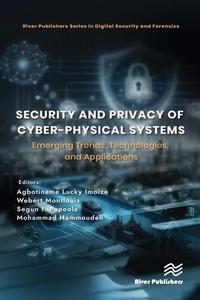
Security and Privacy of Cyber-Physical Systems
Description

This book examines vulnerability threats and attack detection and mitigation, including the associated legal requirements, regulatory frameworks, and policies for enabling the security and privacy of cyber-physical systems. It provides researchers, academics, and practitioners with new insights into the real-world scenarios of deploying, applying, and managing security and privacy frameworks in modern cyber-physical systems.
It addresses critical security and privacy concerns, including theoretical analysis, novel system architecture design and implementation, vulnerability discovery, analysis, mitigation, emerging application scenarios, experimental frameworks, and social and ethical dilemmas affecting all parties in cyber-physical systems. The book is an ideal reference for practitioners and researchers in cyber-physical systems, security and privacy, the Internet of Things, advanced cryptography, cyber defensive walls, industrial systems, and cyber threats. It is also a suitable textbook for graduate and senior undergraduate courses in these subjects.
More details
Other editions
Additional editions
Persons
Agbotiname Lucky Imoize is a Lecturer in the Department of Electrical and Electronics Engineering at the University of Lagos, Nigeria. His research interests include 6G wireless communications, wireless security systems, holographic metasurfaces, and artificial intelligence. He is a Fulbright fellow, the vice chair of the IEEE Communication Society Nigeria chapter, and a registered engineer with the Council for the Regulation of Engineering in Nigeria. He is a senior member of IEEE.
Webert Montlouis is a Chief Scientist at Johns Hopkins University, where he shares his time between the Applied Physics Laboratory (APL) and the Electrical and Computer Engineering department. He received his Ph.D. degree in electrical engineering from Northeastern University, Boston, MA, USA. His research interests are Communications, Adaptive Signal Processing, Robust Tracking and Localization, Algorithm Development, System-On-Chip implementation of DSP algorithms, Networking, and Antenna Array Signal Processing. He is a Fellow of IEEE, AAIA, and AIIA.
Segun I. Popoola is a senior lecturer at the School of Computing and Information Science at Anglia Ruskin University, United Kingdom. He received a Ph.D. degree in cyber security and artificial intelligence from the Department of Engineering, Faculty of Science and Engineering, Manchester Metropolitan University, Manchester, U.K., in 2022. In June 2022, The Royal Society, United Kingdom endorsed him as a Global Exceptional Talent. His research interests include wireless communications, deep learning, federated learning, cyber security, the Internet of Things, and smart critical infrastructure.
Mohammad Hammoudeh received a B.Sc. degree in computer communications from Arts Sciences and Technology University in 2004, an M.Sc. degree in advanced distributed systems from the University of Leicester in 2006, and a Ph.D. degree in computer science from the University of Wolverhampton in 2008. He is the Saudi Aramco Chair Professor of Cyber Security with the King Fahd University of Petroleum and Minerals. His research interests include the applications of zero trust security to internet-connected critical national infrastructures, blockchains, and other complex and highly decentralized systems.
Content
1. An Overview of Security and Privacy in Cyber-physical Systems: Emerging Trends and Strategies 2. Protection and Fault Diagnostics in Legacy Cyber-physical Systems 3. Explainable Artificial Intelligence for Intrusion Detection in Cyber-Physical Systems 4. Addressing Security and Privacy Issues in Cyber-physical Systems 5. Physical Layer Security of 6G Vehicle Visible Light Communications for Cyber-Physical Systems 6. Hardware Security and Privacy for Cyber-physical Systems 7. A Secure Biometric Authentication Architecture for Blockchain-driven Cyber-physical Systems 8. Secure IoT-Based Smart Wheelchair System: From Implementation to Security Enhancement Strategy 9. Statistical Estimation of User Location Distribution via Anonymized Dummy Data Transmission 10. Emerging Security and Privacy Schemes for Cyber-physical Systems 11. Security and Privacy Concerns and Risks in Modern Cyber-physical Systems 12. The Ethics of Security and Privacy of Cyber-physical Systems: Emerging Trends, Technology and Applications 13. Intrusion Detection Techniques for Cyber-physical Systems 14. Cyber-physical Systems: Strategies for Enhancing Availability, Recovery, and Auditing for Optimal Performance 15. Legal Framework and Regulatory Policies for Cyber-physical Systems 16. Blockchain-based Security and Privacy Solutions for Cyber-physical Systems 17. Privacy-utility Trade-offs in IoT Networks: A Comparative Analysis of Differential Privacy Mechanisms for Sensor Data Aggregation 18. Enhancing Cyber-physical Systems Through Artificial Intelligence and Machine Learning 19. Case Studies on the Security and Privacy of Cyber-physical Systems 20. Recent Advances and the Future of Cyber-physical Systems
