

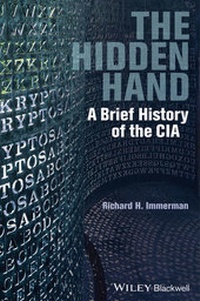
The Hidden Hand
Description

Reviews / Votes
"I highly recommend Immerman's history as a corrective." (Journal of American History, 3 January 2016) "Written in clear terms with excellent summaries of complex events, The Hidden Hand makes a mass of history and bureaucratic strife manageable to newcomers of the subject. ...The redactions in this volume serve as an introduction for would-be scholars to the risks of researching so close to the circles of power and authority." (Intelligence and National Security, 6 February 2015) "Richard H. Immerman, who teaches the history of American foreign policy and intelligence at Temple University, has produced a fine, concise history of the Central Intelligence Agency (CIA). The Hidden Handhas three major virtues: it is fair-minded, readable and up-to-date, including a useful insider's analysis of how the creation of the new position of National Director of Intelligence (NDI) in 2005 has affected the role of the CIA and its director." (Survival: Global Politics and Strategy, 1 January 2015) "Meantime, as far as the book under review is concerned, It's a very well written piece of history and well referenced with numerous end-of-chapter source notes." (Nurturing Potential, 1 March 2014) "Richard Immerman's brief history of the CIA is, Ibelieve, the best one currently available." - JohnLewis Gaddis, Yale University "In this important book, Richard Immerman examines thetorturous history and mixed record of the CIA. Arguing that theagency was engulfed from its inception in controversy betweenintelligence analysts and covert operators, Immerman laments theagency's post-9/11 trajectory toward paramilitary operations.If you are looking for a good, short text in your courses onintelligence history, this should serve you well."-Melvyn P. Leffler, Edward Stettinius Professor of AmericanHistory, University of Virginia "The hidden Hand provides a balanced andinformative history of CIA covert actions, why they wereundertaken, and what they accomplished." -ThomasFingar, Former Deputy Director of National Intelligence forAnalysis "Born in conflict and steeped in controversy, the CIAremains extraordinarily difficult to understand. But now it has afair and insightful biography. Richard Immerman bring to the taskthe skills of an accomplished historian and the personal experienceof having seen it from the inside. The result is fascinating andimportant." - Robert Jervis, author of WhyIntelligence Fails: Lessons from the Iranian Revolution and theIraq WarMore details
Other editions
Additional editions
Person
Content
Preface and Acknowledgments
This is a short book with a long history. The number of debts I have accumulated along the way is therefore also long. The list begins with Walt LaFeber and Arnie Offner. Walt was almost solely responsible for shifting my interests from political science (“government” at Cornell) to history, specifically the history of US foreign relations. What is more, he provoked my curiosity about Latin America, particularly Central America. My decision to write my dissertation on the Central Intelligence Agency (CIA) intervention in Guatemala, accordingly, was a logical progression. The problem was that writing in the 1970s a history of a covert operation was highly illogical. There were no archives or, for that matter, documentation of any kind. As a graduate student, I received encouragement only from my faculty advisor, but he died. I then turned to Arnie Offner. Arnie, although at another university, believed in the project. More important, he believed in me. Under Arnie's guidance, I wrote my dissertation. It became a book, The CIA in Guatemala.
By the time of the book's publication, I had become a historian of intelligence, although I did not realize that I had. I continued to dabble in the subject over the subsequent years, but only dabble. Without fully appreciating the implications, during these same years I revived my interest in political science. Fred Greenstein and Bob Jervis are the reasons. Fred became the kind of mentor one never expects after completing the PhD. He introduced me to the literature on personality and politics, advising, and decision making. He also introduced me to Bob. Bob has no peer when it comes to applying theories of cognitive psychology to the study of international relations. He also has no peer as a scholar of intelligence. He inspired me in both spheres.
Athan Theoharis was the catalyst for my synthesizing these early influences and interests and finally admitting that I wanted to concentrate my writing on the CIA and the Intelligence Community. I knew Athan only by reputation. He of course is renowned for his scholarship on domestic surveillance, civil liberties, and the FBI. When he contacted me shortly after the 9/11 tragedy, however, it was to invite me to contribute to a collection of essays on the CIA. Athan wanted me to write a lengthy overview of the agency's history. All of the contributors would be co-editors.
I accepted Athan's invitation, and my “Brief History of the CIA” came out in 2006 as the first chapter of The Central Intelligence Agency: Security under Scrutiny. I took great pleasure in writing it, and it serves as the foundation of this book. The essay provided me with the opportunity to evaluate the CIA through a much broader lens than “operations.” I examined its origins and evolution over time, its relations with other elements in the Intelligence Community, the problems produced by the tensions inherent in its roles and missions, and more. Still, the project was as frustrating as it was exciting. I very much enjoy the challenge of trying to capture vast swaths of history in relatively few words. But an 80-page history of the CIA was a bridge too far.
Enter Peter Coveney into my story. Peter is a terrific editor with Wiley-Blackwell, a long-time favorite of many of us who boast of our membership in the Society for Historians of American Foreign Relations. I have no idea how many people read my “Brief History.” I would bet very few. But Peter was one, and he thought it had the makings of a book. We struck a deal, and I can't thank Peter enough for making it happen. The Hidden Hand not only was his idea, but I also benefited from his advice, editing, and attention from beginning to end. And I also benefited from those at Wiley-Blackwell whom Peter recruited to help me. Specifically, I must thank my copy editor, Jamila Niroop, and Annette Musker, who compiled the index, and Georgina Coleby, who managed the manuscript through production.
Peter was very patient with me. He had to be. That's because in 2007 the book, my career, and my life turned in a very unexpected direction. Thanks in large part to the late Nancy Bernkopf Tucker, a dear friend, distinguished scholar, and committed citizen, I was asked to come to Washington to serve as assistant deputy director of intelligence for analytic integrity and standards and analytic ombudsman for the Office of the Director of National Intelligence (ODNI). I was stunned. I had just returned to Temple from leave, I was finishing one book and had promised Peter I'd start on this one, and I had never, ever considered government work. But accepting was one of the smartest decisions I ever made. Leaving aside any assessments of my performance, I cannot exaggerate the new insights on the entire intelligence enterprise I gained during my eighteen-month tenure in the ODNI and the extent to which my appreciation for the dedication and capabilities of my coworkers grew. For this most rewarding and educational experience, I have my entire office to thank: Jim Marchio, Scott McCall, Karl Pieragostini, Kyle Rector, Steve Rieber, Glen Simpers, Jeff Stillman, Becky Strode, and Linda Whitehurst. I owe a special debt to my boss, Tom Fingar, the deputy director of national intelligence for analysis. As far as I am concerned, no one knows more than Tom about the finer points of intelligence. And no one is a better leader, or in my case, a better teacher.
I also must thank Tom and Bob Jervis, and Mel Leffler as well, for the advice and support they offered me in my ordeal with the requisite prepublication review of this book. I briefly describe this very difficult experience in a note immediately following these acknowledgments. Their assistance proved not only invaluable but also instrumental to reaching a resolution. I also express my gratitude to Jennifer Hudson. Her intervention months into the process was vital to reaching that resolution.
Whether I was struggling with my writing, readjusting to my comings and goings from Temple, or otherwise trying to find some semblance of balance in what became a very complicated life, I could not have asked for more support from my colleagues at Temple. The list is endless, but deserving special thanks are Petra Goode, Drew Isenberg, Jay Lockenour, Bryant Simon, Ralph Young, Vlad Zubok, and before they defected, Will Hitchcock and Liz Varon. For making me laugh as well as providing priceless assistance in so many ways, I also thank Vangie Campbell, Lafrance Howard, and, for always being there for me, Patricia Williams. My Temple students have always been a source of ideas as well as pleasure. Among the many that warrant thanks, Tim Sayle not only provided me with exceptional research help, but he also allowed himself to serve as my sounding board. I took full advantage. Matt Fay arrived at Temple as I was approaching the finish line, but not too late to provide essential assistance. Beth Bailey and David Farber warrant a category of their own, and not only for critiquing my text. For more than 25 years, whether or not at the same institution, they have been the closest of friends and the most gracious of colleagues and the closest of colleagues and the most gracious of friends. It's a distinction without a difference.
I have many friends and colleagues beyond Temple, and I have imposed on most of them over the years that it took to conceptualize and write this book. I can't name them all, but I must single out some. I asked Matthew Jones to read the entire manuscript. Matthew had been one of the principals in a British project on the CIA, “Landscapes of Secrecy.” I could not have asked for a better critic. I did not ask Jeffrey Engel. He volunteered. I must apologize as well as thank Jeff. He was so thorough, and made so many good suggestions, that had I followed up on them all I would have doubled the manuscript's length. So I compromised. Because of Jeff, the book is only several thousand words better.
Others I must thank include Sid Milkis and Jeff Jenkins of the University of Virginia. Their invitation for me to present a paper at the Miller Center on the politics of intelligence reform raised a whole new set of questions for me to address. My many conversations with Frank Costigliola about not just intelligence but also the craft of history has made me a much improved scholar. But in this case, Frank went a step farther by arranging for me to present some of my formative ideas to the University of Connecticut's Foreign Policy Seminar. Klaus Larres was similarly helpful by providing me with the opportunity to contribute to his U.S. in World Affairs lecture series at the University of North Carolina, Chapel Hill. And I owe a debt to Ara Keys that I can never hope to repay. Ara encouraged me to apply for the Miegunyah Distinguished Visiting Fellowship at Australia's University of Melbourne. Once I applied, she shepherded through the paperwork, rewriting much of it. I am sure I would not have received the Miegunyah without her help. Winning this fellowship forced me to accelerate the pace of my completing the manuscript even as I refined my argument for the public lecture. I could also undertake the revisions in the most wondrous and hospitable of settings.
In all of my previous books, I've ended my acknowledgments by thanking my family—for their presence in my life and, frankly, for when necessary staying out of my way. This time, however, my debt to them is greater, and deeper. My wife Marion is my best friend and greatest booster. She has over the past thirty-something years regularly made sacrifices for me, but never more so than when she all but commanded me to accept...
