

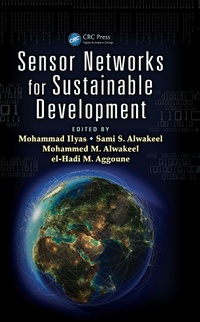
Sensor Networks for Sustainable Development
Published on 19. December 2017
568 pages
978-1-4665-8207-1 (ISBN)
Description

Recent advances in technology and manufacturing have made it possible to create small, powerful, energy-efficient, cost-effective sensor nodes for specialized telecommunication applications-nodes "smart" enough to be capable of adaptation, self-awareness, and self-organization.
Sensor Networks for Sustainable Development examines sensor network technologies that increase the quality of human life and encourage societal progress with minimal effect on the earth's natural resources and environment. Organized as a collection of articles authored by leading experts in the field, this valuable reference captures the current state of the art and explores applications where sensor networks are used for sustainable development in:
Agriculture
Environment
Energy
Healthcare
Transportation
Disaster management
Beneficial to designers and planners of emerging telecommunication networks, researchers in related industries, and students and academia seeking to learn about the impact of sensor networks on sustainable development, Sensor Networks for Sustainable Development provides scientific tutorials and technical information about smart sensor networks and their use in everything from remote patient monitoring to improving safety on the roadways and beyond.
Sensor Networks for Sustainable Development examines sensor network technologies that increase the quality of human life and encourage societal progress with minimal effect on the earth's natural resources and environment. Organized as a collection of articles authored by leading experts in the field, this valuable reference captures the current state of the art and explores applications where sensor networks are used for sustainable development in:
Agriculture
Environment
Energy
Healthcare
Transportation
Disaster management
Beneficial to designers and planners of emerging telecommunication networks, researchers in related industries, and students and academia seeking to learn about the impact of sensor networks on sustainable development, Sensor Networks for Sustainable Development provides scientific tutorials and technical information about smart sensor networks and their use in everything from remote patient monitoring to improving safety on the roadways and beyond.
More details
Language
English
Place of publication
Baton Rouge
United States
Publishing group
Taylor & Francis Inc
Target group
College/higher education
Illustrations
38 Tables, black and white; 239 Illustrations, black and white
File size
35,21 MB
ISBN-13
978-1-4665-8207-1 (9781466582071)
Copyright in bibliographic data and cover images is held by Nielsen Book Services Limited or by the publishers or by their respective licensors: all rights reserved.
Schweitzer Classification
Other editions
Additional editions
Mohammad Ilyas | Sami S. Alwakeel | Mohammed M. Alwakeel
Sensor Networks for Sustainable Development
Book
04/2017
1st Edition
CRC Press
€114.80
Shipment within 10-20 days
Mohammad Ilyas | Sami S. Alwakeel | Mohammed M. Alwakeel
Sensor Networks for Sustainable Development
Book
06/2014
1st Edition
CRC Press
€293.50
Article not available at the moment
Persons
Mohammad Ilyas holds a B.Sc from the University of Engineering and Technology, Lahore, Pakistan; M.Sc from Shiraz University, Iran; and Ph.D from Queen's University in Kingston, Ontario, Canada. Since September 1983, he has been with the College of Engineering and Computer Science at Florida Atlantic University, Boca Raton, USA, where he is currently associate dean for research and industry relations. His areas of research include traffic management and congestion control in broadband/high-speed communication networks, traffic characterization, wireless communication networks, performance modeling, and simulation. Widely published, he is a senior member of IEEE, a member of ASEE, and has been a consultant to several national and international organizations.
Sami S. Alwakeel holds a B.Sc from King Saud University (KSU), Riyadh, Saudi Arabia as well as an M.Sc and Ph.D from Stanford University, California, USA. He is currently a professor for the College of Computer and Information Sciences (CCIS) at KSU. An IEEE, ACM, and IASTED member, he is a founder and former dean of the CCIS at KSU, a key contributor in the development of many computer colleges throughout Saudi Arabia, and has served on the Ministry of Education's National Computer Education Committee, the Saudi Computer Society, and various Saudi National Computer Conference organization committees, as well as been a consultant to several Saudi government agencies.
Mohammed M. Alwakeel holds a BA and MA from King Saud University (KSU), Riyadh, Saudi Arabia and a Ph.D from Florida Atlantic University, Boca Raton, USA. He is currently vice rector for development and quality at the University of Tabuk, Saudi Arabia, where he also serves as the dean for the College of Computers and Information Technology. He previously taught and held administrative roles at Tabuk Community College-KSU. He is a recipient of the Prince Sultan bin Abdulaziz International Prize for Water, and his work is published in several international journals and conference proceedings. In addition, he has been an active participant in numerous committees and workshops.
el-Hadi M. Aggoune holds an M.Sc and Ph.D from the University of Washington (UW), Seattle, USA. Currently, he is professor and director of the Sensor Networks and Cellular Systems Research Center at the University of Tabuk, Saudi Arabia. A senior IEEE member, he is a recipient of the IEEE Professor of the Year Award, UW Branch. In addition, he was the director of a research lab that won the Boeing Supplier Excellence Award, and he is listed as inventor in a major patent assigned to the Boeing Company. His research work is also referred to in patents assigned to ABB, Switzerland and EPRI, USA. A professional engineer registered in the State of Washington, USA, he has taught and held administrative positions at several universities in the US and abroad, authored numerous journal and conference papers, and served on many technical committees.
Sami S. Alwakeel holds a B.Sc from King Saud University (KSU), Riyadh, Saudi Arabia as well as an M.Sc and Ph.D from Stanford University, California, USA. He is currently a professor for the College of Computer and Information Sciences (CCIS) at KSU. An IEEE, ACM, and IASTED member, he is a founder and former dean of the CCIS at KSU, a key contributor in the development of many computer colleges throughout Saudi Arabia, and has served on the Ministry of Education's National Computer Education Committee, the Saudi Computer Society, and various Saudi National Computer Conference organization committees, as well as been a consultant to several Saudi government agencies.
Mohammed M. Alwakeel holds a BA and MA from King Saud University (KSU), Riyadh, Saudi Arabia and a Ph.D from Florida Atlantic University, Boca Raton, USA. He is currently vice rector for development and quality at the University of Tabuk, Saudi Arabia, where he also serves as the dean for the College of Computers and Information Technology. He previously taught and held administrative roles at Tabuk Community College-KSU. He is a recipient of the Prince Sultan bin Abdulaziz International Prize for Water, and his work is published in several international journals and conference proceedings. In addition, he has been an active participant in numerous committees and workshops.
el-Hadi M. Aggoune holds an M.Sc and Ph.D from the University of Washington (UW), Seattle, USA. Currently, he is professor and director of the Sensor Networks and Cellular Systems Research Center at the University of Tabuk, Saudi Arabia. A senior IEEE member, he is a recipient of the IEEE Professor of the Year Award, UW Branch. In addition, he was the director of a research lab that won the Boeing Supplier Excellence Award, and he is listed as inventor in a major patent assigned to the Boeing Company. His research work is also referred to in patents assigned to ABB, Switzerland and EPRI, USA. A professional engineer registered in the State of Washington, USA, he has taught and held administrative positions at several universities in the US and abroad, authored numerous journal and conference papers, and served on many technical committees.
Content
A Review of Applications of Sensor Networks in Smart Agriculture. Wireless Sensor Networks with Dynamic Nodes for Water and Crop Health Management. Scaling Smart Environments. Localization of a Wireless Sensor Network for Environment Monitoring using Maximum Likelihood Estimation with Negative Constraints. Reconfigurable Intelligent Space and the Mobile Module for Flexible Smart Space. Sensor Networks for Energy Sustainability in Buildings. Wireless Sensor and Actor Networks for Monitoring and Controlling Energy Use in the Smart Grid. Mobile Monitoring Application to Support Sustainable Behavioral Change toward Healthy Lifestyle. Cooperative and Self-Organizing Sensor Networks: The Enabler for Smarter Grids. Sensor Networks in Healthcare. Use of Body Sensor Networks in Clinical Settings and Medical Research. Prototype on RFID and Sensor Networks for Elder Healthcare. Exploiting Network Coding for Smart Healthcare: Scenarios and Research Challenges. Inference of Wellness Indicators and Patterns of Behavior in Elderly Care Applications using Long-Term Sensor Network Observations. Architecture of Sports Log Application using Nine-Axis MEMS. Social Sensor Networks for Transportation Management in Smart Cities. Applying RFID Techniques for the Next-Generation Automotive Services. Intelligent Control Mechanisms for Vehicular Sensor Networks. Sensor Networks for Underwater Ecosystem Monitoring and Port Surveillance Systems. Triage with RFID Tags for Massive Incidents. Survey of Sybil Attacks in Networks.
