

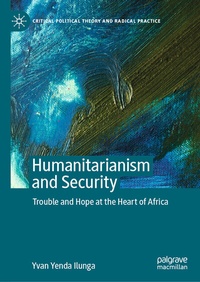
Humanitarianism and Security
Description

Humanitarianism and Security contends that the search for stability and peace remains central to the political environment within the Democratic Republic of Congo (DRC). Despite some positive political and economic progress observed in the Central African Region and the DRC in particular, the future of the region remains uncertain. Due to many unaddressed issues, including the multidimensional manifestations of humanitarian crises, the region is fragile with the potential for a relapse into violent conflict. Moreover, the DRC's humanitarian crises have yet to be effectively addressed as consequences and promoters of insecurity and violence. Based on the "humanitarian-security-development" paradigm as an inclusive operational framework, Humanitarianism and Security articulates the trend of peace recovery in the DRC as contingent upon issues of security and the refugee/internally displaced population crisis. It claims and demonstrates that effective solutions must incorporate considerations of pre-colonial security dynamics, the place and role of identity within the humanitarian discourse/strategies, the determinants of transitional public security (TPS), and the various dynamics regarding the return and re/integration processes, into one operational framework. This framework must be accompanied by a continued effort to build strong local institutions as a critical component to the sustainability of operations.
Reviews / Votes
"Dr. Yvan Ilunga presents a welcome addition to the Political Science and Peace and Conflict Studies literature concerning conflict and violence present in the Central Africa Region. His assessment and recognition of the need for and understanding of traditional values and practices in building 'strong, viable, and credible' governance institutions is directly on point and often missed by well-meaning peacebuilders anchored to Western conflict transformation strategies."- Thomas Matyók , Middle Georgia State University, USA, and Joint Civil-Military Interaction Network
More details
Other editions
Additional editions
Person
Yvan Yenda Ilunga is an Instructor of Political Science at James Madison University, USA. He holds a Ph.D. in Global Affairs from Rutgers University, USA. His research agenda broadly focuses on international relations, security, peace and development; but more specifically, on questions related to humanitarian action, civil-military interactions, natural resources-based conflicts, peace operations, regional cooperation and security, economic and social sustainability.
Content
Chapter 1. Humanitarianism and Security: An Introduction.- Chapter 2. Security Factors In Africa.- Chapter 3. The Crisis of Identity.- Chapter 4. Institutional Deficit.- Chapter 5. Rethinking Transitional Public Security In Humanitarian Recovery.- Chapter 6. When Home Does Not Exist.- Chapter 7. Conclusion: The Search for Stability.
