
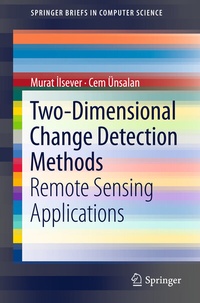
Two-Dimensional Change Detection Methods
Description
Alles über E-Books | Antworten auf Fragen rund um E-Books, Kopierschutz und Dateiformate finden Sie in unserem Info- & Hilfebereich.
Change detection using remotely sensed images has many applications, such as urban monitoring, land-cover change analysis, and disaster management. This work investigates two-dimensional change detection methods. The existing methods in the literature are grouped into four categories: pixel-based, transformation-based, texture analysis-based, and structure-based. In addition to testing existing methods, four new change detection methods are introduced: fuzzy logic-based, shadow detection-based, local feature-based, and bipartite graph matching-based. The latter two methods form the basis for a structural analysis of change detection. Three thresholding algorithms are compared, and their effects on the performance of change detection methods are measured. These tests on existing and novel change detection methods make use of a total of 35 panchromatic and multi-spectral Ikonos image sets. Quantitative test results and their interpretations are provided.
More details
Other editions
Additional editions
Content
Introduction.- Pixel-Based Change Detection Methods.- Transformation-Based Change Detection Methods.- Structure-Based Change Detection Methods.- Fusion of Change Detection Methods.- Experiments.- Final Comments.

System requirements
File format: PDF
Copy protection: Watermark-DRM (Digital Rights Management)
System requirements:
- Computer (Windows; MacOS X; Linux): Use the free software Adobe Reader, Adobe Digital Editions, or any other PDF viewer of your choice (see eBook Help).
- Tablet/Smartphone (Android; iOS): Install the free app Adobe Digital Editions or another reading app for eBooks, e.g., PocketBook (see eBook Help).
- E-reader: Bookeen, Kobo, Pocketbook, Sony, Tolino and many more (only limited: Kindle).
The file format PDF always displays a book page identically on any hardware. This makes PDF suitable for complex layouts such as those used in textbooks and reference books (images, tables, columns, footnotes). Unfortunately, on the small screens of e-readers or smartphones, PDFs are rather annoying, requiring too much scrolling.
This eBook uses Watermark-DRM, a „soft” copy protection. This means that there are no technical restrictions to prevent illegal distribution. However, there is a personalised watermark embedded in the eBook that can be used to identify the purchaser of the eBook in the event of misuse and to provide evidence for legal purposes.
For more information, see our eBook Help page.