

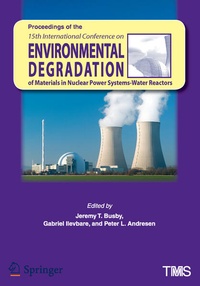
Proceedings of the 15th International Conference on Environmental Degradation of Materials in Nuclear Power Systems - Water Reactors
1st Edition
Published on 17. July 2017
MMCDLXXII, 2354 pages
978-3-319-48760-1 (ISBN)
Description

This 15th Edition of the International Conference on Materials Degradation in Light Water Reactors focuses on subject areas critical to the safe and efficient running of nuclear reactor systems through the exchange and discussion of reseach results as well as field operating and management experience.
More details
Other editions
Additional editions
The Minerals, Metals & Materials Society (TMS)
15th International Conference on Environmental Degradation of Materials in Nuclear Power Systems
Water Reactors
Software
02/2012
1st Edition
Wiley
€122.00
Article exhausted; check different version
Persons
The Minerals, Metals & Materials Society (TMS) is a member-driven international professional society dedicated to fostering the exchange of learning and ideas across the entire range of materials science and engineering, from minerals processing and primary metals production, to basic research and the advanced applications of materials. Included among its nearly 13,000 professional and student members are metallurgical and materials engineers, scientists, researchers, educators, and administrators from more than 70 countries on six continents. For more information on TMS, visit www.tms.org.
Content
1 - Cover [Seite 1]
2 - Title Page [Seite 2]
3 - Copyright Page [Seite 3]
4 - Table of Contents [Seite 4]
5 - Preface [Seite 20]
6 - Conference Organizing Committee/Program Committee [Seite 22]
7 - Session Chairs and Technical Reviewers [Seite 23]
8 - Student Volunteers [Seite 25]
9 - Financial Sponsors [Seite 26]
10 - Opening Session [Seite 28]
10.1 - Overview of NRC Proactive Management of Materials Degradation (PMMD) Program [Seite 28]
10.1.1 - Questions & Answers [Seite 37]
10.2 - Conditions for Long Term Operation of Nuclear Power Plants in Sweden [Seite 39]
11 - Alloy 690 and Its Weld Metals I [Seite 51]
11.1 - Current NRC Perspectives Concerning Primary Water Stress Corrosion Cracking [Seite 51]
11.1.1 - Questions & Answers [Seite 65]
11.2 - Evaluation of the Susceptibility to SCC Initiation of Alloy 690 in Simulated PWR Primary Water [Seite 66]
11.2.1 - Questions & Answers [Seite 78]
11.3 - Role of Cavity Formation on Crack Growth of Cold-Worked Carbon Steel, TT 690 and MA 600 in High Temperature Water [Seite 79]
11.4 - Crack Growth Testing on Cold Worked Alloy 690 in Primary Water Environment [Seite 94]
11.4.1 - Questions & Answers [Seite 111]
11.5 - One-Dimensional Cold Rolling Effects on Stress Corrosion Crack Growth in Alloy 690 Tubing and Plate Materials [Seite 112]
11.5.1 - Questions & Answers [Seite 128]
12 - Alloy 690 and Its Weld Metals II [Seite 129]
12.1 - Cyclic and SCC Behavior of Alloy 690 HAZ in a PWR Environment [Seite 129]
12.1.1 - Questions & Answers [Seite 146]
12.2 - Stress Corrosion Crack Growth Rate Testing of Novel Composite Arrest Specimens [Seite 150]
12.2.1 - Questions & Answers [Seite 166]
12.3 - Environmentally Assisted Crack Growth in Cold Worked Alloy 690TT in Primary Water at Low and High Temperatures [Seite 167]
12.3.1 - Questions & Answers [Seite 177]
12.4 - SCC of Alloy 690 and Its Weld Metals [Seite 178]
12.4.1 - Questions & Answers [Seite 194]
12.5 - SCC Behavior of Alloy 152 Weld in PWR Environment [Seite 196]
13 - Alloy 690 and Its Weld Metals III [Seite 214]
13.1 - Effect of Hot Cracks on EAC Crack Initiation and Growth in Nickel-Base Alloy Weld Metals [Seite 214]
13.1.1 - Questions & Answers [Seite 240]
13.2 - Stress Corrosion Crack Growth of Alloy 52M in Simulated PWR Primary Water [Seite 242]
13.3 - Cyclic and SCC Behavior of Alloy 52M/182 Weld Overlay in a PWR Environment [Seite 261]
13.4 - SCC of High Cr Alloys in BWR Environments [Seite 283]
13.4.1 - Questions & Answers [Seite 314]
13.5 - High-Resolution Characterizations of Grain Boundary Damage and Stress Corrosion Crack Tips in Cold-Rolled Alloy 690 [Seite 316]
14 - Alloy 690 and Its Weld Metals IV [Seite 330]
14.1 - Research and Evaluation of Low Temperature Crack Propagation of Ni Base Alloys in Actual Plants [Seite 330]
14.1.1 - Questions & Answers [Seite 342]
14.2 - Penetrative Internal Oxidation from Alloy 690 Surfaces and Stress Corrosion Crack Walls during Exposure to PWR Primary Water [Seite 345]
14.3 - Predicting Chromium Depletion of Nickel-Base Alloys [Seite 357]
14.3.1 - Questions & Answers [Seite 369]
15 - BWR Initiation and Oxide Film Characterization I [Seite 371]
15.1 - In-situ and Ex-situ Oxide Characterization by Synchrotron X-ray (SPring-8) in Non-Sensitized 316 Stainless Steel and High Temperature Water Combination [Seite 371]
15.1.1 - Questions & Answers [Seite 383]
15.2 - High Resolution Electron Microscopy Study on Oxide Films Formed on Nickel-Base Alloys X-750, 182 and 82 in Simulated High Flow Velocity BWR Water Conditions [Seite 385]
15.2.1 - Questions & Answers [Seite 398]
15.3 - Destructive Examinations on Divider Plates from Decommissioned Steam Generators Affected by Superficial Stress Corrosion Cracks [Seite 402]
15.3.1 - Questions & Answers [Seite 418]
15.4 - Non-linear Dynamics of the Morphology at the Oxide / Metal Interface of Austenitic Steels in Simulated Light Water Reactor Environments and Its Implications for SCC Initiation [Seite 421]
15.4.1 - Questions & Answers [Seite 432]
16 - BWR Initiation and Oxide Film Characterization II [Seite 436]
16.1 - The Effect of Cold Work on Microstructure and SCC Susceptibility in Simulated BWR Environment for Non-Sensitized Austenitic Stainless Steels [Seite 436]
16.2 - Behavior of Stress Corrosion Cracking for Type 316L Stainless Steel with Controlled Distribution of Surface Work Hardened Layer in Simulated Boiling Water Reactors Environment [Seite 449]
16.2.1 - Questions & Answers [Seite 460]
16.3 - Influence of Bulk and Surface Cold Work on Crack Initiation and Crack Growth of Austenitic Stainless Steels under Simulated BWR Environment [Seite 462]
16.3.1 - Questions & Answers [Seite 478]
17 - BWR Stainless Steels CGR I [Seite 479]
17.1 - Effect of Nitrogen Addition in 304 L Stainless Steel on the IGSCC Crack Growth Rate in Simulated BWR Environment [Seite 479]
17.1.1 - Questions & Answers [Seite 494]
17.2 - Characterization of Type 304L Stainless Steel: Comparison of ASTM A262 Practice A and Analytical Electron Microscopy Techniques [Seite 498]
17.2.1 - Questions & Answers [Seite 508]
18 - BWR Stainless Steels CGR II [Seite 511]
18.1 - The Effect of Grain Size on IGSCC in SS 316L in Simulated BWR Environment [Seite 511]
18.1.1 - Questions & Answers [Seite 524]
18.2 - An Investigation into Stress Corrosion Cracking of Dissimilar Metal Welds with 304L Stainless Steel and Alloy 82 in High Temperature Pure Water [Seite 526]
18.2.1 - Questions & Answers [Seite 535]
18.3 - Deformation Mode and Microstructure on Stress Corrosion Cracking Path and Kinetics in High Temperature Water Environments [Seite 537]
18.3.1 - Questions & Answers [Seite 549]
19 - Corrosion Fatigue - BWR, PWR [Seite 550]
19.1 - Effect of Static Load Hold Periods on the Corrosion Fatigue Behavior of Austenitic Stainless Steels in Simulated BWR Environments [Seite 550]
19.2 - Effects of Material Composition on Corrosion Fatigue Crack Growth of Austenitic Stainless Steels in High Temperature Water [Seite 564]
19.2.1 - Questions & Answers [Seite 583]
19.3 - Fatigue Limit and Hysteresis Behavior of Type 304l SS in Air and PWR Water, at 150°C and 300°C [Seite 584]
19.4 - NRC Research Activities on Environmentally-Assisted Fatigue [Seite 605]
19.4.1 - Questions & Answers [Seite 617]
20 - Fuel and Fuel Related Materials I [Seite 620]
20.1 - PWR Fuel Deposit Analysis at a B&W Plant with a 24-Month Fuel Cycle [Seite 620]
20.1.1 - Questions & Answers [Seite 625]
20.2 - Effect of DH Concentration on Crud Deposition on Heated Zircaloy-4 in Simulated PWR Primary Water [Seite 630]
20.2.1 - Questions & Answers [Seite 642]
20.3 - Use of AREVA BWR CRUD Model To Study High Zinc Operation at a US Plant [Seite 646]
20.4 - Electrochemical Study of Pre- and Post-Transition Corrosion of Zr Alloys in PWR Coolant [Seite 651]
20.5 - AREVA Fuel Condition Index for a Pressurized Water Reactor [Seite 660]
21 - Fuel and Fuel Related Materials II [Seite 665]
21.1 - Structure and Thermodynamical Properties of Zirconium Hydrides from First-Principle [Seite 665]
21.1.1 - Questions & Answers [Seite 674]
21.2 - Hydride Behavior in Zircaloy-4 during Thermomechanical Cycling [Seite 675]
22 - Fuel and Fuel Related Materials III PWR-BWR [Seite 681]
22.1 - Development of a Method for Studying the Influence of Stress State on the Iodine-Induced Stress Corrosion Cracking of Zirconium Alloys [Seite 681]
22.2 - Wear of Zircaloy-4 Grid Straps Due to Fretting and Periodic Impact with RV Internals Baffle Plates [Seite 694]
22.2.1 - Questions & Answers [Seite 707]
23 - Alloy 718 and X-750 [Seite 709]
23.1 - Microstructure and SCC of Alloy X-750 [Seite 709]
23.1.1 - Questions & Answers [Seite 731]
23.2 - Stress Corrosion Cracking and Crack Tip Characterization of Alloy X-750 in Boiling Water Reactor Environments [Seite 735]
23.2.1 - Questions & Answers [Seite 751]
23.3 - SCC Properties of Modified Alloy 718 in BWR Plant [Seite 753]
23.3.1 - Questions & Answers [Seite 767]
23.4 - Influence of Chloride Ions as Contaminants on the Corrosion Behavior of Alloy 718 in Pool Water of Nuclear Power Plants [Seite 771]
24 - BWR Low Alloy Steel [Seite 781]
24.1 - Stress Corrosion Cracking Behavior near the Fusion Boundary of Dissimilar Weld Joint with Alloy 182 - A533B Low Alloy Steel [Seite 781]
24.1.1 - Questions & Answers [Seite 793]
24.2 - Effect of Chloride on Environmentally Assisted Cracking of Low Alloy Steels in Oxygenated Hightemperature Water - General Corrosion [Seite 795]
24.2.1 - Questions & Answers [Seite 810]
25 - BWR Stainless Steels CGR III [Seite 816]
25.1 - The Effect of Temperature on the Crack Growth Rate in Simulated BWR Environment [Seite 816]
25.1.1 - Questions & Answers [Seite 828]
25.2 - Effects of Temperature and Corrosion Potential on SCC [Seite 837]
25.2.1 - Questions & Answers [Seite 866]
25.3 - Effect of Thermal Aging on SCC, Material Properties and Fracture Toughness of Stainless Steel Weld Metals [Seite 870]
25.3.1 - Questions & Answers [Seite 888]
26 - Flow Assisted Corrosion [Seite 893]
26.1 - Flow Accelerated Corrosion of Carbon Steel in the Feedwater System of Pwr Plants - Behaviour of Welds and Weld Assemblies [Seite 893]
26.1.1 - Questions & Answers [Seite 906]
26.2 - Modelling Material Effects in Flow-Accelerated Corrosion [Seite 910]
27 - PWR Oxide Films and Characterization [Seite 923]
27.1 - 3D Atom-Probe Characterization of Stress and Cold-Work in Stress Corrosion Cracking of 304 Stainless Steel [Seite 923]
27.1.1 - Questions & Answers [Seite 931]
27.2 - Effect of Dissolved Hydrogen, Surface Conditions and Composition on the Electronic Properties of the Oxide Films Formed on Nickel-Base Alloys in PWR Primary Water [Seite 936]
27.2.1 - Questions & Answers [Seite 947]
27.3 - Influence of Primary Water Chemistry on Oxides Formed on Alloy 600 and Alloy690 [Seite 949]
27.4 - Characterizing Environmental Degradation in PWRs by 3D FIB Sequential Sectioning [Seite 975]
27.4.1 - Questions & Answers [Seite 987]
28 - PWR Secondary Side/Balance of Plant I [Seite 989]
28.1 - On the Microstructure of Alloy 600 SCC Cracks Observed by TEM on PWR SG Pulled Tubes and on Laboratory Specimens [Seite 989]
28.2 - Balance of Plant Corrosion Issues in Aging Nuclear Power Plants [Seite 1004]
28.2.1 - Questions & Answers [Seite 1016]
28.3 - Containment Liner Corrosion [Seite 1017]
28.3.1 - Questions & Answers [Seite 1029]
29 - PWR Secondary Side/Balance of Plant II [Seite 1030]
29.1 - Electrochemical Studies of Steam Generator Tube Degradation in the Presence of Thiosulphate [Seite 1030]
29.1.1 - Questions & Answers [Seite 1042]
29.2 - X-Ray Photoelectron Study of the Oxides Formed on Nickel Metal and Nickel-Chromium 20% Alloy Surfaces under Reducing and Oxidizing Potentials in Basic, Neutral and Acidic Solutions [Seite 1044]
29.2.1 - Questions & Answers [Seite 1061]
30 - SCC of Alloy 82, 182 Welds I [Seite 1064]
30.1 - Interaction of Microstructure, Composition, and Cold Work on the Stress Corrosion Cracking of Alloy 82 Weld Metal [Seite 1064]
30.1.1 - Questions & Answers [Seite 1079]
30.2 - Stress Corrosion Cracking Behavior of Dissimilar Metal Weldments in High Temperature Water Environment [Seite 1081]
30.2.1 - Questions & Answers [Seite 1099]
30.3 - SCC Crack Growth Rate of Alloy 82 in PWR Primary Water Conditions - Effect of a Thermal Treatment [Seite 1102]
31 - SCC of Alloy 82, 182 Welds II [Seite 1115]
31.1 - Initiation of PWSCC of Weld Alloys 182 [Seite 1115]
31.1.1 - Questions & Answers [Seite 1126]
31.2 - NRC/EPRI Welding Residual Stress Validation Program (Phase III) [Seite 1128]
31.2.1 - Questions & Answers [Seite 1139]
32 - IASCC Stainless Steels CGR I [Seite 1141]
32.1 - Crack Growth Behavior of Irradiated Type 316 SS in Low Dissolved Oxygen Environment [Seite 1141]
32.1.1 - Questions & Answers [Seite 1155]
32.2 - Stress Corrosion Crack Initiation Susceptibility of Irradiated Austenitic Stainless Steels [Seite 1159]
32.2.1 - Questions & Answers [Seite 1172]
32.3 - Stress Corrosion Cracking Behavior of Type 304 Stainless Steel Irradiated under Different Neutron Dose Rates at JMTR [Seite 1173]
32.3.1 - Questions & Answers [Seite 1187]
32.4 - In-Pile Tests for IASCC Growth Behavior of Irradiated 316L Stainless Steel under Simulated BWR Condition in JMTR [Seite 1188]
32.5 - Crack Growth Rates of Irradiated Commercial Stainless Steels in BWR and PWR Environments [Seite 1198]
33 - IASCC Stainless Steels CGR II [Seite 1210]
33.1 - The Key Factors Affecting Crack Growth Behavior of Neutron-Irradiated Austenitic Alloys [Seite 1210]
33.1.1 - Questions & Answers [Seite 1224]
33.2 - Irradiation-Assisted Stress Corrosion Cracking of Austenitic Stainless Steel WWER Reactor Core Internals [Seite 1225]
33.2.1 - Questions & Answers [Seite 1241]
33.3 - Slow Strain Rate Tensile Tests of Irradiated Austenitic Stainless Steels in Simulated PWR Environment [Seite 1244]
33.3.1 - Questions & Answers [Seite 1257]
33.4 - Irradiation Assisted Stress Corrosion Cracking of Stainless Steels in a PWR Environment (A Combined Approach) [Seite 1258]
33.5 - A Preliminary Hybrid Model of Irradiation-Assisted Stress Corrosion Cracking of 300 Series Stainless Steels in PWR Primary Environments [Seite 1273]
33.5.1 - Questions & Answers [Seite 1289]
34 - Irradiation Effects - General I [Seite 1292]
34.1 - Oxidation of a Proton-irradiated 316 Stainless Steel in Simulated BWR NWC Environment [Seite 1292]
34.2 - Irradiation Creep and Irradiation Stress Relaxation of 316 and 304l Stainless Steels in Thermal and Fast Neutron Spectrum Reactors [Seite 1302]
34.2.1 - Questions & Answers [Seite 1314]
34.3 - Recent Insights on the Parametric Dependence of Irradiation Creep of Austenitic Stainless Steels [Seite 1318]
34.3.1 - Questions & Answers [Seite 1331]
34.4 - Cluster Dynamics Prediction of the Microstructure Evolution of 300-series Austenitic Stainless Steel under Irradiation: Influence of Helium [Seite 1332]
35 - Irradiation Effects on Deformation [Seite 1344]
35.1 - Role of Slip Behavior in the Irradiation Assisted Stress Corrosion Cracking in Austenitic Steels [Seite 1344]
35.1.1 - Questions & Answers [Seite 1356]
35.2 - Effect of Environment and Prestrain on IASCC of Austenitic Stainless Steels [Seite 1357]
35.2.1 - Questions & Answers [Seite 1373]
35.3 - Influence of Localized Plasticity on IASCC Sensitivity of Austenitic Stainless Steels under PWR Primary Water [Seite 1376]
35.4 - Deformation Microstructures of 30 dpa AISI 304 Stainless Steel after Monotonic Tensile and Constant Load Autoclave Testing [Seite 1387]
35.4.1 - Questions & Answers [Seite 1402]
36 - PWR Alloy 600 Oxidation and Mechanisms I [Seite 1404]
36.1 - Degradation of Grain Boundary Strength by Oxidation in Alloy 600 [Seite 1404]
36.1.1 - Questions & Answers [Seite 1418]
36.2 - Evaluation of the Oxygen Diffusion Coefficient in Nickel-Base Alloys [Seite 1419]
36.3 - Stress Corrosion Cracking of Alloy 600 in PWR Primary Water: Influence of Chromium, Oxygen and Hydrogen Diffusion [Seite 1432]
36.3.1 - Questions & Answers [Seite 1444]
36.4 - Grain Boundary Oxidation and Embrittlement Prior to Crack Initiation in Alloy 600 in PWR Primary Water [Seite 1446]
37 - PWR Alloy 600 Oxidation and Mechanisms II [Seite 1457]
37.1 - Electron Microscopy Characterizations and Atom Probe Tomography of Intergranular Attack in Alloy 600 Exposed to PWR Primary Water [Seite 1457]
37.1.1 - Questions & Answers [Seite 1471]
37.2 - Grain Boundary Oxidation and Stress Corrosion Cracking in Nickel-base Alloys Strained in Supercritical Water [Seite 1473]
37.2.1 - Questions & Answers [Seite 1485]
37.3 - Quantitative Micro-nano (QMN) Approach to SCC Mechanism and Prediction-Starting a Third Meeting [Seite 1488]
37.3.1 - Questions & Answers [Seite 1579]
38 - PWR Alloy 600 SCC I [Seite 1582]
38.1 - Strain Path Effect on IGSCC Initiation and Oxidation of Alloy 182 Exposed to PWR Primary Water [Seite 1582]
38.1.1 - Questions & Answers [Seite 1595]
38.2 - Experimental Study of Short Crack Coalescence in Nickel-Base Alloys In PWR Primary Water [Seite 1597]
38.2.1 - Questions & Answers [Seite 1615]
38.3 - Mechanistic Study on PWSCC of Ni-Based Alloys Using Hump-SSRT Tests under Dry Hydrogen Gas Environment, Simulated Primary Water and Rapid Straining Electrode Test in Simulated Primary Water [Seite 1616]
38.3.1 - Questions & Answers [Seite 1632]
38.4 - Crystallographical Characterization of Initiation of Intergranular Stress Corrosion Cracking of Alloy 600 in PWR Environment [Seite 1634]
38.4.1 - Questions & Answers [Seite 1646]
38.5 - Environmental Effects on PWSCC Initiation and Propagation in Alloy 600 [Seite 1648]
38.5.1 - Questions & Answers [Seite 1661]
39 - PWR Alloy 600 SCC II [Seite 1662]
39.1 - Probabilistic Environmentally-Assisted Cracking Modeling for Primary Water Stress Corrosion Cracking of Alloy 600 [Seite 1662]
39.1.1 - Questions & Answers [Seite 1675]
39.2 - The Role of Lattice Curvature on the SCC Susceptibility of Alloy 600 [Seite 1676]
39.2.1 - Questions & Answers [Seite 1689]
39.3 - PWSCC Susceptibility in Heat-Affected Zones of Alloy 600 [Seite 1690]
39.3.1 - Questions & Answers [Seite 1700]
39.4 - Quantitative Residual Strain Analyses on Strain Hardened Nickel Based Alloy [Seite 1702]
39.5 - The Study of Stress Corrosion Cracking on Alloy 600 C-Ring Samples by Polychromatic X-Ray Microdiffraction [Seite 1715]
39.5.1 - Questions & Answers [Seite 1725]
40 - PWR Degradation Management [Seite 1728]
40.1 - Proposed Coordinated U.S. PWR Reactor Vessel Surveillance Program: An Updated Summary Including Program Optimization [Seite 1728]
40.2 - Developing PWR Aging-Management Strategies for Reactor Vessel Internals [Seite 1741]
40.3 - Development of the Extremely Low Probability of Rupture (xLPR) Code [Seite 1751]
40.3.1 - Questions & Answers [Seite 1767]
40.4 - Databases of Operationally Induced Damage [Seite 1769]
40.4.1 - Questions & Answers [Seite 1782]
41 - PWR Water Chemistry and Mitigation [Seite 1785]
41.1 - Introduction to a New Real-Time Water Chemistry Measurement System [Seite 1785]
41.1.1 - Questions & Answers [Seite 1792]
41.2 - Comparison of DBU, NH3, DMA, ETA, and Morpholine Interactions with Ferrous Chloride Solution and Carbon Steel Surfaces [Seite 1795]
41.2.1 - Questions & Answers [Seite 1813]
41.3 - Role of Dissolved Hydrogen in Water in Corrosion of Alloy 600 in High Temperature Water [Seite 1815]
41.3.1 - Questions & Answers [Seite 1825]
41.4 - Quantifying the Benefit of Chemical Mitigation of PWSCC via Zinc Addition or Hydrogen Optimization [Seite 1829]
41.4.1 - Questions & Answers [Seite 1843]
42 - Super Critical Water [Seite 1845]
42.1 - Computational Thermodynamics for Interpreting Oxidation of Structural Materials in Supercritical Water [Seite 1845]
42.1.1 - Questions & Answers [Seite 1854]
42.2 - Stress Corrosion Cracking of Austenitic Alloys in Supercritical Water [Seite 1858]
42.2.1 - Questions & Answers [Seite 1872]
42.3 - Comparison of the Oxidation Behavior of the 14Cr ODS Alloy in Steam and Supercritical Water [Seite 1873]
42.3.1 - Questions & Answers [Seite 1882]
42.4 - Grain Boundary Engineering and Air Oxidation Behavior of Alloy 690 [Seite 1883]
42.4.1 - Questions & Answers [Seite 1896]
43 - BWR Water Chemistry and Mitigation I [Seite 1897]
43.1 - Developments in SCC Mitigation by Electrocatalysis [Seite 1897]
43.1.1 - Questions & Answers [Seite 1919]
43.2 - Use of Noble Metal Nanoparticle for SCC Mitigation in BWRs [Seite 1922]
43.2.1 - Questions & Answers [Seite 1931]
43.3 - The Influence of Minor Additions of Platinum Group Metals on Stress Corrosion Cracking in Austenitic Stainless Steels [Seite 1932]
43.3.1 - Questions & Answers [Seite 1947]
43.4 - The Effect of On-Line Noble Metal Addition on the Shut Down Dose Rates of Boiling Water Reactors [Seite 1949]
43.4.1 - Questions & Answers [Seite 1963]
43.5 - Effects of Hydrogen on SCC Growth Rate of Ni Alloys in BWR Water [Seite 1964]
43.6 - Technical Basis for Water Chemistry Control of IGSCC in Boiling Water Reactors [Seite 1985]
43.6.1 - Questions & Answers [Seite 2001]
44 - BWR Water Chemistry and Mitigation II [Seite 2002]
44.1 - Water Chemistry in the Primary Coolant Circuit of a Boiling Water Reactor during Startup Operations [Seite 2002]
44.2 - Simulation of Water Radiolysis by Sonochemistry: Effects on the Electrochemical Behavior of a Stainless Steel [Seite 2013]
44.2.1 - Questions & Answers [Seite 2023]
44.3 - Protective Insulated Coating for SCC Mitigation in BWRs [Seite 2024]
44.3.1 - Questions & Answers [Seite 2038]
44.4 - Influence of Treating Temperature on the Deposition of TiO2 on Type 304 Stainless Steels for Corrosion Mitigation in High Temperature Pure Water [Seite 2041]
44.4.1 - Questions & Answers [Seite 2054]
45 - Irradiation Effects - General II [Seite 2056]
45.1 - Irradiation Microstructure of Austenitic Steels and Cast Steels Irradiated in the BOR-60 Reactor at 320°C [Seite 2056]
45.1.1 - Questions & Answers [Seite 2068]
46 - PWR Field Experience I [Seite 2069]
46.1 - Laboratory Stress Corrosion Cracking Propagation in a Superficial Cold-Worked Layer in SG Divider Plates in Alloy 600 [Seite 2069]
46.2 - Destructive Examinations on Divider Plates from Decommissionned Steam Generators Affectined by Superficial Stress Corrosion Cracks [Seite 2089]
46.2.1 - Questions & Answers [Seite 2102]
46.3 - Investigations on Core Basket Bolts from a VVER 440 Power Plant [Seite 2105]
46.3.1 - Questions & Answers [Seite 2117]
46.4 - Laboratory Analysis of a Reactor Coolant Pump Seal [Seite 2123]
46.5 - PWSCC of Thermocoax Pressurizer Heaters in Austenitic Stainless Steel and Remedial Actions to Preventing SCC [Seite 2135]
47 - PWR Field Experience II [Seite 2147]
47.1 - Residual Stress Measurement and the Effect of Heat Treatment in Cladded Control Rod Drive Specimens [Seite 2147]
47.1.1 - Questions & Answers [Seite 2160]
47.2 - Detailed Root Cause Analysis of SG Tube ODSCC Indications within the Tube Sheets of NPP Biblis Unit A [Seite 2162]
47.2.1 - Questions & Answers [Seite 2175]
47.3 - Laboratory Investigation of a Leaking Type 316 Socket Weld in a Boron Injection Tank Sampling Line [Seite 2176]
47.4 - Pressure Tests on SG Pulled Tubes at TSP Level [Seite 2188]
47.5 - Implications of Steam Generator Fouling on the Degradation of Thermal and Material Performance [Seite 2200]
47.5.1 - Questions & Answers [Seite 2213]
47.6 - Key Issues Related to Corrosion Protection of Brackish Water and Sea Water Bearing Components in Cooling Water Systems [Seite 2214]
48 - PWR Initiation and CGR Stainless Steels I [Seite 2231]
48.1 - Understanding the Limits of Lattice Orientation Data Analysis in Environmental Degradation Studies [Seite 2231]
48.1.1 - Questions & Answers [Seite 2243]
48.2 - A Microstructural Investigation on the Effect of Cold Work on Environmentally Assisted Cracking of Austenitic Stainless Steels [Seite 2244]
48.2.1 - Questions & Answers [Seite 2256]
48.3 - Plastic Strain and Residual Stress Distributions in an AISI 304 Stainless Steel BWR Pipe Weld [Seite 2260]
48.4 - Assessment of Lean Grade Duplex Stainless Steels for Nuclear Power Applications [Seite 2277]
49 - PWR Initiation and CGR Stainless Steels II [Seite 2289]
49.1 - Effects of Thermo-Mechanical Treatments on Deformation Behavior and IGSCC Susceptibility of Stainless Steels in PWR Primary Water Chemistry [Seite 2289]
49.1.1 - Questions & Answers [Seite 2310]
50 - Previously Unpublished Manuscripts from the 14th International Conference on Environmental Degradation of Materials in Nuclear Power Systems,23-29th August 2009, Virginia Beach, VA, USA [Seite 2313]
50.1 - SCC Initiation Testing of Alloy 600 in High Temperature Water [Seite 2313]
50.2 - The Effects of Deaerated Water on the Toughness of Nickel-based Alloys [Seite 2324]
50.3 - Physical Metallurgy, Weldability, and In-service Performance of Nickel-chromium Filler Metals Used in Nuclear Power Systems [Seite 2336]
51 - Author Index [Seite 2347]
52 - Subject Index [Seite 2351]
2 - Title Page [Seite 2]
3 - Copyright Page [Seite 3]
4 - Table of Contents [Seite 4]
5 - Preface [Seite 20]
6 - Conference Organizing Committee/Program Committee [Seite 22]
7 - Session Chairs and Technical Reviewers [Seite 23]
8 - Student Volunteers [Seite 25]
9 - Financial Sponsors [Seite 26]
10 - Opening Session [Seite 28]
10.1 - Overview of NRC Proactive Management of Materials Degradation (PMMD) Program [Seite 28]
10.1.1 - Questions & Answers [Seite 37]
10.2 - Conditions for Long Term Operation of Nuclear Power Plants in Sweden [Seite 39]
11 - Alloy 690 and Its Weld Metals I [Seite 51]
11.1 - Current NRC Perspectives Concerning Primary Water Stress Corrosion Cracking [Seite 51]
11.1.1 - Questions & Answers [Seite 65]
11.2 - Evaluation of the Susceptibility to SCC Initiation of Alloy 690 in Simulated PWR Primary Water [Seite 66]
11.2.1 - Questions & Answers [Seite 78]
11.3 - Role of Cavity Formation on Crack Growth of Cold-Worked Carbon Steel, TT 690 and MA 600 in High Temperature Water [Seite 79]
11.4 - Crack Growth Testing on Cold Worked Alloy 690 in Primary Water Environment [Seite 94]
11.4.1 - Questions & Answers [Seite 111]
11.5 - One-Dimensional Cold Rolling Effects on Stress Corrosion Crack Growth in Alloy 690 Tubing and Plate Materials [Seite 112]
11.5.1 - Questions & Answers [Seite 128]
12 - Alloy 690 and Its Weld Metals II [Seite 129]
12.1 - Cyclic and SCC Behavior of Alloy 690 HAZ in a PWR Environment [Seite 129]
12.1.1 - Questions & Answers [Seite 146]
12.2 - Stress Corrosion Crack Growth Rate Testing of Novel Composite Arrest Specimens [Seite 150]
12.2.1 - Questions & Answers [Seite 166]
12.3 - Environmentally Assisted Crack Growth in Cold Worked Alloy 690TT in Primary Water at Low and High Temperatures [Seite 167]
12.3.1 - Questions & Answers [Seite 177]
12.4 - SCC of Alloy 690 and Its Weld Metals [Seite 178]
12.4.1 - Questions & Answers [Seite 194]
12.5 - SCC Behavior of Alloy 152 Weld in PWR Environment [Seite 196]
13 - Alloy 690 and Its Weld Metals III [Seite 214]
13.1 - Effect of Hot Cracks on EAC Crack Initiation and Growth in Nickel-Base Alloy Weld Metals [Seite 214]
13.1.1 - Questions & Answers [Seite 240]
13.2 - Stress Corrosion Crack Growth of Alloy 52M in Simulated PWR Primary Water [Seite 242]
13.3 - Cyclic and SCC Behavior of Alloy 52M/182 Weld Overlay in a PWR Environment [Seite 261]
13.4 - SCC of High Cr Alloys in BWR Environments [Seite 283]
13.4.1 - Questions & Answers [Seite 314]
13.5 - High-Resolution Characterizations of Grain Boundary Damage and Stress Corrosion Crack Tips in Cold-Rolled Alloy 690 [Seite 316]
14 - Alloy 690 and Its Weld Metals IV [Seite 330]
14.1 - Research and Evaluation of Low Temperature Crack Propagation of Ni Base Alloys in Actual Plants [Seite 330]
14.1.1 - Questions & Answers [Seite 342]
14.2 - Penetrative Internal Oxidation from Alloy 690 Surfaces and Stress Corrosion Crack Walls during Exposure to PWR Primary Water [Seite 345]
14.3 - Predicting Chromium Depletion of Nickel-Base Alloys [Seite 357]
14.3.1 - Questions & Answers [Seite 369]
15 - BWR Initiation and Oxide Film Characterization I [Seite 371]
15.1 - In-situ and Ex-situ Oxide Characterization by Synchrotron X-ray (SPring-8) in Non-Sensitized 316 Stainless Steel and High Temperature Water Combination [Seite 371]
15.1.1 - Questions & Answers [Seite 383]
15.2 - High Resolution Electron Microscopy Study on Oxide Films Formed on Nickel-Base Alloys X-750, 182 and 82 in Simulated High Flow Velocity BWR Water Conditions [Seite 385]
15.2.1 - Questions & Answers [Seite 398]
15.3 - Destructive Examinations on Divider Plates from Decommissioned Steam Generators Affected by Superficial Stress Corrosion Cracks [Seite 402]
15.3.1 - Questions & Answers [Seite 418]
15.4 - Non-linear Dynamics of the Morphology at the Oxide / Metal Interface of Austenitic Steels in Simulated Light Water Reactor Environments and Its Implications for SCC Initiation [Seite 421]
15.4.1 - Questions & Answers [Seite 432]
16 - BWR Initiation and Oxide Film Characterization II [Seite 436]
16.1 - The Effect of Cold Work on Microstructure and SCC Susceptibility in Simulated BWR Environment for Non-Sensitized Austenitic Stainless Steels [Seite 436]
16.2 - Behavior of Stress Corrosion Cracking for Type 316L Stainless Steel with Controlled Distribution of Surface Work Hardened Layer in Simulated Boiling Water Reactors Environment [Seite 449]
16.2.1 - Questions & Answers [Seite 460]
16.3 - Influence of Bulk and Surface Cold Work on Crack Initiation and Crack Growth of Austenitic Stainless Steels under Simulated BWR Environment [Seite 462]
16.3.1 - Questions & Answers [Seite 478]
17 - BWR Stainless Steels CGR I [Seite 479]
17.1 - Effect of Nitrogen Addition in 304 L Stainless Steel on the IGSCC Crack Growth Rate in Simulated BWR Environment [Seite 479]
17.1.1 - Questions & Answers [Seite 494]
17.2 - Characterization of Type 304L Stainless Steel: Comparison of ASTM A262 Practice A and Analytical Electron Microscopy Techniques [Seite 498]
17.2.1 - Questions & Answers [Seite 508]
18 - BWR Stainless Steels CGR II [Seite 511]
18.1 - The Effect of Grain Size on IGSCC in SS 316L in Simulated BWR Environment [Seite 511]
18.1.1 - Questions & Answers [Seite 524]
18.2 - An Investigation into Stress Corrosion Cracking of Dissimilar Metal Welds with 304L Stainless Steel and Alloy 82 in High Temperature Pure Water [Seite 526]
18.2.1 - Questions & Answers [Seite 535]
18.3 - Deformation Mode and Microstructure on Stress Corrosion Cracking Path and Kinetics in High Temperature Water Environments [Seite 537]
18.3.1 - Questions & Answers [Seite 549]
19 - Corrosion Fatigue - BWR, PWR [Seite 550]
19.1 - Effect of Static Load Hold Periods on the Corrosion Fatigue Behavior of Austenitic Stainless Steels in Simulated BWR Environments [Seite 550]
19.2 - Effects of Material Composition on Corrosion Fatigue Crack Growth of Austenitic Stainless Steels in High Temperature Water [Seite 564]
19.2.1 - Questions & Answers [Seite 583]
19.3 - Fatigue Limit and Hysteresis Behavior of Type 304l SS in Air and PWR Water, at 150°C and 300°C [Seite 584]
19.4 - NRC Research Activities on Environmentally-Assisted Fatigue [Seite 605]
19.4.1 - Questions & Answers [Seite 617]
20 - Fuel and Fuel Related Materials I [Seite 620]
20.1 - PWR Fuel Deposit Analysis at a B&W Plant with a 24-Month Fuel Cycle [Seite 620]
20.1.1 - Questions & Answers [Seite 625]
20.2 - Effect of DH Concentration on Crud Deposition on Heated Zircaloy-4 in Simulated PWR Primary Water [Seite 630]
20.2.1 - Questions & Answers [Seite 642]
20.3 - Use of AREVA BWR CRUD Model To Study High Zinc Operation at a US Plant [Seite 646]
20.4 - Electrochemical Study of Pre- and Post-Transition Corrosion of Zr Alloys in PWR Coolant [Seite 651]
20.5 - AREVA Fuel Condition Index for a Pressurized Water Reactor [Seite 660]
21 - Fuel and Fuel Related Materials II [Seite 665]
21.1 - Structure and Thermodynamical Properties of Zirconium Hydrides from First-Principle [Seite 665]
21.1.1 - Questions & Answers [Seite 674]
21.2 - Hydride Behavior in Zircaloy-4 during Thermomechanical Cycling [Seite 675]
22 - Fuel and Fuel Related Materials III PWR-BWR [Seite 681]
22.1 - Development of a Method for Studying the Influence of Stress State on the Iodine-Induced Stress Corrosion Cracking of Zirconium Alloys [Seite 681]
22.2 - Wear of Zircaloy-4 Grid Straps Due to Fretting and Periodic Impact with RV Internals Baffle Plates [Seite 694]
22.2.1 - Questions & Answers [Seite 707]
23 - Alloy 718 and X-750 [Seite 709]
23.1 - Microstructure and SCC of Alloy X-750 [Seite 709]
23.1.1 - Questions & Answers [Seite 731]
23.2 - Stress Corrosion Cracking and Crack Tip Characterization of Alloy X-750 in Boiling Water Reactor Environments [Seite 735]
23.2.1 - Questions & Answers [Seite 751]
23.3 - SCC Properties of Modified Alloy 718 in BWR Plant [Seite 753]
23.3.1 - Questions & Answers [Seite 767]
23.4 - Influence of Chloride Ions as Contaminants on the Corrosion Behavior of Alloy 718 in Pool Water of Nuclear Power Plants [Seite 771]
24 - BWR Low Alloy Steel [Seite 781]
24.1 - Stress Corrosion Cracking Behavior near the Fusion Boundary of Dissimilar Weld Joint with Alloy 182 - A533B Low Alloy Steel [Seite 781]
24.1.1 - Questions & Answers [Seite 793]
24.2 - Effect of Chloride on Environmentally Assisted Cracking of Low Alloy Steels in Oxygenated Hightemperature Water - General Corrosion [Seite 795]
24.2.1 - Questions & Answers [Seite 810]
25 - BWR Stainless Steels CGR III [Seite 816]
25.1 - The Effect of Temperature on the Crack Growth Rate in Simulated BWR Environment [Seite 816]
25.1.1 - Questions & Answers [Seite 828]
25.2 - Effects of Temperature and Corrosion Potential on SCC [Seite 837]
25.2.1 - Questions & Answers [Seite 866]
25.3 - Effect of Thermal Aging on SCC, Material Properties and Fracture Toughness of Stainless Steel Weld Metals [Seite 870]
25.3.1 - Questions & Answers [Seite 888]
26 - Flow Assisted Corrosion [Seite 893]
26.1 - Flow Accelerated Corrosion of Carbon Steel in the Feedwater System of Pwr Plants - Behaviour of Welds and Weld Assemblies [Seite 893]
26.1.1 - Questions & Answers [Seite 906]
26.2 - Modelling Material Effects in Flow-Accelerated Corrosion [Seite 910]
27 - PWR Oxide Films and Characterization [Seite 923]
27.1 - 3D Atom-Probe Characterization of Stress and Cold-Work in Stress Corrosion Cracking of 304 Stainless Steel [Seite 923]
27.1.1 - Questions & Answers [Seite 931]
27.2 - Effect of Dissolved Hydrogen, Surface Conditions and Composition on the Electronic Properties of the Oxide Films Formed on Nickel-Base Alloys in PWR Primary Water [Seite 936]
27.2.1 - Questions & Answers [Seite 947]
27.3 - Influence of Primary Water Chemistry on Oxides Formed on Alloy 600 and Alloy690 [Seite 949]
27.4 - Characterizing Environmental Degradation in PWRs by 3D FIB Sequential Sectioning [Seite 975]
27.4.1 - Questions & Answers [Seite 987]
28 - PWR Secondary Side/Balance of Plant I [Seite 989]
28.1 - On the Microstructure of Alloy 600 SCC Cracks Observed by TEM on PWR SG Pulled Tubes and on Laboratory Specimens [Seite 989]
28.2 - Balance of Plant Corrosion Issues in Aging Nuclear Power Plants [Seite 1004]
28.2.1 - Questions & Answers [Seite 1016]
28.3 - Containment Liner Corrosion [Seite 1017]
28.3.1 - Questions & Answers [Seite 1029]
29 - PWR Secondary Side/Balance of Plant II [Seite 1030]
29.1 - Electrochemical Studies of Steam Generator Tube Degradation in the Presence of Thiosulphate [Seite 1030]
29.1.1 - Questions & Answers [Seite 1042]
29.2 - X-Ray Photoelectron Study of the Oxides Formed on Nickel Metal and Nickel-Chromium 20% Alloy Surfaces under Reducing and Oxidizing Potentials in Basic, Neutral and Acidic Solutions [Seite 1044]
29.2.1 - Questions & Answers [Seite 1061]
30 - SCC of Alloy 82, 182 Welds I [Seite 1064]
30.1 - Interaction of Microstructure, Composition, and Cold Work on the Stress Corrosion Cracking of Alloy 82 Weld Metal [Seite 1064]
30.1.1 - Questions & Answers [Seite 1079]
30.2 - Stress Corrosion Cracking Behavior of Dissimilar Metal Weldments in High Temperature Water Environment [Seite 1081]
30.2.1 - Questions & Answers [Seite 1099]
30.3 - SCC Crack Growth Rate of Alloy 82 in PWR Primary Water Conditions - Effect of a Thermal Treatment [Seite 1102]
31 - SCC of Alloy 82, 182 Welds II [Seite 1115]
31.1 - Initiation of PWSCC of Weld Alloys 182 [Seite 1115]
31.1.1 - Questions & Answers [Seite 1126]
31.2 - NRC/EPRI Welding Residual Stress Validation Program (Phase III) [Seite 1128]
31.2.1 - Questions & Answers [Seite 1139]
32 - IASCC Stainless Steels CGR I [Seite 1141]
32.1 - Crack Growth Behavior of Irradiated Type 316 SS in Low Dissolved Oxygen Environment [Seite 1141]
32.1.1 - Questions & Answers [Seite 1155]
32.2 - Stress Corrosion Crack Initiation Susceptibility of Irradiated Austenitic Stainless Steels [Seite 1159]
32.2.1 - Questions & Answers [Seite 1172]
32.3 - Stress Corrosion Cracking Behavior of Type 304 Stainless Steel Irradiated under Different Neutron Dose Rates at JMTR [Seite 1173]
32.3.1 - Questions & Answers [Seite 1187]
32.4 - In-Pile Tests for IASCC Growth Behavior of Irradiated 316L Stainless Steel under Simulated BWR Condition in JMTR [Seite 1188]
32.5 - Crack Growth Rates of Irradiated Commercial Stainless Steels in BWR and PWR Environments [Seite 1198]
33 - IASCC Stainless Steels CGR II [Seite 1210]
33.1 - The Key Factors Affecting Crack Growth Behavior of Neutron-Irradiated Austenitic Alloys [Seite 1210]
33.1.1 - Questions & Answers [Seite 1224]
33.2 - Irradiation-Assisted Stress Corrosion Cracking of Austenitic Stainless Steel WWER Reactor Core Internals [Seite 1225]
33.2.1 - Questions & Answers [Seite 1241]
33.3 - Slow Strain Rate Tensile Tests of Irradiated Austenitic Stainless Steels in Simulated PWR Environment [Seite 1244]
33.3.1 - Questions & Answers [Seite 1257]
33.4 - Irradiation Assisted Stress Corrosion Cracking of Stainless Steels in a PWR Environment (A Combined Approach) [Seite 1258]
33.5 - A Preliminary Hybrid Model of Irradiation-Assisted Stress Corrosion Cracking of 300 Series Stainless Steels in PWR Primary Environments [Seite 1273]
33.5.1 - Questions & Answers [Seite 1289]
34 - Irradiation Effects - General I [Seite 1292]
34.1 - Oxidation of a Proton-irradiated 316 Stainless Steel in Simulated BWR NWC Environment [Seite 1292]
34.2 - Irradiation Creep and Irradiation Stress Relaxation of 316 and 304l Stainless Steels in Thermal and Fast Neutron Spectrum Reactors [Seite 1302]
34.2.1 - Questions & Answers [Seite 1314]
34.3 - Recent Insights on the Parametric Dependence of Irradiation Creep of Austenitic Stainless Steels [Seite 1318]
34.3.1 - Questions & Answers [Seite 1331]
34.4 - Cluster Dynamics Prediction of the Microstructure Evolution of 300-series Austenitic Stainless Steel under Irradiation: Influence of Helium [Seite 1332]
35 - Irradiation Effects on Deformation [Seite 1344]
35.1 - Role of Slip Behavior in the Irradiation Assisted Stress Corrosion Cracking in Austenitic Steels [Seite 1344]
35.1.1 - Questions & Answers [Seite 1356]
35.2 - Effect of Environment and Prestrain on IASCC of Austenitic Stainless Steels [Seite 1357]
35.2.1 - Questions & Answers [Seite 1373]
35.3 - Influence of Localized Plasticity on IASCC Sensitivity of Austenitic Stainless Steels under PWR Primary Water [Seite 1376]
35.4 - Deformation Microstructures of 30 dpa AISI 304 Stainless Steel after Monotonic Tensile and Constant Load Autoclave Testing [Seite 1387]
35.4.1 - Questions & Answers [Seite 1402]
36 - PWR Alloy 600 Oxidation and Mechanisms I [Seite 1404]
36.1 - Degradation of Grain Boundary Strength by Oxidation in Alloy 600 [Seite 1404]
36.1.1 - Questions & Answers [Seite 1418]
36.2 - Evaluation of the Oxygen Diffusion Coefficient in Nickel-Base Alloys [Seite 1419]
36.3 - Stress Corrosion Cracking of Alloy 600 in PWR Primary Water: Influence of Chromium, Oxygen and Hydrogen Diffusion [Seite 1432]
36.3.1 - Questions & Answers [Seite 1444]
36.4 - Grain Boundary Oxidation and Embrittlement Prior to Crack Initiation in Alloy 600 in PWR Primary Water [Seite 1446]
37 - PWR Alloy 600 Oxidation and Mechanisms II [Seite 1457]
37.1 - Electron Microscopy Characterizations and Atom Probe Tomography of Intergranular Attack in Alloy 600 Exposed to PWR Primary Water [Seite 1457]
37.1.1 - Questions & Answers [Seite 1471]
37.2 - Grain Boundary Oxidation and Stress Corrosion Cracking in Nickel-base Alloys Strained in Supercritical Water [Seite 1473]
37.2.1 - Questions & Answers [Seite 1485]
37.3 - Quantitative Micro-nano (QMN) Approach to SCC Mechanism and Prediction-Starting a Third Meeting [Seite 1488]
37.3.1 - Questions & Answers [Seite 1579]
38 - PWR Alloy 600 SCC I [Seite 1582]
38.1 - Strain Path Effect on IGSCC Initiation and Oxidation of Alloy 182 Exposed to PWR Primary Water [Seite 1582]
38.1.1 - Questions & Answers [Seite 1595]
38.2 - Experimental Study of Short Crack Coalescence in Nickel-Base Alloys In PWR Primary Water [Seite 1597]
38.2.1 - Questions & Answers [Seite 1615]
38.3 - Mechanistic Study on PWSCC of Ni-Based Alloys Using Hump-SSRT Tests under Dry Hydrogen Gas Environment, Simulated Primary Water and Rapid Straining Electrode Test in Simulated Primary Water [Seite 1616]
38.3.1 - Questions & Answers [Seite 1632]
38.4 - Crystallographical Characterization of Initiation of Intergranular Stress Corrosion Cracking of Alloy 600 in PWR Environment [Seite 1634]
38.4.1 - Questions & Answers [Seite 1646]
38.5 - Environmental Effects on PWSCC Initiation and Propagation in Alloy 600 [Seite 1648]
38.5.1 - Questions & Answers [Seite 1661]
39 - PWR Alloy 600 SCC II [Seite 1662]
39.1 - Probabilistic Environmentally-Assisted Cracking Modeling for Primary Water Stress Corrosion Cracking of Alloy 600 [Seite 1662]
39.1.1 - Questions & Answers [Seite 1675]
39.2 - The Role of Lattice Curvature on the SCC Susceptibility of Alloy 600 [Seite 1676]
39.2.1 - Questions & Answers [Seite 1689]
39.3 - PWSCC Susceptibility in Heat-Affected Zones of Alloy 600 [Seite 1690]
39.3.1 - Questions & Answers [Seite 1700]
39.4 - Quantitative Residual Strain Analyses on Strain Hardened Nickel Based Alloy [Seite 1702]
39.5 - The Study of Stress Corrosion Cracking on Alloy 600 C-Ring Samples by Polychromatic X-Ray Microdiffraction [Seite 1715]
39.5.1 - Questions & Answers [Seite 1725]
40 - PWR Degradation Management [Seite 1728]
40.1 - Proposed Coordinated U.S. PWR Reactor Vessel Surveillance Program: An Updated Summary Including Program Optimization [Seite 1728]
40.2 - Developing PWR Aging-Management Strategies for Reactor Vessel Internals [Seite 1741]
40.3 - Development of the Extremely Low Probability of Rupture (xLPR) Code [Seite 1751]
40.3.1 - Questions & Answers [Seite 1767]
40.4 - Databases of Operationally Induced Damage [Seite 1769]
40.4.1 - Questions & Answers [Seite 1782]
41 - PWR Water Chemistry and Mitigation [Seite 1785]
41.1 - Introduction to a New Real-Time Water Chemistry Measurement System [Seite 1785]
41.1.1 - Questions & Answers [Seite 1792]
41.2 - Comparison of DBU, NH3, DMA, ETA, and Morpholine Interactions with Ferrous Chloride Solution and Carbon Steel Surfaces [Seite 1795]
41.2.1 - Questions & Answers [Seite 1813]
41.3 - Role of Dissolved Hydrogen in Water in Corrosion of Alloy 600 in High Temperature Water [Seite 1815]
41.3.1 - Questions & Answers [Seite 1825]
41.4 - Quantifying the Benefit of Chemical Mitigation of PWSCC via Zinc Addition or Hydrogen Optimization [Seite 1829]
41.4.1 - Questions & Answers [Seite 1843]
42 - Super Critical Water [Seite 1845]
42.1 - Computational Thermodynamics for Interpreting Oxidation of Structural Materials in Supercritical Water [Seite 1845]
42.1.1 - Questions & Answers [Seite 1854]
42.2 - Stress Corrosion Cracking of Austenitic Alloys in Supercritical Water [Seite 1858]
42.2.1 - Questions & Answers [Seite 1872]
42.3 - Comparison of the Oxidation Behavior of the 14Cr ODS Alloy in Steam and Supercritical Water [Seite 1873]
42.3.1 - Questions & Answers [Seite 1882]
42.4 - Grain Boundary Engineering and Air Oxidation Behavior of Alloy 690 [Seite 1883]
42.4.1 - Questions & Answers [Seite 1896]
43 - BWR Water Chemistry and Mitigation I [Seite 1897]
43.1 - Developments in SCC Mitigation by Electrocatalysis [Seite 1897]
43.1.1 - Questions & Answers [Seite 1919]
43.2 - Use of Noble Metal Nanoparticle for SCC Mitigation in BWRs [Seite 1922]
43.2.1 - Questions & Answers [Seite 1931]
43.3 - The Influence of Minor Additions of Platinum Group Metals on Stress Corrosion Cracking in Austenitic Stainless Steels [Seite 1932]
43.3.1 - Questions & Answers [Seite 1947]
43.4 - The Effect of On-Line Noble Metal Addition on the Shut Down Dose Rates of Boiling Water Reactors [Seite 1949]
43.4.1 - Questions & Answers [Seite 1963]
43.5 - Effects of Hydrogen on SCC Growth Rate of Ni Alloys in BWR Water [Seite 1964]
43.6 - Technical Basis for Water Chemistry Control of IGSCC in Boiling Water Reactors [Seite 1985]
43.6.1 - Questions & Answers [Seite 2001]
44 - BWR Water Chemistry and Mitigation II [Seite 2002]
44.1 - Water Chemistry in the Primary Coolant Circuit of a Boiling Water Reactor during Startup Operations [Seite 2002]
44.2 - Simulation of Water Radiolysis by Sonochemistry: Effects on the Electrochemical Behavior of a Stainless Steel [Seite 2013]
44.2.1 - Questions & Answers [Seite 2023]
44.3 - Protective Insulated Coating for SCC Mitigation in BWRs [Seite 2024]
44.3.1 - Questions & Answers [Seite 2038]
44.4 - Influence of Treating Temperature on the Deposition of TiO2 on Type 304 Stainless Steels for Corrosion Mitigation in High Temperature Pure Water [Seite 2041]
44.4.1 - Questions & Answers [Seite 2054]
45 - Irradiation Effects - General II [Seite 2056]
45.1 - Irradiation Microstructure of Austenitic Steels and Cast Steels Irradiated in the BOR-60 Reactor at 320°C [Seite 2056]
45.1.1 - Questions & Answers [Seite 2068]
46 - PWR Field Experience I [Seite 2069]
46.1 - Laboratory Stress Corrosion Cracking Propagation in a Superficial Cold-Worked Layer in SG Divider Plates in Alloy 600 [Seite 2069]
46.2 - Destructive Examinations on Divider Plates from Decommissionned Steam Generators Affectined by Superficial Stress Corrosion Cracks [Seite 2089]
46.2.1 - Questions & Answers [Seite 2102]
46.3 - Investigations on Core Basket Bolts from a VVER 440 Power Plant [Seite 2105]
46.3.1 - Questions & Answers [Seite 2117]
46.4 - Laboratory Analysis of a Reactor Coolant Pump Seal [Seite 2123]
46.5 - PWSCC of Thermocoax Pressurizer Heaters in Austenitic Stainless Steel and Remedial Actions to Preventing SCC [Seite 2135]
47 - PWR Field Experience II [Seite 2147]
47.1 - Residual Stress Measurement and the Effect of Heat Treatment in Cladded Control Rod Drive Specimens [Seite 2147]
47.1.1 - Questions & Answers [Seite 2160]
47.2 - Detailed Root Cause Analysis of SG Tube ODSCC Indications within the Tube Sheets of NPP Biblis Unit A [Seite 2162]
47.2.1 - Questions & Answers [Seite 2175]
47.3 - Laboratory Investigation of a Leaking Type 316 Socket Weld in a Boron Injection Tank Sampling Line [Seite 2176]
47.4 - Pressure Tests on SG Pulled Tubes at TSP Level [Seite 2188]
47.5 - Implications of Steam Generator Fouling on the Degradation of Thermal and Material Performance [Seite 2200]
47.5.1 - Questions & Answers [Seite 2213]
47.6 - Key Issues Related to Corrosion Protection of Brackish Water and Sea Water Bearing Components in Cooling Water Systems [Seite 2214]
48 - PWR Initiation and CGR Stainless Steels I [Seite 2231]
48.1 - Understanding the Limits of Lattice Orientation Data Analysis in Environmental Degradation Studies [Seite 2231]
48.1.1 - Questions & Answers [Seite 2243]
48.2 - A Microstructural Investigation on the Effect of Cold Work on Environmentally Assisted Cracking of Austenitic Stainless Steels [Seite 2244]
48.2.1 - Questions & Answers [Seite 2256]
48.3 - Plastic Strain and Residual Stress Distributions in an AISI 304 Stainless Steel BWR Pipe Weld [Seite 2260]
48.4 - Assessment of Lean Grade Duplex Stainless Steels for Nuclear Power Applications [Seite 2277]
49 - PWR Initiation and CGR Stainless Steels II [Seite 2289]
49.1 - Effects of Thermo-Mechanical Treatments on Deformation Behavior and IGSCC Susceptibility of Stainless Steels in PWR Primary Water Chemistry [Seite 2289]
49.1.1 - Questions & Answers [Seite 2310]
50 - Previously Unpublished Manuscripts from the 14th International Conference on Environmental Degradation of Materials in Nuclear Power Systems,23-29th August 2009, Virginia Beach, VA, USA [Seite 2313]
50.1 - SCC Initiation Testing of Alloy 600 in High Temperature Water [Seite 2313]
50.2 - The Effects of Deaerated Water on the Toughness of Nickel-based Alloys [Seite 2324]
50.3 - Physical Metallurgy, Weldability, and In-service Performance of Nickel-chromium Filler Metals Used in Nuclear Power Systems [Seite 2336]
51 - Author Index [Seite 2347]
52 - Subject Index [Seite 2351]
