Alles über E-Books | Antworten auf Fragen rund um E-Books, Kopierschutz und Dateiformate finden Sie in unserem Info- & Hilfebereich.
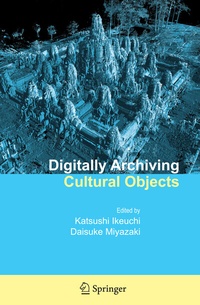
A large number of cultural heritage objects around the world are deteriorating or being destroyed due to the work of natural disasters, such as earthquakes and floods, and human-inflicted destruction, such as war and vandalism. In the wake of these threats, 3D data becomes a critical component to permanently recording the shapes of these important objects so that they might be passed down to future generations.
Digitally Archiving Cultural Objects describes thorough research and methods for preserving cultural heritage objects through the use of 3D digital data. These methods were developed through using computer vision and computer graphics technologies. This data can also be used for simulation and restoration purposes as well as towards various multimedia applications.
This comprehensive book is organized into four parts. Part 1 describes various sensors designed to obtain data. Part 2 contains a collection of papers that describe the geometric pipeline, converting obtained data into a consistent geometric model, through determining relative relations among digital data and connecting those data into a uniform representation. Part 3 concerns photometric issues, including how to map color pictures on a geometric model and how to remove the effect of sunlight in the pictures obtained. Part 4 reports on the effort to establish a digital museum to restore and display the original appearance of heritage objects as well as conduct analyses of obtained data for heritage research.
Language
Place of publication
Publishing group
Illustrations
File size
ISBN-13
978-0-387-75807-7 (9780387758077)
DOI
Schweitzer Classification
Range Sensor.- Shape Rectification of 3D Data Obtained by a Moving Range Sensor by using Image Sequences.- The Climbing Sensor: 3D Modeling of Narrow Areas by Using Space- Time Analysis.- Inverse Polarization Raytracing: Estimating Surface Shapes of Transparent Objects.- Range Data Analysis.- Robust Simultaneous Registration of Multiple Range Images.- A Fast Simultaneous Alignment of Multiple Range Images.- Parallel Alignment of a Large Number of Range Images.- Simultaneous Determination of Registration and Deformation Parameters among 3D Range Images.- Parallel Processing of Range Data Merging.- Adaptively Merging Large-Scale Range Data with Reflectance Properties.- Iterative Refinement of Range Images with Anisotropic Error Distribution.- Hole Filling of 3D Model by Flipping Signs of Signed Distance Field in Adaptive Resolution.- Color Analysis.- Simultaneous Registration of 2D Images onto 3D Models for Texture Mapping.- Consistent Surface Color for Texturing Large Objects in Outdoor Scenes.- Separating Illumination and Surface Spectral from Multiple Color Signals.- Color Constancy through Inverse-Intensity Chromaticity Space.- Separating Reflection Components of Textured Surfaces using a Single Image.- Creating Photorealistic Virtual Model with Polarization-based Vision System.- Digitizing Cultural Heritage.- Classification of Bayon Faces.- Illumination Simulation for Archaeological Investigation.- Editing, Retrieval, and Display System of Archeological Information on Large 3D Geometric Models.- Virtual Asukakyo: Real-time Soft Shadows in Mixed Reality using Shadowing Planes.- Digital Restoration of the Nara Great Buddha.