

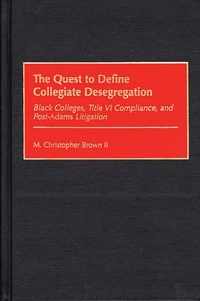
The Quest to Define Collegiate Desegregation
Black Colleges, Title vi Compliance, and Post-Adams Litigation
1st Edition
Published on 30. May 1999
192 pages
978-0-313-00592-3 (ISBN)
Description

In 1954, the United States Supreme Court's ruling in Brown v. Board of Education Topeka (347 U.S. 483) overturned the prevailing doctrine of separate but equal introduced by Plessy v. Ferguson (163 U.S. 537) fifty-eight years prior. By the time Brown was decided, many states had created dual collegiate structures of public education, most of which operated exclusively for Caucasians in one system and African Americans in the other.
Although Brown focused national attention on desegregation in primary and secondary public education, the issue of disestablishing dual systems of public higher education would come to the forefront two years later in Florida ex rel. Hawkins v. Board of Control (350 U.S. 413 [1956]). However, the pressure to dismantle dual systems of public education was not extended to higher education until the passage of the Civil Rights Act of 1964. Despite Title VI of this Act, which stated that No person in the United States shall, on the ground of race, color, or national origin, be excluded from participation in, or be denied the benefits of, or be subjected to discrimination under any program or activity receiving Federal financial assistance, nineteen states continued to operate dual systems of public higher education. The Quest to Define Collegiate Desegregation explores the evolution of the legal standard for collegiate desegregation after Adams v. Richardson (351 F2d 636 [D.C. Cir. 1972]).
Although Brown focused national attention on desegregation in primary and secondary public education, the issue of disestablishing dual systems of public higher education would come to the forefront two years later in Florida ex rel. Hawkins v. Board of Control (350 U.S. 413 [1956]). However, the pressure to dismantle dual systems of public education was not extended to higher education until the passage of the Civil Rights Act of 1964. Despite Title VI of this Act, which stated that No person in the United States shall, on the ground of race, color, or national origin, be excluded from participation in, or be denied the benefits of, or be subjected to discrimination under any program or activity receiving Federal financial assistance, nineteen states continued to operate dual systems of public higher education. The Quest to Define Collegiate Desegregation explores the evolution of the legal standard for collegiate desegregation after Adams v. Richardson (351 F2d 636 [D.C. Cir. 1972]).
More details
Edition
1. Auflage
Language
English
Place of publication
New York
United States
Publishing group
Bloomsbury Publishing Plc
Target group
Interest Age: From 7 to 17 years
ISBN-13
978-0-313-00592-3 (9780313005923)
Copyright in bibliographic data and cover images is held by Nielsen Book Services Limited or by the publishers or by their respective licensors: all rights reserved.
Schweitzer Classification
Other editions
Additional editions
M. Christopher Brown
The Quest to Define Collegiate Desegregation
Black Colleges, Title VI Compliance, and Post-Adams Litigation
Book
05/1999
Praeger Publishers Inc
€78.30
Shipment within 3-4 weeks
Person
M. CHRISTOPHER BROWN II is Assistant Professor of Higher Education in the Department of Educational Organization and Leadership at the University of Illinois at Urbana-Champaign./e Professor Brown has published in the areas of equity and access in postsecondary education.
Content
Foreword by Charles V. Willie
An Introduction to the Quest
Black Colleges and Desegregation
The Unfinished Quest for Compliance
Desegregation Litigation Reborn
Legal Standards for Compliance
Challenges to Compliance
Defining Collegiate Desegregation
Afterword by Robert M. Hendrickson
Appendix A: Glossary of Legal Terms
Appendix B: A Note on Methodology
Bibliography
Index
An Introduction to the Quest
Black Colleges and Desegregation
The Unfinished Quest for Compliance
Desegregation Litigation Reborn
Legal Standards for Compliance
Challenges to Compliance
Defining Collegiate Desegregation
Afterword by Robert M. Hendrickson
Appendix A: Glossary of Legal Terms
Appendix B: A Note on Methodology
Bibliography
Index
