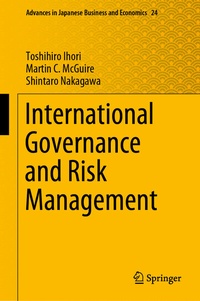
International Governance and Risk Management
Description

In this book the authors demonstrate how the economics of insurance, risk reduction, and damage control or limitation can be combined with concepts of collective choice and collective behavior to improve analysis of the escalating threats faced by alliances throughout the world.
The book develops a theory of risk management as integrating likelihood of loss, magnitude of loss, and isolation from loss into a consolidated model. It extends existing concepts of individual risk management by a single person to decision theory for an entire country, managed by a government bureaucracy and lodged in a universe of overlapping alliances.
The authors uncover a tendency, inherent in any bureaucracy for policy coordination in the realm of risk control to fail because of misunderstanding, disinterest, or perverse incentives. Understanding such incentives is essential to any sort of progress in risk management of proliferating national and global threats.
Self-protection aims to reduce the chances of loss. This reduction may require the use, or threat or promise of use, of defensive military weapons or, depending on context, the use of offensive military weapons. Japan's constitution limits Japan to use of defensive measures only, even if Japan and the USA have formed a military alliance. This places Japan at an "economic corner solution" of providing only self-insurance. However, the Abe government intends to change the interpretation of the constitution so that Japan can provide a full range of self-protection as well as self-insurance. With the prospect of such constitutional change, this book becomes of special relevance to Japan's national security.
More details
Other editions
Additional editions