

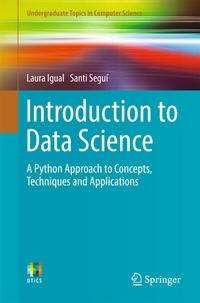
Introduction to Data Science
Description

This accessible and classroom-tested textbook/reference presents an introduction to the fundamentals of the emerging and interdisciplinary field of data science. The coverage spans key concepts adopted from statistics and machine learning, useful techniques for graph analysis and parallel programming, and the practical application of data science for such tasks as building recommender systems or performing sentiment analysis. Topics and features: provides numerous practical case studies using real-world data throughout the book; supports understanding through hands-on experience of solving data science problems using Python; describes techniques and tools for statistical analysis, machine learning, graph analysis, and parallel programming; reviews a range of applications of data science, including recommender systems and sentiment analysis of text data; provides supplementary code resources and data at an associated website.
Reviews / Votes
"This book contains a broad range of timely topics and presents interesting examples on real-life data using Python. . the book is a good addition to references on Python and data science. Students as well as practicing data scientists and engineers will benefit from the many techniques and use cases presented in the book." (Computing Reviews, December, 2017)
"The book 'Introduction to Data Science' is built as a starter presentation of concepts, techniques and approaches that constitute the initial contact with data science for scientists . . The style of the book recommends it to both undergraduates and postgraduates and the concluding remarks and references provide guidance for the next steps in the study of particular topics." (Irina Ioana Mohorianu, zbMATH, Vol. 1365.62003, 2017)More details
Other editions
New editions
Additional editions
Persons
Dr. Laura Igual is an Associate Professor at the Departament de Matemàtiques i Informàtica, Universitat de Barcelona, Spain. Dr. Santi Seguí is an Assistant Professor at the same institution.
The authors wish to mention that some chapters were co-written by Jordi Vitrià, Eloi Puertas, Petia Radeva, Oriol Pujol, Sergio Escalera, Francesc Dantí and Lluís Garrido.
Content
Introduction to Data Science.- Toolboxes for Data Scientists.- Descriptive statistics.- Statistical Inference.- Supervised Learning.- Regression Analysis.- Unsupervised Learning.- Network Analysis.- Recommender Systems.- Statistical Natural Language Processing for Sentiment Analysis.- Parallel Computing.
