

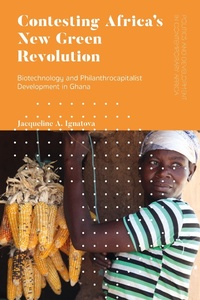
Contesting Africa's New Green Revolution
Biotechnology and Philanthrocapitalist Development in Ghana
1st Edition
Published on 20. May 2021
216 pages
978-1-78699-658-9 (ISBN)
Description

Genetically modified crops have become a key element of development
strategies across the Global South, despite remaining deeply controversial. Proponents hail them as an example of 'pro-poor' innovation, while critics regard them as a threat to food sovereignty and the environment. The promotion
of biotechnology is an integral part of 'new Green Revolution for Africa' interventions and is also intimately linked to the rise of 'philanthrocapitalism,' which advances business solutions to address the problem of poverty.
Through interviews with farmers, policymakers and agricultural scientists, Jacqueline Ignatova shows how efforts to transform the seed sector in northern Ghana - one of the key laboratories of this 'new Green Revolution' - may serve to exacerbate the inequality it was notionally intended to address. But she also argues that its effects in Ghana have been far more complex than either side of the debate has acknowledged, with local farmers proving adept at blending traditional and modern agricultural methods that subvert the interests of global agribusiness.
strategies across the Global South, despite remaining deeply controversial. Proponents hail them as an example of 'pro-poor' innovation, while critics regard them as a threat to food sovereignty and the environment. The promotion
of biotechnology is an integral part of 'new Green Revolution for Africa' interventions and is also intimately linked to the rise of 'philanthrocapitalism,' which advances business solutions to address the problem of poverty.
Through interviews with farmers, policymakers and agricultural scientists, Jacqueline Ignatova shows how efforts to transform the seed sector in northern Ghana - one of the key laboratories of this 'new Green Revolution' - may serve to exacerbate the inequality it was notionally intended to address. But she also argues that its effects in Ghana have been far more complex than either side of the debate has acknowledged, with local farmers proving adept at blending traditional and modern agricultural methods that subvert the interests of global agribusiness.
Reviews / Votes
Ignatova's important book illuminates profound problems with public-private partnerships that skirt democratic accountability and empower wealthy interests at the expense of local communities. But it's not a despairing account: she centres Ghanaian activists and policy-makers who are pioneering a new type of philanthropy, one emphasizing interdependency and social justice over anti-democratic efforts to privatize seed commons. A revelatory and insightful study. * Professor Linsey McGoey, University of Essex, UK * Like a combine through a field of genetically modified maize, Jacqueline Ignatova cuts through the rhetoric surrounding the 'Green Revolution for Africa' to reveal the underlying power, politics and inequities that shape agricultural development in contemporary Ghana. Full of rich empirics and analytical insights, this book is essential reading for those seeking a comprehensive understanding of how public-private partnerships and philanthropy-driven initiatives are reshaping smallholder agriculture across the African continent. * Marcus Taylor, Associate Professor & Head of Department, Global Development Studies, Queen's University, Canada *More details
Series
Edition
1. Auflage
Language
English
Place of publication
United Kingdom
Publishing group
Bloomsbury Publishing PLC
Target group
College/higher education
ISBN-13
978-1-78699-658-9 (9781786996589)
Copyright in bibliographic data and cover images is held by Nielsen Book Services Limited or by the publishers or by their respective licensors: all rights reserved.
Schweitzer Classification
Other editions
Additional editions

Jacqueline A. Ignatova
Contesting Africa's New Green Revolution
Biotechnology and Philanthrocapitalist Development in Ghana
Book
12/2022
Zed Books Ltd
€55.95
Shipment within 3-4 weeks
Person
Jacqueline A. Ignatova is an Assistant Professor of Sustainable Development at Appalachian State University in North Carolina, USA. She is vice chair of the board of F.A.R.M. (Feed All Regardless of Means) Cafe and a co-founder of the Watauga Seed Library in Boone, North Carolina. Her work has been featured in Third World Quarterly and African and Black Diaspora: An International Journal.
Content
Acknowledgments
List of abbreviations
Preface
Introduction
Chapter 1: Green Revolution discourse, structural adjustment, and the "enabling environment" for agribusiness
Chapter 2: Philanthrocapitalism and the politics of public-private partnerships
Chapter 3: Biocapital, "pro-poor" biotechnology, and legislative changes in the seed sector
Chapter 4: Technological savior or terminator gene? Biotechnology, food security, and the political economy of hype
Chapter 5: Experts, entrepreneurs, and the "last mile user"
Interlude: On "mixing"
Chapter 6: Neocolonial anxieties
Conclusion
List of abbreviations
Preface
Introduction
Chapter 1: Green Revolution discourse, structural adjustment, and the "enabling environment" for agribusiness
Chapter 2: Philanthrocapitalism and the politics of public-private partnerships
Chapter 3: Biocapital, "pro-poor" biotechnology, and legislative changes in the seed sector
Chapter 4: Technological savior or terminator gene? Biotechnology, food security, and the political economy of hype
Chapter 5: Experts, entrepreneurs, and the "last mile user"
Interlude: On "mixing"
Chapter 6: Neocolonial anxieties
Conclusion
