

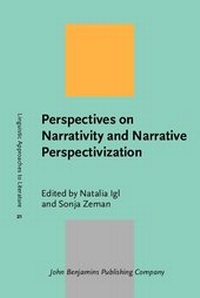
Perspectives on Narrativity and Narrative Perspectivization
1st Edition
Published on 15. March 2016
VII, 182 pages
978-90-272-6744-3 (ISBN)
Description

The book offers a novel approach to the question of how to model narrativity against the background of perspectivization. By bringing together contributions from cognitive and neurolinguistics, literary studies, and picture theory, the volume uncovers basic mechanisms of perspectivization that are common to the different levels of linguistic structure, literary novels, and narrative pictures. As such, it is also a book on narrative perspectivization since its contributions examine in detail the perspectival principles in medieval, romantic and postmodern literature, in the micro-linguistic structure of language, narrative pictures, literary novels, dramatic texts, and everyday stories. In doing so, it contributes both to the theoretical debate on the core definition of narrativity and offers new empirical investigations on perspectival principles in specific historical, medial, and genre constellations. This volume will be of interest to scholars and students of cognitive linguistics, narrative research and (transmedial) narratology, cognitive poetics, and stylistics.
More details
Other editions
Additional editions
Natalia Igl | Sonja Zeman
Perspectives on Narrativity and Narrative Perspectivization
Book
03/2016
John Benjamins Publishing Co
€100.70
Shipment within 10-15 days
Persons
Content
- Intro
- Perspectives on Narrativity and Narrative Perspectivization
- Editorial page
- Title page
- LCC data
- Table of contents
- Preface and Acknowledgements
- Introduction
- 1. The perspectival character of narrativity
- 2. Perspectives on narrativity
- 2.1 Narrativity as a perspectival constellation
- 2.2 Narrativity as a recursive property
- 2.3 Narrativity as a dynamic configuration
- 3. Narrative perspectivization
- 4. The perspectives of the volume
- References
- Part I: Cognitive-linguistic perspectives
- Perspectivization as a link between narrative micro- and macro-structure
- 1. Why are narratives special?
- 2. The core principle of perspectivization
- 3. Perspectivization on the linguistic micro-structure
- 3.1 Temporal perspectivization and the "Jekyll-and-Hyde effect"
- 3.2 Perspectivization vs. deixis
- 3.3 Effects on the textual level: The double-layered structure of discourse
- 4. The double-layered structure of narrative discourse
- 5. Recursive embedding and the emerging story: The case of Nabokov's Lolita
- 5.1 Viewpoint multiplication: Who speaks and who perceives?
- 5.2 The epistemic path, or: What do we really know about Lolita?
- 6. Conclusion: The characteristics of narrative structure
- References
- Presenting narration
- 1. Introduction
- 2. The data: Paving the way
- 2.1 Renarrative
- 2.2 Tripartite article
- 3. Semantics: Referential anchoring
- 3.1 Renarrative
- 3.2 Tripartite article
- 4. Discourse-pragmatics: Perspectival effects
- 4.1 Deixis - point of view - perspectivity
- 4.2 Renarrative
- 4.3 Tripartite article
- 5. Narrativity: Presenting narration
- 5.1 Renarrative
- 5.2 Tripartite article
- 6. Summary
- References
- Neurolinguistic view into narrative processing
- 1. A neurolinguistic path to narrativity
- 2. Processing of macro-structures in neurologic patients
- 2.1 Influence of executive function on language processing
- 2.2 Narrative processing in acquired language disorders
- 3. Psycholinguistic models of narrative processing
- 4. Exploring the cognitive-linguistic interface of narratives
- 4.1 Procedure
- 4.2 Participants
- 4.3 Impact of cognitive functions on narrative processing
- 4.3.1 Narrative text comprehension
- 4.3.2 Narrative text production
- 5. Conclusion
- References
- Appendix
- Part II: Literary and transmedial perspectives
- The double-layered structure of narrative discourse and complex strategies of perspectivization
- 1. Starting point: Distance, perspective, and "meta"
- 2. A three-staged model of narrative communication
- 3. Exemplary analysis of complex forms of perspectivization in narrative
- 3.1 Meta-discursive strategies in E.T.A. Hoffmann's The Golden Pot
- 3.2 Bridging the gap between narrator and narratee - Wolf Haas' metanarrative detective novels
- 4. Conclusion
- Primary Sources
- References
- Narrator and narrative space in Middle High German epic poetry (Parzival, Ehescheidungsgespräch, Prosalancelot)
- 1. The fundamental difference between modern and medieval storytelling
- 2. The emergence of vernacular script-based storytelling at the end of the 12th century
- 3. The differentiation of the fundamental form of courtly storytelling in the 13th century
- 3.1 Wolfram's Parzival
- 3.2 The Stricker: Ehescheidungsgespräch
- 3.3 Prosalancelot
- 4. Outlook
- Seeing or meaning?
- 1. Perspective as a visual and analytical term
- 2. Pfister's concept of perspective in drama
- 3. Play within the play revealing dramatic perspectivization
- 4. Linking macro- and micro-structure
- 4.1 Catharina von Georgien
- 4.2 Prince Friedrich von Homburg
- 4.3 The God of Carnage
- 5. Conclusion
- Primary sources
- References
- Pictorial narrativity
- 1. Introduction
- 2. The critical arguments and their presuppositions
- 2.1 The presupposed concepts of narrativity
- 2.2 The presupposed characterizations of the pictorial medium
- 3. Conditions for pictorial narrativity
- 3.1 The "suitable relation" and its reasons
- 3.2 The fruitful moment
- 4. Narrative stimuli in different types of pictures
- 4.1 Narrative stimuli in single pictures
- 4.2 Narrative stimuli in multiphase pictures and picture series
- 5. Conclusion
- References
- Index
