

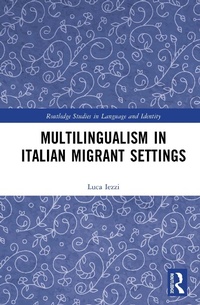
Multilingualism in Italian Migrant Settings
1st Edition
Published on 26. September 2024
158 pages
978-1-040-11397-4 (ISBN)
Description

Multilingualism in Italian Migrant Settings investigates the plural linguistic practices of the migrants in a particular refugee centre in Italy, the CAS (centri di accoglienza straordinaria; "extraordinary refugee centre").
This book offers a practical and rigorous study of contact situations surrounding migrants from areas with complex repertoires. Language is inherently connected to migration, especially through its role as a principal tool for communication.
This volume places multilingualism in migratory contexts to comprehend how plurilingual migrants move freely between languages, and to evaluate their role in the linguistic landscape of the host country.
This monograph will appeal to scholars specialising in sociolinguistics and contact linguistics. The volume will also be informative for postgraduate students in the field of sociolinguistics, with a focus on migration and language use.
This book offers a practical and rigorous study of contact situations surrounding migrants from areas with complex repertoires. Language is inherently connected to migration, especially through its role as a principal tool for communication.
This volume places multilingualism in migratory contexts to comprehend how plurilingual migrants move freely between languages, and to evaluate their role in the linguistic landscape of the host country.
This monograph will appeal to scholars specialising in sociolinguistics and contact linguistics. The volume will also be informative for postgraduate students in the field of sociolinguistics, with a focus on migration and language use.
More details
Series
Edition
1. Auflage
Language
English
Place of publication
London
United Kingdom
Publishing group
Taylor & Francis Ltd
Target group
College/higher education
Professional and scholarly
Illustrations
20 Tables, black and white; 22 Line drawings, black and white; 15 Halftones, black and white; 37 Illustrations, black and white
ISBN-13
978-1-040-11397-4 (9781040113974)
Copyright in bibliographic data and cover images is held by Nielsen Book Services Limited or by the publishers or by their respective licensors: all rights reserved.
Schweitzer Classification
Other editions
Additional editions
Luca Iezzi
Multilingualism in Italian Migrant Settings
Book
09/2024
1st Edition
Routledge
€184.80
Shipment within 10-20 days
Luca Iezzi
Multilingualism in Italian Migrant Settings
Book
09/2024
1st Edition
Taylor & Francis Group
€63.10
Shipment within 10-20 days
Person
Luca Iezzi is a postdoctoral fellow at "G. d'Annunzio" University of Chieti-Pescara (Italy). His major research interests include the sociolinguistics of immigration in Italy, contact phenomena in spoken and written communication, as well as maintenance and shift of minority languages in societal and educational contexts. He has authored various research articles and book chapters on these topics. He has also taught English, and holds several Cambridge TESOL certifications.
Content
List of figures and tables
Acknowledgements
INTRODUCTION: Beyond borders: global changes and linguistic challenges in migratory contexts
CHAPTER 1: The European migrant crisis
1.1 Migrations and migratory policies in Europe
1.2 Unauthorised migrations in Italy
1.3 Migration and language
CHAPTER 2: The sociolinguistics of (im)migration
2.1 Multilingualism, speech community, and repertoires
2.2 The sociolinguistics of (im)migration across time and space
2.3 Multilingualism in postcolonial countries
2.4 Status and function of a language
2.4.1 Geopolitical factors
2.4.2 Socio-demographical factors
2.4.3 Linguistic factors
2.5 Language ideologies and attitudes
CHAPTER 3: Language contact
3.1 Language maintenance and shift
3.2 Contact in speech
3.2.1 Structural approaches to CS
3.2.2 Functional approaches to CS
3.3 From CS to grammaticalisation
3.4 Contact in language
3.4.1 Matter replication
3.4.2 At the boundary between switching and matter replication
3.4.3 Pattern replication
3.5 Structure, function and cognition: the usage-based approach
CHAPTER 4: Linguistic ethnography and multilingualism
4.1 Objectives of the research
4.1.1 Research methods
4.2 Data transcription
4.2.1 Language transcription
4.2.2 Graphic and phonetic correspondences
4.2.3 Morphemic glossing
4.3 The pilot study
4.3.1 The CAS
4.3.2 Methodology
4.3.3 Data analysis
4.3.4 Discussion
4.4 The main study
4.4.1 Informants and linguistic biographies
4.4.2 Other subjects
CHAPTER 5: The urban variety of Punjabi
5.1 Population in Pakistan
5.2 The languages of the Pakistan
5.2.1 English, the conquerors' language
5.2.2 The privileging of Urdu as national language
5.2.3 Urdu and Punjabi
5.3 Urban Punjabi
5.3.1 Borrowing vs CS
5.3.2 Instances of switching phenomena within the urban variety
5.4 Discussion
CHAPTER 6: Italian within the speech community
6.1 Code choice in the CAS (centro di accoglienza straordinaria)
6.2 Instances of code mixing within the urban variety
6.3 Discussion
CHAPTER 7: Ideologies and attitudes
7.1 Language proficiency in the CAS(centro di accoglienza straordinaria)
7.2 Interviews
7.3 Ideologies and attitudes
7.3.1 Urdu
7.3.2 English
7.3.3 Italian
7.3.4 Minority languages
7.4 Some reflections on the linguistic repertoire of the migrants
CONCLUSIONS: Beyond challenge: understanding multilingualism in a time of change
References
Appendix I: Questionnaire
Appendix II: GDPR
Index
Acknowledgements
INTRODUCTION: Beyond borders: global changes and linguistic challenges in migratory contexts
CHAPTER 1: The European migrant crisis
1.1 Migrations and migratory policies in Europe
1.2 Unauthorised migrations in Italy
1.3 Migration and language
CHAPTER 2: The sociolinguistics of (im)migration
2.1 Multilingualism, speech community, and repertoires
2.2 The sociolinguistics of (im)migration across time and space
2.3 Multilingualism in postcolonial countries
2.4 Status and function of a language
2.4.1 Geopolitical factors
2.4.2 Socio-demographical factors
2.4.3 Linguistic factors
2.5 Language ideologies and attitudes
CHAPTER 3: Language contact
3.1 Language maintenance and shift
3.2 Contact in speech
3.2.1 Structural approaches to CS
3.2.2 Functional approaches to CS
3.3 From CS to grammaticalisation
3.4 Contact in language
3.4.1 Matter replication
3.4.2 At the boundary between switching and matter replication
3.4.3 Pattern replication
3.5 Structure, function and cognition: the usage-based approach
CHAPTER 4: Linguistic ethnography and multilingualism
4.1 Objectives of the research
4.1.1 Research methods
4.2 Data transcription
4.2.1 Language transcription
4.2.2 Graphic and phonetic correspondences
4.2.3 Morphemic glossing
4.3 The pilot study
4.3.1 The CAS
4.3.2 Methodology
4.3.3 Data analysis
4.3.4 Discussion
4.4 The main study
4.4.1 Informants and linguistic biographies
4.4.2 Other subjects
CHAPTER 5: The urban variety of Punjabi
5.1 Population in Pakistan
5.2 The languages of the Pakistan
5.2.1 English, the conquerors' language
5.2.2 The privileging of Urdu as national language
5.2.3 Urdu and Punjabi
5.3 Urban Punjabi
5.3.1 Borrowing vs CS
5.3.2 Instances of switching phenomena within the urban variety
5.4 Discussion
CHAPTER 6: Italian within the speech community
6.1 Code choice in the CAS (centro di accoglienza straordinaria)
6.2 Instances of code mixing within the urban variety
6.3 Discussion
CHAPTER 7: Ideologies and attitudes
7.1 Language proficiency in the CAS(centro di accoglienza straordinaria)
7.2 Interviews
7.3 Ideologies and attitudes
7.3.1 Urdu
7.3.2 English
7.3.3 Italian
7.3.4 Minority languages
7.4 Some reflections on the linguistic repertoire of the migrants
CONCLUSIONS: Beyond challenge: understanding multilingualism in a time of change
References
Appendix I: Questionnaire
Appendix II: GDPR
Index
