

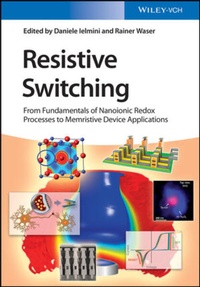
Resistive Switching
From Fundamentals of Nanoionic Redox Processes to Memristive Device Applications
1st Edition
Published on 28. December 2015
XXVI, 755 pages
978-3-527-68094-8 (ISBN)
Description

With its comprehensive coverage, this reference introduces readers to the wide topic of resistance switching, providing the knowledge, tools, and methods needed to understand, characterize and apply resistive switching memories.
Starting with those materials that display resistive switching behavior, the book explains the basics of resistive switching as well as switching mechanisms and models. An in-depth discussion of memory reliability is followed by chapters on memory cell structures and architectures, while a section on logic gates rounds off the text.
An invaluable self-contained book for materials scientists, electrical engineers and physicists dealing with memory research and development.
Starting with those materials that display resistive switching behavior, the book explains the basics of resistive switching as well as switching mechanisms and models. An in-depth discussion of memory reliability is followed by chapters on memory cell structures and architectures, while a section on logic gates rounds off the text.
An invaluable self-contained book for materials scientists, electrical engineers and physicists dealing with memory research and development.
More details
Other editions
Additional editions
Daniele Ielmini | Rainer Waser
Resistive Switching
From Fundamentals of Nanoionic Redox Processes to Memristive Device Applications
Book
02/2016
1st Edition
Wiley-VCH
€219.00
Article exhausted; check different version
Daniele Ielmini | Rainer Waser
Resistive Switching
From Fundamentals of Nanoionic Redox Processes to Memristive Device Applications
Software
01/2016
Wiley-VCH
€305.65
No shipping information available
Persons
Daniele Ielmini is associate professor in the Department of Electrical Engineering, Information Science and Bioengineering, Politecnico di Milano, Italy. He obtained his Ph.D. in Nuclear Engineering from Politecnico di Milano in 2000. He held visiting positions at Intel and Stanford University in 2006. His research group investigates emerging device technologies, such as phase change memory (PCM) and resistive switching memory (ReRAM) for both memory and computing applications. He has authored six book chapters, more than 200 papers published in international journals and presented at international conferences, and four patents to his name. Professor Ielmini received the Intel Outstanding Research Award in 2013 and the ERC Consolidator Grant in 2014.
Rainer Waser is professor at the faculty for Electrical Engineering and Information Technology at the RWTH Aachen University and director at the Peter Grünberg Institute at the Forschungszentrum Jülich (FZJ), Germany. His research group is focused on fundamental aspects of electronic materials and on such integrated devices as nonvolatile memories, logic devices, sensors and actuators.
Professor Waser has published about 500 technical papers. Since 2003, he has been the coordinator of the research program on nanoelectronic systems within the Germany national research centres in the Helmholtz Association. In 2007, he has been co-founder of the Jülich-Aachen Research Alliance, section Fundamentals of Future Information Technology (JARA-FIT). In 2014, he was awarded the Gottfried Wilhelm Leibniz Prize of the Deutsche Forschungsgemeinschaft and the Tsungming Tu Award of the Ministry of Science and Technology of Taiwan.
Rainer Waser is professor at the faculty for Electrical Engineering and Information Technology at the RWTH Aachen University and director at the Peter Grünberg Institute at the Forschungszentrum Jülich (FZJ), Germany. His research group is focused on fundamental aspects of electronic materials and on such integrated devices as nonvolatile memories, logic devices, sensors and actuators.
Professor Waser has published about 500 technical papers. Since 2003, he has been the coordinator of the research program on nanoelectronic systems within the Germany national research centres in the Helmholtz Association. In 2007, he has been co-founder of the Jülich-Aachen Research Alliance, section Fundamentals of Future Information Technology (JARA-FIT). In 2014, he was awarded the Gottfried Wilhelm Leibniz Prize of the Deutsche Forschungsgemeinschaft and the Tsungming Tu Award of the Ministry of Science and Technology of Taiwan.
Content
INTRODUCTION
TRANSITION METAL OXIDES
Atomic Structures of Selected Binary, Ternary Oxides
Deposition Techniques
Thermodynamics of Oxidation, Ellingham Diagram
Electronic Structure and Conduction
Correlated Electrons
Ionic Conduction
RESISTIVE SWITCHING
Device Structure
Unipolar Switching: Forming, Set/Reset Operations
Bipolar Switching: Forming, Set/Reset Operations
Coexistence of Unipolar/Bipolar Switching
Filamentary Switching and Atomic Force Microscopy Analysis
Interface Switching
Threshold and Memory Switching
Time Dependence of Set/Reset
Resistance Dependence of Set/Reset
SWITCHING MECHANISMS AND MODELS
Unipolar Switching: Set/Reset Mechanisms and Models
Bipolar Switching: Set/Reset Mechanisms and Models
Modeling of Resistance Dependence (Filament Size and Gap)
Modeling of Time Dependence
Modeling of Set Current Dependence
Overshoot and Parasitic Effects
Material Dependence and Universal Switching
MEMORY RELIABILITY
Read Disturb and The Time-Voltage Dilemma
Data Retention
1/f and Random Telegraph Signal Noise
Switching Variability and Set/Reset Algorithms
Reset Current Reduction
Set/Reset Instability
Cycling Endurance
MEMORY CELL STRUCTURES
MIM Structures
Bilayered Structures
Lighting-Rod Structures
Contact RRAM
Complementary Resistance Switch (CRS)
Multilevel Cells
Alternative Materials: OxRRAM, PoRRAM, CBRAM
Bottom-Up Approaches: Nanotubes, Nanowires and Self-Assembly
MEMORY ARCHITECTURES
Crossbar Array
Diode Selectors
Transistor Selectors
1T1R Architectures
CMOL
Scaling Issues (Series Resistance, Programming Cross Talk, 3D Stacking Issues)
LOGIC GATES
The Memristor
Crossbar Latch
Data Restoration
IMP Function
STDP in Memristor Gates
CONCLUSIONS
TRANSITION METAL OXIDES
Atomic Structures of Selected Binary, Ternary Oxides
Deposition Techniques
Thermodynamics of Oxidation, Ellingham Diagram
Electronic Structure and Conduction
Correlated Electrons
Ionic Conduction
RESISTIVE SWITCHING
Device Structure
Unipolar Switching: Forming, Set/Reset Operations
Bipolar Switching: Forming, Set/Reset Operations
Coexistence of Unipolar/Bipolar Switching
Filamentary Switching and Atomic Force Microscopy Analysis
Interface Switching
Threshold and Memory Switching
Time Dependence of Set/Reset
Resistance Dependence of Set/Reset
SWITCHING MECHANISMS AND MODELS
Unipolar Switching: Set/Reset Mechanisms and Models
Bipolar Switching: Set/Reset Mechanisms and Models
Modeling of Resistance Dependence (Filament Size and Gap)
Modeling of Time Dependence
Modeling of Set Current Dependence
Overshoot and Parasitic Effects
Material Dependence and Universal Switching
MEMORY RELIABILITY
Read Disturb and The Time-Voltage Dilemma
Data Retention
1/f and Random Telegraph Signal Noise
Switching Variability and Set/Reset Algorithms
Reset Current Reduction
Set/Reset Instability
Cycling Endurance
MEMORY CELL STRUCTURES
MIM Structures
Bilayered Structures
Lighting-Rod Structures
Contact RRAM
Complementary Resistance Switch (CRS)
Multilevel Cells
Alternative Materials: OxRRAM, PoRRAM, CBRAM
Bottom-Up Approaches: Nanotubes, Nanowires and Self-Assembly
MEMORY ARCHITECTURES
Crossbar Array
Diode Selectors
Transistor Selectors
1T1R Architectures
CMOL
Scaling Issues (Series Resistance, Programming Cross Talk, 3D Stacking Issues)
LOGIC GATES
The Memristor
Crossbar Latch
Data Restoration
IMP Function
STDP in Memristor Gates
CONCLUSIONS
