

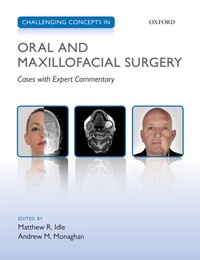
Challenging Concepts in Oral and Maxillofacial Surgery
Cases with Expert Commentary
1st Edition
Published on 18. February 2016
288 pages
978-0-19-166327-7 (ISBN)
Description

Challenging Concepts in Oral and Maxillofacial Surgery details over 25 challenging and complex scenarios matched to the OMFS syllabus including frontal sinus fractures, reconstructive challenges following blast injuries to the facial soft tissue and skeleton, and reratocystic odontogenic tumours.
This case-based learning book is designed to be used by trainees and speciality registrars. Each case is supported by the commentary of a renowned expert in the field, allowing readers to improve their own management of these patients.
As the reader works through each case there are 'Clinical Tips', 'Learning Points' and 'Evidence Base' boxes to enhance the learning process along with the 'Expert Commentary', providing an inside track on how the experts approach challenging cases.
The range of topics discussed including three complex battlefield cases will be essential reading for trainees in oral and maxillofacial surgery and related specialties, such as otolaryngology, oral surgery, orthodontics, and dentistry.
More details
Other editions
Additional editions
Matthew R. Idle | Andrew M. Monaghan
Challenging Concepts in Oral and Maxillofacial Surgery
Cases with Expert Commentary
Book
02/2016
1st Edition
Oxford University Press
€91.50
Shipment within 15-20 days
Persons
Matthew Idle is Specialist Registrar in Oral and Maxillofacial Surgery at the West Midlands Deanery and Queen Elizabeth Hospital Birmingham, UK
Andrew Monaghan is Consultant Oral and Maxillofacial Surgeon at Birmingham Children's Hospital NHS Trust and is Group Captain in the Royal Air Force, Royal Centre for Defence Medicine, UK.
Content
- Head and neck oncology
- 1: Hiba Aga ,Laith Al-Qamachi, Matthew Idle, and Nicholas Grew: Complex midface reconstruction following tumour ablation
- 2: Chris Fowell and Khaleeq-Ur Rehman: Challenging Concepts in Oral and Maxillofacial Surgery
- 3: Anwer Abdullakutty, Jacob D'Souza, and Simon Rogers: Management of osteoradionecrosis of the mandible
- Cranio-maxillofacial trauma
- 4: Rabindra Singh and Lachlan Carter: Frontal sinus fractures
- 5: Richard Burnham and Christopher Bridle: Management of panfacial injuries: top down or bottom upa
- 6: Richard Burnham and Christopher Bridle: Adult orbital wall fracture repair
- 7: Douglas Hammond and Ahmed Messahel: Biomechanics of the mandible and current evidence for treatment of the fractured mandible
- Military maxillofacial trauma
- 8: Johno Breeze, Sat Parmar, and Andrew Monaghan: High-energy ballistic injuries to the face
- 9: Kevin McMillan and Timothy Martin: Reconstructive challenges following blast injuries to the facial soft tissue and skeleton
- 10: Johno Breeze, Andrew Gibbons, and Ian Sharp: Low-energy explosive fragmentation injuries to the neck and face
- Craniofacial surgery
- 11: Luke Williams, Francine Ryba, and Robert Bentley: Cranial vault reconstruction following decompressive craniectomy
- 12: Matthew Idle and Andrew Monaghan: Distraction osteogenesis: a reconstructive option
- 13: Neil Opie and Martin Evans: Posterior calvarial osseodistraction for syndromic craniosynostoses
- Orthognathic surgery
- 14: Barbara Gerber and Andrew Currie: The anterior open bite
- 15: Lisa Greaney, Ken Sneddon, and Jeremy Collyer: Severe class II skeletal deformity
- 16: Nabeela Ahmed and Dilip Srinivasan: The segmental maxillary osteotomy
- Temporomandibular joint disease
- 17: Nabeela Ahmed and Andrew Sidebottom: TMJ replacement
- 18: Alan Attard and Jason Green: Osteochondroma of the mandibular condyle / temporo-mandibular joint
- 19: Grigore Mihalache and Ahmed Messahel: Management of the Wilkes Grade III TMJ
- Salivary gland
- 20: Jahrad Haq and Mark. McGurk: Salivary calculi
- Dentoalveolar surgery
- 21: Matthew Idle and Stephen Dover: Sagittal split osteotomy for the removal of a lower third molar
- 22: Elizabeth Gruber and Graham James: Implant restoration of the atrophic maxilla with concurrent mandibular rehabilitation
- 23: Alan Parbhoo and Mike Simpson: Keratocystic odontogenic tumours (KCOT) and orthokeratinised odontogenic cysts (OKOC)
- Paediatric maxillofacial surgery
- 24: Kevin McMillan and Rhodri Williams: Paediatric temporo-mandibular joint ankylosis
- 25: Chris Sweet and Simon Van Eeden: Cleft palate related velopharyngeal incompetence
- 26: Suraj Thomas, Ujam Atheer, and Simon Holmes: Paediatric maxillofacial trauma
