

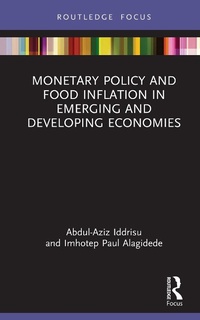
Monetary Policy and Food Inflation in Emerging and Developing Economies
1st Edition
Published on 23. November 2021
120 pages
978-1-000-52842-8 (ISBN)
Description

This book focuses on the impact of monetary policy and food price volatility and inflation in emerging and developing economies.
The tendency for food price volatility to blot inflation forecasting accuracy, engender tail dynamics in the overall inflation trajectory and derail economic welfare is well known in the literature. The ability of monetary policy to exact stability in food prices, theoretically, has also been well espoused. The empirical evidence, however, is not only in short supply, but also the studies available have dwelt on approaches that underplay the volatile behaviour of food prices. This book focuses on inflation targeting in emerging economies such as Chile, Mexico, Turkey, Brazil, Hungary, Russia, Colombia, South Africa, Indonesia and Ghana, as these are economies with considerable proportion of the consumption basket occupied by food. The book provides the means to understand at first hand the correct way to model food inflation, account for the related policy responses to deviations either in the short or medium to long term, and in market conditions that are subject to excessive variability. Strong evidence is presented that captures deviations of food prices from their trend and the accompanying monetary policy effect in stabilizing such variabilities across distinct frequencies. The novel approach in this book addresses the burgeoning puzzles of asymmetry in monetary policy effect on food prices at high, medium and low episodes of food inflation. In doing so, this book presents a powerful tool for researchers interested in understanding not just the transmission mechanism, but also the magnitudes involved, and to policymakers whose existing tools have failed them. Future studies will do well to deepen the evidence and seek new grounds to which the phenomenon manifests beyond and below emerging markets.
This book will be of great interest to students, scholars and policymakers involved in agricultural economics, financial economics, food security and sustainable development.
The tendency for food price volatility to blot inflation forecasting accuracy, engender tail dynamics in the overall inflation trajectory and derail economic welfare is well known in the literature. The ability of monetary policy to exact stability in food prices, theoretically, has also been well espoused. The empirical evidence, however, is not only in short supply, but also the studies available have dwelt on approaches that underplay the volatile behaviour of food prices. This book focuses on inflation targeting in emerging economies such as Chile, Mexico, Turkey, Brazil, Hungary, Russia, Colombia, South Africa, Indonesia and Ghana, as these are economies with considerable proportion of the consumption basket occupied by food. The book provides the means to understand at first hand the correct way to model food inflation, account for the related policy responses to deviations either in the short or medium to long term, and in market conditions that are subject to excessive variability. Strong evidence is presented that captures deviations of food prices from their trend and the accompanying monetary policy effect in stabilizing such variabilities across distinct frequencies. The novel approach in this book addresses the burgeoning puzzles of asymmetry in monetary policy effect on food prices at high, medium and low episodes of food inflation. In doing so, this book presents a powerful tool for researchers interested in understanding not just the transmission mechanism, but also the magnitudes involved, and to policymakers whose existing tools have failed them. Future studies will do well to deepen the evidence and seek new grounds to which the phenomenon manifests beyond and below emerging markets.
This book will be of great interest to students, scholars and policymakers involved in agricultural economics, financial economics, food security and sustainable development.
More details
Series
Edition
1. Auflage
Language
English
Place of publication
London
United Kingdom
Publishing group
Taylor & Francis Ltd
Target group
College/higher education
Illustrations
33 Tables, black and white; 31 Line drawings, black and white; 31 Illustrations, black and white
ISBN-13
978-1-000-52842-8 (9781000528428)
Copyright in bibliographic data and cover images is held by Nielsen Book Services Limited or by the publishers or by their respective licensors: all rights reserved.
Schweitzer Classification
Other editions
Additional editions
Abdul-Aziz Iddrisu | Imhotep Paul Alagidede
Monetary Policy and Food Inflation in Emerging and Developing Economies
Book
05/2023
1st Edition
Routledge
€32.80
Shipment within 10-20 days
Abdul-Aziz Iddrisu | Imhotep Paul Alagidede
Monetary Policy and Food Inflation in Emerging and Developing Economies
Book
11/2021
1st Edition
Routledge
€76.70
Shipment within 10-20 days
Persons
Abdul-Aziz Iddrisu is a Senior Lecturer in the Department of Banking Technology and Finance at Kumasi Technical University, Ghana.
Imhotep Paul Alagidede is a Metaeconomist at the Nile Valley Multiversity, and Professor of Finance at the Wits Business School at the University of the Witwatersrand, South Africa, and SDD-UBIDS at Wa, Ghana.
Imhotep Paul Alagidede is a Metaeconomist at the Nile Valley Multiversity, and Professor of Finance at the Wits Business School at the University of the Witwatersrand, South Africa, and SDD-UBIDS at Wa, Ghana.
Content
1. Introduction and background to the study 2. Inflation targeting framework in emerging and developing economies: experiences and milestones 3. World food price paths, domestic food and overall prices and monetary policy conduct 4. Monetary policy and food price inflation: a wavelet-based quantile regression analysis 5. Summary and conclusion
