

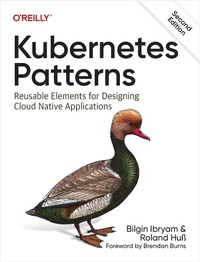
Kubernetes Patterns
Description

The way developers design, build, and run software has changed significantly with the evolution of microservices and containers. These modern architectures offer new distributed primitives that require a different set of practices than many developers, tech leads, and architects are accustomed to. With this focused guide, Bilgin Ibryam and Roland Huss provide common reusable patterns and principles for designing and implementing cloud native applications on Kubernetes.
Each pattern includes a description of the problem and a Kubernetes-specific solution. All patterns are backed by and demonstrated with concrete code examples. This updated edition is ideal for developers and architects familiar with basic Kubernetes concepts who want to learn how to solve common cloud native challenges with proven design patterns.
You''ll explore:
- Foundational patterns covering core principles and practices for building and running container-based cloud native applications
- Behavioral patterns that delve into finer-grained concepts for managing various types of container and platform interactions
- Structural patterns for organizing containers within a Pod for addressing specific use cases
- Configuration patterns that provide insight into how application configurations can be handled in Kubernetes
- Security patterns for hardening the access to cloud native applications running on KubernetesAdvanced patterns covering more complex topics such as operators and autoscaling
More details
Other editions
Additional editions
Content
- Cover
- Copyright
- Table of Contents
- Foreword
- Preface
- Kubernetes
- Design Patterns
- How This Book Is Structured
- Who This Book Is For
- What You Will Learn
- What's New in the Second Edition
- Conventions Used in This Book
- Using Code Examples
- O'Reilly Online Learning
- How to Contact Us
- Acknowledgments
- Chapter 1. Introduction
- The Path to Cloud Native
- Distributed Primitives
- Containers
- Pods
- Services
- Labels
- Namespaces
- Discussion
- More Information
- Part I. Foundational Patterns
- Chapter 2. Predictable Demands
- Problem
- Solution
- Runtime Dependencies
- Resource Profiles
- Pod Priority
- Project Resources
- Capacity Planning
- Discussion
- More Information
- Chapter 3. Declarative Deployment
- Problem
- Solution
- Rolling Deployment
- Fixed Deployment
- Blue-Green Release
- Canary Release
- Discussion
- More Information
- Chapter 4. Health Probe
- Problem
- Solution
- Process Health Checks
- Liveness Probes
- Readiness Probes
- Startup Probes
- Discussion
- More Information
- Chapter 5. Managed Lifecycle
- Problem
- Solution
- SIGTERM Signal
- SIGKILL Signal
- PostStart Hook
- PreStop Hook
- Other Lifecycle Controls
- Discussion
- More Information
- Chapter 6. Automated Placement
- Problem
- Solution
- Available Node Resources
- Container Resource Demands
- Scheduler Configurations
- Scheduling Process
- Node Affinity
- Pod Affinity and Anti-Affinity
- Topology Spread Constraints
- Taints and Tolerations
- Discussion
- More Information
- Part II. Behavioral Patterns
- Chapter 7. Batch Job
- Problem
- Solution
- Discussion
- More Information
- Chapter 8. Periodic Job
- Problem
- Solution
- Discussion
- More Information
- Chapter 9. Daemon Service
- Problem
- Solution
- Discussion
- More Information
- Chapter 10. Singleton Service
- Problem
- Solution
- Out-of-Application Locking
- In-Application Locking
- Pod Disruption Budget
- Discussion
- More Information
- Chapter 11. Stateless Service
- Problem
- Solution
- Instances
- Networking
- Storage
- Discussion
- More Information
- Chapter 12. Stateful Service
- Problem
- Storage
- Networking
- Identity
- Ordinality
- Other Requirements
- Solution
- Storage
- Networking
- Identity
- Ordinality
- Other Features
- Discussion
- More Information
- Chapter 13. Service Discovery
- Problem
- Solution
- Internal Service Discovery
- Manual Service Discovery
- Service Discovery from Outside the Cluster
- Application Layer Service Discovery
- Discussion
- More Information
- Chapter 14. Self Awareness
- Problem
- Solution
- Discussion
- More Information
- Part III. Structural Patterns
- Chapter 15. Init Container
- Problem
- Solution
- Discussion
- More Information
- Chapter 16. Sidecar
- Problem
- Solution
- Discussion
- More Information
- Chapter 17. Adapter
- Problem
- Solution
- Discussion
- More Information
- Chapter 18. Ambassador
- Problem
- Solution
- Discussion
- More Information
- Part IV. Configuration Patterns
- Chapter 19. EnvVar Configuration
- Problem
- Solution
- Discussion
- More Information
- Chapter 20. Configuration Resource
- Problem
- Solution
- Discussion
- More Information
- Chapter 21. Immutable Configuration
- Problem
- Solution
- Docker Volumes
- Kubernetes Init Containers
- OpenShift Templates
- Discussion
- More Information
- Chapter 22. Configuration Template
- Problem
- Solution
- Discussion
- More Information
- Part V. Security Patterns
- Chapter 23. Process Containment
- Problem
- Solution
- Running Containers with a Non-Root User
- Restricting Container Capabilities
- Avoiding a Mutable Container Filesystem
- Enforcing Security Policies
- Discussion
- More Information
- Chapter 24. Network Segmentation
- Problem
- Solution
- Network Policies
- Authorization Policies
- Discussion
- More Information
- Chapter 25. Secure Configuration
- Problem
- Solution
- Out-of-Cluster Encryption
- Centralized Secret Management
- Discussion
- More Information
- Chapter 26. Access Control
- Problem
- Solution
- Authentication
- Authorization
- Admission Controllers
- Subject
- Role-Based Access Control
- Discussion
- More Information
- Part VI. Advanced Patterns
- Chapter 27. Controller
- Problem
- Solution
- Discussion
- More Information
- Chapter 28. Operator
- Problem
- Solution
- Custom Resource Definitions
- Controller and Operator Classification
- Operator Development and Deployment
- Example
- Discussion
- More Information
- Chapter 29. Elastic Scale
- Problem
- Solution
- Manual Horizontal Scaling
- Horizontal Pod Autoscaling
- Vertical Pod Autoscaling
- Cluster Autoscaling
- Scaling Levels
- Discussion
- More Information
- Chapter 30. Image Builder
- Problem
- Solution
- Container Image Builder
- Build Orchestrators
- Build Pod
- OpenShift Build
- Discussion
- More Information
- Afterword
- What We Covered
- Final Words
- Index
- About the Authors
- Colophon
