

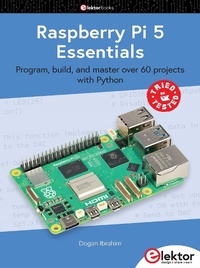
Raspberry Pi 5 Essentials
Program, build, and master over 60 projects with Python
1st Edition
Published on 4. January 2024
332 pages
978-3-89576-587-2 (ISBN)
Description

The Raspberry Pi 5 is the latest single-board computer from the Raspberry Pi Foundation. It can be used in many applications, such as in audio and video media centers, as a desktop computer, in industrial controllers, robotics, and in many domestic and commercial applications. In addition to the well-established features found in other Raspberry Pi computers, the Raspberry Pi 5 offers Wi-Fi and Bluetooth (classic and BLE), which makes it a perfect match for IoT as well as in remote and Internet-based control and monitoring applications. It is now possible to develop many real-time projects such as audio digital signal processing, real-time digital filtering, real-time digital control and monitoring, and many other real-time operations using this tiny powerhouse.
The book starts with an introduction to the Raspberry Pi 5 computer and covers the important topics of accessing the computer locally and remotely. Use of the console language commands as well as accessing and using the desktop GUI are described with working examples. The remaining parts of the book cover many Raspberry Pi 5-based hardware projects using components and devices such as
> LEDs and buzzers
> LCDs
> Ultrasonic sensors
> Temperature and atmospheric pressure sensors
> The Sense HAT
> Camera modules
Example projects are given using Wi-Fi and Bluetooth modules to send and receive data from smartphones and PCs, and sending real-time temperature and atmospheric pressure data to the cloud.
All projects given in the book have been fully tested for correct operation. Only basic programming and electronics experience are required to follow the projects. Brief descriptions, block diagrams, detailed circuit diagrams, and full Python program listings are given for all projects described. Readers can find the program listings on the Elektor Store website, elektor.com (search for: book title).
More details
Other editions
Additional editions
Book
11/2023
1st Edition
Elektor
€39.95
Available immediately
Person
Prof Dogan Ibrahim has a BSc (Hons) degree in Electronic Engineering, an MSc degree in Automatic Control Engineering, and a PhD degree in Digital Signal Processing and Microprocessors.
Dogan has worked in many organizations and is a Fellow of the Institution of Engineering and Technology (IET) in UK as well as a Chartered Electrical Engineer. He has authored over 100 technical books and over 200 technical articles on electronics, microprocessors, microcontrollers, and related fields. Dogan is a certified Arduino professional and has many years of experience with numerous types of microprocessors and microcontrollers.
Dogan has worked in many organizations and is a Fellow of the Institution of Engineering and Technology (IET) in UK as well as a Chartered Electrical Engineer. He has authored over 100 technical books and over 200 technical articles on electronics, microprocessors, microcontrollers, and related fields. Dogan is a certified Arduino professional and has many years of experience with numerous types of microprocessors and microcontrollers.
Content
- Raspberry Pi 5 Essentials
- All rights reserved
- Contents
- Preface
- Chapter 1 The Raspberry Pi 5
- 1.1 Overview
- 1.2 The Raspberry Pi 5
- Chapter 2 Installing the Raspberry Pi 5 Operating System
- 2.1 Overview
- 2.2 Using a pre-installed SD card
- 2.3 Larger font in Console mode
- 2.4 Accessing your Raspberry Pi 5 Console from your PC - the Putty program
- 2.4.1 Configuring Putty
- 2.5 Accessing the Desktop GUI from your PC
- 2.6 Assigning a static IP address to your Raspberry Pi 5
- 2.7 Enabling Bluetooth
- 2.8 Connecting the Raspberry Pi 5 to a wired network
- 2.8.1 Unable to connect to a wired network
- 2.9 Installing the Raspberry Pi 5 Bookworm operating system on a blank microSD card
- Chapter 3 Using The Console Commands
- 3.1 Overview
- 3.2 The Command Prompt
- 3.3 Useful Console commands
- 3.3.1 System and user information
- 3.3.2 The Raspberry Pi 5 directory structure
- 3.3.3 Resource monitoring on the Raspberry Pi 5
- 3.3.4 Shutting Down
- 3.3.5 Networking
- 3.3.6 System information and other useful commands
- Chapter 4 Desktop GUI - Desktop Applications
- 4.1 Overview
- 4.2 Desktop GUI Applications
- 4.2.1 Applications Menu
- 4.2.2 Web browser
- 4.2.3 File manager
- 4.2.4 Terminal
- 4.2.5 Manage Bluetooth devices
- 4.2.6 Wi-Fi
- 4.2.7 Volume control
- 4.2.8 Date and time
- Chapter 5 Using a Text Editor in Console Mode
- 5.1 nano text editor
- 5.2 vi text editor
- Chapter 6 Creating and Running a Python Program
- 6.1 Overview
- 6.2 Method 1 - Interactively from command prompt in console mode
- 6.3 Method 2 - Create a Python file in console mode
- 6.4 Method 3 - Create a Python file in Desktop GUI mode
- 6.5 Which method?
- Chapter 7 Python Programming and Simple Programs
- 7.1 Overview
- 7.2 Variable names
- 7.3 Reserved words
- 7.4 Comments
- 7.5 Line continuation
- 7.6 Blank lines
- 7.7 More than one statement on a line
- 7.8 Indentation
- 7.9 Python data types
- 7.10 Numbers
- 7.11 Strings
- 7.11.1 String functions
- 7.11.2 Escape sequences
- 7.12 Print statement
- 7.13 List variables
- 7.13.1 List functions
- 7.14 Tuple variables
- 7.15 Dictionary variables
- 7.15.1 Dictionary functions
- 7.16 Keyboard input
- 7.17 Comparison operators
- 7.18 Logical operators
- 7.19 Assignment operators
- 7.20 Control of flow
- 7.20.1 if, if.else, and elif
- 7.20.2 for statement
- 7.20.3 while statement
- 7.20.4 continue statement
- 7.20.5 break statement
- 7.20.6 pass statement
- 7.21 Example 1 - 4-Band resistor colour code identifier
- 7.22 Example 2 - Series or parallel resistors
- 7.23 Example 3 - Resistive potential divider
- 7.24 Trigonometric functions
- 7.25 User-defined functions
- 7.26 Examples
- 7.27 Recursive functions
- 7.28 Exceptions
- 7.29 try/final exceptions
- 7.30 Date and time
- 7.31 Creating your own modules
- Chapter 8 Raspberry Pi 5 LED Projects
- 8.1 Overview
- 8.2 Raspberry Pi 5 GPIO pin definitions
- 8.3 Project 1 - Flashing an LED
- 8.4 Project 2 - Alternately flashing LEDs
- 8.5 Project 3 - Binary counting with 8 LEDs
- 8.6 Project 4 - Christmas lights (random flashing 8 LEDs)
- 8.7 Project 5 - Chasing LEDs
- 8.8 Project 6 - Rotating LEDs with push-button switch
- 8.9 Project 7 - Morse Code exerciser with LED or buzzer
- 8.10 Project 8 - Electronic dice
- Chapter 9 Using an I²C LCD
- 9.1 Overview
- 9.2 The I²C Bus
- 9.3 I²C pins of Raspberry Pi 5
- 9.4 Project 1 - Using an I²C LCD - Seconds counter
- 9.5 Project 2 - Using an I²C LCD - Display time
- 9.6 Project 3 - Using an I²C LCD - Display IP address of Raspberry Pi 5
- 9.7 Project 4 - Voltmeter - Output to the screen
- 9.8 Project 5 - Voltmeter - Output to LCD
- 9.9 Project 6 - Analog temperature sensor thermometer - output to the screen
- 9.10 Project 7 - Analog temperature sensor thermometer - output on LCD
- 9.11 Project 8 - Reaction timer - output to screen
- 9.12 Project 9 - Reaction timer - output to LCD
- 9.13 Project 10 - Automatic dusk lights
- 9.14 Project 11 - Ultrasonic distance measurement
- 9.15 Project 12 - Car parking sensors
- 9.16 Project 13 - Fading LED
- 9.17 Project 14 - Melody maker
- Chapter 10 Plotting Graphs with Python and Raspberry Pi 5
- 10.1 Overview
- 10.2 The Matplotlib graph plotting library
- 10.3 Project 1 - RC transient circuit analysis - Charging
- 10.4 Project 2 - RC transient circuit analysis - Discharging
- 10.5 Transient RL circuits
- 10.6 Project 3 - RCL transient circuit analysis
- 10.7 Project 4 - Temperature, pressure and humidity measurement - Display on the screen
- 10.8 Project 5 - Temperature, pressure and humidity measurement - Plotting the data
- Chapter 11 Waveform Generation - Using the Digital-to-Analog Converter (DAC)
- 11.1 Overview
- 11.2 The MCP4921 DAC
- 11.3 Project 1 - Generating a square wave signal with any peak voltage up to +3.3 V
- 11.4 Project 2 - Generating a sawtooth wave signal
- 11.5 Project 3 - Generating a triangle wave signal
- 11.6 Project 4 - Generating an arbitrary wave signal
- 11.7 Project 5 - Generating a sine wave signal
- Chapter 12 Using the Sense HAT
- 12.1 Overview
- 12.2 The Sense HAT interface
- 12.3 Programming the Sense HAT
- 12.4 Project 1 - Displaying text on Sense HAT
- 12.5 Project 2 - Test your math skills - multiplication
- 12.6 Project 3 - Learning the times tables
- 12.7 Project 4 - Display the temperature, humidity, and pressure
- 12.8 Project 5 - ON-OFF temperature controller
- 12.9 Project 6 - Generate two dice numbers
- 12.10 Project 7 - Display the current time
- 12.11 Project 8 - Displaying two-digit integer numbers
- 12.12 Project 9 - Up counter
- 12.13 The inertial measurement sensor
- 12.13.1 Project 10 - Reading the acceleration
- 12.13.2 Project 11 - Accelerometer-based dice
- 12.13.3 Project 12 - Accelerometer-based LED shapes
- Chapter 13 Using a 4×4 Keypad
- 13.1 Overview
- 13.2 Project 1 - Using a 4×4 keypad
- Chapter 14 Communication over Wi-Fi
- 14.1 Overview
- 14.2 UDP and TCP
- 14.2.1 UDP communication
- 14.2.2 TCP communication
- 14.3 Project 1 - Sending a text message to a smartphone using TCP/IP
- 14.4 Project 2 - Two-way communication with the smartphone using TCP/IP
- 14.5 Project 3 - Communicating with a PC using TCP/IP
- 14.6 Project 4 - Controlling an LED connected to Raspberry Pi 5 from a smartphone using TCP/IP
- 14.7 Project 5 - Sending a text message to a smartphone using UDP
- 14.8 Project 6 - Controlling an LED connected to Raspberry Pi 5 from a smartphone using UDP
- 14.9 Communicating with the Raspberry Pi Pico W over Wi-Fi
- 14.9.1 Project 7 - Raspberry Pi 5 and Raspberry Pi Pico W communication - controlling a relay over Wi-Fi
- 14.10 Project 8 - Storing ambient temperature and atmospheric pressure data on the Cloud
- Chapter 15 Communication over Bluetooth
- 15.1 Overview
- 15.2 Project 1 - Exchanging text with a smartphone
- 15.3 Project 2 - Bluetooth control of LED from a smartphone
- 15.4 Arduino UNO - Raspberry Pi 5 Bluetooth communication
- 15.4.1 Project 3 - Communicating with an Arduino UNO over Bluetooth
- 15.4.2 Project 4 - Play audio (e.g. music) on Bluetooth speaker via Raspberry Pi 5
- Chapter 16 Raspberry Pi 5 Camera Projects
- 16.1 Overview
- 16.2 Installing the Camera
- 16.3 Project 1 - Still camera commands
- 16.3.1 libcamera
- 16.4 Project 2 - Building a time-lapse camera - Who is in my parking place?
- 16.5 Project 3 - Video camera commands
- 16.6 Project 4 - Who is ringing my doorbell?
- Index
