

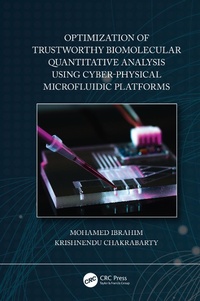
Optimization of Trustworthy Biomolecular Quantitative Analysis Using Cyber-Physical Microfluidic Platforms
1st Edition
Published on 31. May 2020
363 pages
978-1-000-08270-8 (ISBN)
Description

A microfluidic biochip is an engineered fluidic device that controls the flow of analytes, thereby enabling a variety of useful applications. According to recent studies, the fields that are best set to benefit from the microfluidics technology, also known as lab-on-chip technology, include forensic identification, clinical chemistry, point-of-care (PoC) diagnostics, and drug discovery. The growth in such fields has significantly amplified the impact of microfluidics technology, whose market value is forecast to grow from $4 billion in 2017 to $13.2 billion by 2023. The rapid evolution of lab-on-chip technologies opens up opportunities for new biological or chemical science areas that can be directly facilitated by sensor-based microfluidics control. For example, the digital microfluidics-based ePlex system from GenMarkDx enables automated disease diagnosis and can bring syndromic testing near patients everywhere.
However, as the applications of molecular biology grow, the adoption of microfluidics in many applications has not grown at the same pace, despite the concerted effort of microfluidic systems engineers. Recent studies suggest that state-of-the-art design techniques for microfluidics have two major drawbacks that need to be addressed appropriately: (1) current lab-on-chip systems were only optimized as auxiliary components and are only suitable for sample-limited analyses; therefore, their capabilities may not cope with the requirements of contemporary molecular biology applications; (2) the integrity of these automated lab-on-chip systems and their biochemical operations are still an open question since no protection schemes were developed against adversarial contamination or result-manipulation attacks. Optimization of Trustworthy Biomolecular Quantitative Analysis Using Cyber-Physical Microfluidic Platforms provides solutions to these challenges by introducing a new design flow based on the realistic modeling of contemporary molecular biology protocols. It also presents a microfluidic security flow that provides a high-level of confidence in the integrity of such protocols. In summary, this book creates a new research field as it bridges the technical skills gap between microfluidic systems and molecular biology protocols but it is viewed from the perspective of an electronic/systems engineer.
However, as the applications of molecular biology grow, the adoption of microfluidics in many applications has not grown at the same pace, despite the concerted effort of microfluidic systems engineers. Recent studies suggest that state-of-the-art design techniques for microfluidics have two major drawbacks that need to be addressed appropriately: (1) current lab-on-chip systems were only optimized as auxiliary components and are only suitable for sample-limited analyses; therefore, their capabilities may not cope with the requirements of contemporary molecular biology applications; (2) the integrity of these automated lab-on-chip systems and their biochemical operations are still an open question since no protection schemes were developed against adversarial contamination or result-manipulation attacks. Optimization of Trustworthy Biomolecular Quantitative Analysis Using Cyber-Physical Microfluidic Platforms provides solutions to these challenges by introducing a new design flow based on the realistic modeling of contemporary molecular biology protocols. It also presents a microfluidic security flow that provides a high-level of confidence in the integrity of such protocols. In summary, this book creates a new research field as it bridges the technical skills gap between microfluidic systems and molecular biology protocols but it is viewed from the perspective of an electronic/systems engineer.
More details
Edition
1. Auflage
Language
English
Place of publication
London
United Kingdom
Publishing group
Taylor & Francis Ltd
Target group
College/higher education
Product notice
Reflowable
Illustrations
17 Tables, black and white; 163 Illustrations, black and white
ISBN-13
978-1-000-08270-8 (9781000082708)
Copyright in bibliographic data and cover images is held by Nielsen Book Services Limited or by the publishers or by their respective licensors: all rights reserved.
Schweitzer Classification
Other editions
Additional editions
Mohamed Ibrahim | Krishnendu Chakrabarty
Optimization of Trustworthy Biomolecular Quantitative Analysis Using Cyber-Physical Microfluidic Platforms
Book
08/2024
1st Edition
CRC Press
€72.60
Shipment within 15-20 days
Mohamed Ibrahim | Krishnendu Chakrabarty
Optimization of Trustworthy Biomolecular Quantitative Analysis Using Cyber-Physical Microfluidic Platforms
Book
07/2020
1st Edition
CRC Press
€173.40
Shipment within 15-20 days
Persons
Mohamed Ibrahim was a Visiting Scholar with the Technical University of Munich, Germany, and the University of Bremen, Germany. He spent a total of three years as a Research and Development Engineer in the semiconductor industry where he worked on design-for-test and post-silicon validation methodologies for several system-on-chip (SoC) designs. His current research interests include SoC design and embedded systems, electronic design automation of LOC systems, Internet-of-Bio-Things, security and trust of bio-systems, and machine-learning applications of bio-systems. Dr. Ibrahim was a recipient of the Best Paper award at the 2017 IEEE/ACM Design, Automation, and Test in Europe Conference, the 2017 Postdoc Mobility award from the Technical University of Munich, Germany, two ACM conference travel awards from ACM-SIGBED in 2016 and ACM-SIGDA in 2017, and Duke Graduate School Fellowship in 2013.
Krishnendu Chakrabarty is the William H. Younger Distinguished Professor and Department Chair of Electrical and Computer Engineering, and Professor of Computer Science, at Duke University. He is a recipient of the National Science Foundation CAREER award, the Office of Naval Research Young Investigator award, the Humboldt Research Award from the Alexander von Humboldt Foundation, Germany, the IEEE Transactions on CAD Donald O. Pederson Best Paper Award (2015), the ACM Transactions on Design Automation of Electronic Systems Best Paper Award (2017), and over a dozen best paper awards at major conferences. He is also a recipient of the IEEE Computer Society Technical Achievement Award (2015), the IEEE Circuits and Systems Society Charles A. Desoer Technical Achievement Award (2017), the Semiconductor Research Corporation Technical Excellence Award (2018), and the Distinguished Alumnus Award from the Indian Institute of Technology, Kharagpur (2014). Prof. Chakrabarty's current research projects include: testing and design-for-testability of integrated circuits and systems; digital microfluidics, biochips, and cyberphysical systems; data analytics for fault diagnosis, failure prediction, anomaly detection, and hardware security; neuromorphic computing systems.
Krishnendu Chakrabarty is the William H. Younger Distinguished Professor and Department Chair of Electrical and Computer Engineering, and Professor of Computer Science, at Duke University. He is a recipient of the National Science Foundation CAREER award, the Office of Naval Research Young Investigator award, the Humboldt Research Award from the Alexander von Humboldt Foundation, Germany, the IEEE Transactions on CAD Donald O. Pederson Best Paper Award (2015), the ACM Transactions on Design Automation of Electronic Systems Best Paper Award (2017), and over a dozen best paper awards at major conferences. He is also a recipient of the IEEE Computer Society Technical Achievement Award (2015), the IEEE Circuits and Systems Society Charles A. Desoer Technical Achievement Award (2017), the Semiconductor Research Corporation Technical Excellence Award (2018), and the Distinguished Alumnus Award from the Indian Institute of Technology, Kharagpur (2014). Prof. Chakrabarty's current research projects include: testing and design-for-testability of integrated circuits and systems; digital microfluidics, biochips, and cyberphysical systems; data analytics for fault diagnosis, failure prediction, anomaly detection, and hardware security; neuromorphic computing systems.
Content
1. Introduction. 2. Synthesis for Multiple Sample Pathways: Gene-Expression Analysis. 3. Synthesis of Protocols with Temporal Constraints: Epigenetic Analysis. 4. A Micro fluidics-Driven Cloud Service: Genomic Association Studies. 5. Synthesis of Protocols with Indexed Samples: Single-Cell Analysis. 6. Timing-Driven Synthesis with Pin Constraints: Single-Cell Screening. 7. Synthesis for Parameter-Space Exploration: Synthetic Bio-circuits. 8. Fault-Tolerant Realization of Biomolecular Assays. 9. Security Vulnerabilities of Quantitative-Analysis Frame-works. 10. Security Countermeasures of Quantitative-Analysis Frame-works. 11. Conclusion and Future Outlook. Appendix A Proof of Theorem 5.1: A Fully Connected Routing Crossbar. Appendix B Modeling a Fully Connected Routing Crossbar. Appendix C Proof of Lemma 6.1: Derivation of Control Delay Vector. Appendix D Proof of Theorem 6.1: Derivation of Control Latency. Appendix E Proof of Lemma 7.1: Properties of Aliquot-Generation Trees. Appendix F Proof of Theorem 7.1: Recursion in Aliquot-Generation Trees. Bibliography.
