

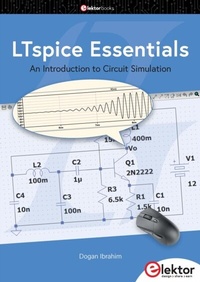
LTspice Essentials
An Introduction to Circuit Simulation
1st Edition
Published on 19. June 2024
194 pages
978-3-89576-623-7 (ISBN)
Description

LTspice, developed by Analog Devices, is a powerful, fast, and free SPICE simulator, schematic capture, and waveform viewer with a large database of components supported by SPICE models from all over the world. Drawing a schematic in LTspice is easy and fast. Thanks to its powerful graphing features, you can visualize the voltages and currents in a circuit, and also the power consumption of its components and much more.
This book is about learning to design and simulate electronic circuits using LTspice. Among others, the following topics are treated:
> DC and AC circuits
> Signal diodes and Zener diodes
> Transistor circuits including oscillators
> Thyristor/SCR, diac, and triac circuits
> Operational amplifier circuits including oscillators
> The 555 timer IC
> Filters
> Voltage regulators
> Optocouplers
> Waveform generation
> Digital logic simulation including the 74HC family
> SPICE modeling
LTspice is a powerful electronic circuit simulation tool with many features and possibilities. Covering them all in detail is not possible in a book of this size. Therefore, this book presents the most common topics like DC and AC circuit analysis, parameter sweeping, transfer functions, oscillators, graphing, etc. Although this book is an introduction to LTspice, it covers most topics of interest to people engaged in electronic circuit simulation.
The book is aimed at electronic/electrical engineers, students, teachers, and hobbyists. Many tested simulation examples are given in the book. Readers do not need to have any computer programming skills, but it will help if they are familiar with basic electronic circuit design and operation principles. Readers who want to dive deeper can find many detailed tutorials, articles, videos, design files, and SPICE circuit models on the Internet.
All the simulation examples used in the book are available as files at the webpage of this book. Readers can use these example circuits for learning or modify them for their own applications.
All prices
More details
Other editions
Additional editions
Book
08/2024
1st Edition
Elektor
€39.95
Available immediately
Person
Prof Dr Dogan Ibrahim has a BSc degree in electronic engineering, an MSc degree in automatic control engineering, and a PhD degree in digital signal processing. Dogan has worked in many industrial organizations before he returned to academic life. Prof Ibrahim is the author of over 70 technical books and published over 200 technical articles on microcontrollers, microprocessors, and related fields. He is a Chartered electrical engineer and a Fellow of the Institution of the Engineering Technology. He has been an amateur radio operator for several decades and also holds an Arduino certification.
Content
- LTspice Essentials
- All rights reserved
- Contents
- Preface
- 1 Introduction
- 1.1 Why simulate?
- 1.2 Electronic Simulation
- 1.3 The LTspice Simulator
- 1.3.1 Schematic capture
- 1.3.2 DC analysis
- 1.3.3 AC analysis
- 1.3.4 Transient analysis
- 1.3.5 Plotting the results
- 1.3.6 Transient noise analysis
- 1.3.7 Fourier analysis (FFT)
- 1.3.8 Digital simulation
- 1.3.9 Laplace transform based analysis
- 1.3.10 Expression editor
- 1.3.11 Parameter sweeping
- 1.3.12 AC sweep
- 1.3.13 DC sweep
- 1.3.14 SPICE models
- 1.3.15 Netlist
- 1.3.16 Online help
- 2 Getting Started with LTspice
- 2.1 Overview
- 2.2 Installing LTspice on Windows
- 2.3 Running LTspice
- 2.4 Creating a New Schematic
- 2.5 Simulator Settings
- 2.6 Example Schematics
- 2.7 Online Help
- 3 Basic DC Circuit Analysis and Simulation
- 3.1 Overview
- 3.2 Simple 4-Resistor Circuit
- 3.3 A More Complex Resistor Circuit
- 3.4 Resistive Potential Divider - Sweep a DC Voltage
- 3.5 Resistive Potential Divider - Sweep a Resistor Value
- 3.6 Power Dissipation in a DC Circuit
- 3.7 Resistor-Capacitor (RC) Transient Circuit
- 3.8 Resistor-Inductor-Capacitor (RLC) Transient Circuit
- 3.9 Input Resistance, Output Resistance, and Transfer Function
- 4 Basic AC Circuit Analysis and Simulation
- 4.1 Overview
- 4.2 Resistor - Capacitor Circuit
- 4.3 Resistor - Inductor Circuit
- 4.4 Resistor - Inductor - Capacitor Circuit
- 4.5 Thevenin's Theorem - AC Circuit Analysis
- 4.6 Three-Phase Circuits
- 4.6.1 Star with resistive loads
- 4.6.2 Star with resistive and inductive loads
- 4.7 Mutual Inductance
- 4.7.1 Circuit with mutual inductance
- 4.8 Using a Transformer
- 4.9 Frequency Sweeping
- 4.10 Fast Fourier Transform (FFT)
- 4.11 Input & Output Impedance, and Gain
- 5 Diode Circuits
- 5.1 Overview
- 5.2 Half-Wave Rectifier
- 5.3 Full-Wave Rectifier
- 5.4 Full-Wave Rectifier with a Transformer
- 5.5 Zener Diode Voltage Regulator
- 5.6 Diode Clamp
- 5.7 Voltage Multiplier
- 5.8 I-V Characteristic of a Diode
- 6 Transistor Analysis, Design and Simulation
- 6.1 Overview
- 6.2 Bipolar Junction Transistor (BJT) I-V Curve
- 6.3 Common-Emitter Transistor Amplifier - Analysis
- 6.4 Common-Emitter Transistor Amplifier - Design
- 6.5 Audio Power Amplifiers
- 6.5.1 Class A audio power amplifier simulation
- 6.5.2 Class AB audio power amplifier
- 6.6 BJT Switch
- 6.7 JFET Common-Source Amplifier
- 6.8 MOSFET I-V Characteristic Curve
- 7 Thyristors, Diacs and Triacs - Importing a SPICE model
- 7.1 Overview
- 7.2 Thyristors, diacs, and triacs
- 7.2.1 Triac - diac phase control
- 7.3 Inserting a Potentiometer - Using a Potentiometer Model
- 8 Oscillators
- 8.1 Overview
- 8.2 Transistor Sinewave Oscillators
- 8.2.1 Colpitts oscillator
- 8.2.2 Hartley oscillator
- 8.3 Sine Wave Oscillators with Operational Amplifiers
- 8.3.1 Phase-shift oscillator
- 8.3.2 Wien bridge oscillator
- 8.3.3 Colpitts oscillator
- 8.3.4 Hartley oscillator
- 8.4 Op-Amp-Based Square Wave Oscillator
- 8.5 The 555 Timer
- 8.5.1 The 555 astable multivibrator
- 8.5.2 Blinking an LED
- 8.5.3 Metronome
- 8.5.4 Parametric sweep
- 9 Simulating Other Analog Circuits
- 9.1 Overview
- 9.2 The LT1086 Voltage Regulator
- 9.3 10 V Output
- 9.4 DC Boost Converter
- 9.5 Optocoupler Simulation
- 9.6 Operational Amplifier with Single Supply
- 9.7 Sweeping a Resistor Value
- 10 Filters - Hierarchical Blocks
- 10.1 Overview
- 10.2 Low-Pass Filter
- 10.3 Filter Design Tool
- 10.3.1 Low-pass active fi lters
- 10.4 Hierarchical Blocks - 2nd-Order Low-Pass Filter Block
- 10.4.1 Using the filter block
- 10.5 Passing Parameters to Hierarchical Blocks
- 10.5.1 Using the programmable block
- 10.6 Create Your Own Symbol
- 10.7 LTspice Filter Library
- 11 Digital Logic
- 11.1 Overview
- 11.2 Digital Components
- 11.3 Half Adder Using Logic Gates
- 11.4 Full Adder from Two Half Adders
- 11.5 Importing the 74HC Family
- 11.6 Two-Input Multiplexer
- 11.7 4-Bit Binary Counter
- 11.8 More Inputs
- 11.9 Full Adder
- 11.10 Monostable Multivibrator
- 11.11 Square Wave Oscillator
- 12 SPICE models
- 12.1 Overview
- 12.2 The Structure of SPICE Models
- 12.3 Passive Components
- 12.4 Active Components
- 12.4.1 Diodes
- 12.4.2 Bipolar transistors
- 12.4.3 MOSFETs
- 12.4.4 Creating a new diode model
- 12.5 Logic Gates
- 12.6 SPICE Directives
- 13 Some Useful Tools and Functions
- 13.1 Overview
- 13.2 Generating Triangular and Sawtooth Waveforms
- 13.3 Generating a Periodic Arbitrary Waveform
- 13.4 The Voltage-Controlled Switch
- 13.5 Laplace-Transform Based Simulation
- Appendix
- A - Third-Party SPICE Models
- B - Useful Resources
- Index
