

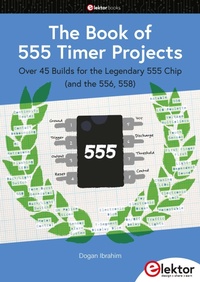
The Book of 555 Timer Projects
Over 45 Builds for the Legendary 555 Chip (and the 556, 558)
1st Edition
Published on 11. July 2024
142 pages
978-3-89576-625-1 (ISBN)
Description

The 555 timer IC, originally introduced by the Signetics Corporation around 1971, is sure to rank high among the most popular analog integrated circuits ever produced. Originally called the IC Time Machine, this chip has been used in many timer-related projects by countless people over decades. This book is all about designing projects based on the 555 timer IC. Over 45 fully tested and documented projects are presented. All projects have been fully tested by the author by constructing them individually on a breadboard. You are not expected to have any programming experiences for constructing or using the projects given in the book. However, it's definitely useful to have some knowledge of basic electronics and the use of a breadboard for constructing and testing electronic circuits. Some of the projects in the book are:
> Alternately Flashing Two LEDs
> Changing LED Flashing Rate
> Touch Sensor On/Off Switch
> Switch On/Off Delay
> Light-Dependent Sound
> Dark/Light Switch
> Tone Burst Generator
> Long Duration Timer
> Chasing LEDs
> LED Roulette Game
> Traffic Lights
> Continuity Tester
> Electronic Lock
> Switch Contact Debouncing
> Toy Electronic Organ
> Multiple Sensor Alarm System
> Metronome
> Voltage Multipliers
> Electronic Dice
> 7-Segment Display Counter
> Motor Control
> 7-Segment Display Dice
> Electronic Siren
> Various Other Projects
The projects given in the book can be modified or expanded by you for your very own applications. Electronic engineering students, people engaged in designing small electronic circuits, and electronic hobbyists should find the projects in the book instructive, fun, interesting, and useful.
All prices
More details
Other editions
Additional editions
Dogan Ibrahim
The Book of 555 Timer Projects
Over 45 Builds for the Legendary 555 Chip (and the 556, 558)
Book
07/2024
1st Edition
Elektor
€34.95
Available immediately
Person
Prof Dr Dogan Ibrahim has a BSc degree in electronic engineering, an MSc degree in automatic control engineering, and a PhD degree in digital signal processing. Dogan has worked in many industrial organizations before he returned to academic life. Prof Ibrahim is the author of over 70 technical books and published over 200 technical articles on microcontrollers, microprocessors, and related fields. He is a Chartered electrical engineer and a Fellow of the Institution of the Engineering Technology. He is a certified Arduino professional.
Content
- Intro
- Contents
- Preface
- Chapter 1 ? Introduction
- 1.1 Overview
- 1.2 Types of 555 timer chips
- 1.3 555 timer chip specifications
- 1.3.1 The NE555P chip
- Chapter 2 ? Operation of the 555 Timer Chip
- 2.1 Block Diagram
- 2.2 Astable Circuit Operation
- 2.2.1 Using a nomogram
- 2.2.2 555 astable online calculator
- 2.2.3 Astable circuit with duty cycle less than or equal to 50%
- 2.2.4 Astable circuit with duty cycle adjustable from 0% to 100%
- 2.2.5 Component values for required frequency and duty cycle range
- 2.2.6 A simpler circuit for 50% duty cycle
- 2.3 Monostable Circuit Operation
- 2.3.1 Using a nomogram
- 2.3.2 555 monostable online calculator
- 2.4 Bistable Circuit Operation
- 2.4.1 Using the Reset input
- 2.4.2 Using pins 2 and 6
- 2.5 Online Calculator Program for Designing 555 Astable andMonostable Circuits
- 2.6 555 Timer Output Current
- 2.7 Driving Heavy Loads
- 2.7.1 Using bipolar transistors
- 2.7.2 Using a MOSFET transistor
- 2.7.3 Using a relay
- Chapter 3 ? 555 Timer Projects
- 3.1 Overview
- 3.2 Project 1: Flashing LED
- 3.3 Project 2: Police Car Emergency Lights - Alternately Flashing TwoLEDs
- 3.4 Project 3: Changing the LED Flash Rate
- 3.5 Project 4: Changing the LED Brightness
- 3.6 Project 5: Touch Sensor On/Off Switch
- 3.7 Project 6: Pushbutton On/Off switch
- 3.8 Project 7: Switch-Off Delay
- 3.9 Project 8: Switch-On Delay
- 3.10 Project 9: Light-dependent Sound
- 3.11 Project 10: Darkness Sensor
- 3.12 Project 11: Light Sensor
- 3.13 Project 12: Astable Frequency Generator
- 3.14 Project 13: Tone Burst Generator
- 3.15 Project 14: Drawer/Cupboard Light Switch
- 3.16 Project 15: Long Duration Timer with Decade Counter
- 3.17 Project 16: Long Duration Timer with Binary Counter
- 3.18 Project 17: Chasing LEDs
- 3.19 Project 18: LED Roulette Game
- 3.20 Project 19: Simple Traffic Lights Controller
- 3.21 Project 20: Professional Traffic Lights Controller
- 3.22 Project 21: Sine Wave Output
- 3.23 Project 22: Continuity Tester
- 3.24 Project 23: Simple Logic Probe
- 3.25 Project 24: Electronic Lock - Bistable Mode
- 3.26 Project 25: Electronic Lock - Monostable Mode
- 3.27 Project 26: Extending the Monostable Duration - Retriggering
- 3.28 Project 27: Switch Contact Debouncing
- 3.29 Project 28: Schmitt Trigger Circuit
- 3.30 Project 29: Monophonic Toy Electronic Organ
- 3.31 Project 30: 8-Tone Electronic Organ
- 3.32 Project 31: Multiple Sensor Alarm Circuit
- 3.33 Project 32: Monostable with Selectable Durations
- 3.34 Project 33: Electronic Metronome
- 3.35 DC Voltage Multipliers
- 3.35.1 Project 34: DC Voltage Doubler
- 3.35.2 Project 35: DC Voltage Tripler
- 3.35.3 Project 36: DC Voltage Quadrupler
- 3.36 Project 37: 7-segment LED Counter
- 3.37 Project 38: 2-digit, 7-segment LED Counter
- 3.38 Project 39: LED Dice
- 3.39 Project 40: 7-segment LED Dice
- 3.40 Project 41: DC Motor Control
- 3.41 Project 42: Servo Motor Control
- 3.42 Project 43: Temperature Alarm Circuit
- 3.43 Project 44: Temperature Controller
- 3.44 Project 45: DC Motor H-bridge Control
- 3.45 Project 46: Fastest Finger First Quiz Circuit - Two Participants
- 3.46 Project 47: Fastest Finger First Quiz Circuit - Six Participants inThree Groups
- 3.47 Using The 555 Timer Control Pin
- 3.47.1 Project 48: Voltage Controlled Oscillator
- 3.47.2 Project 49: Simple British Police Siren
- 3.48 Project 50: More Elaborate British Police Siren
- Chapter 4 ? The 556 and 558 Timer ICs
- 4.1 Overview
- 4.2 The 556 Timer IC
- 4.3 The 558 Timer IC
- Chapter 5 ? The CMOS Version of the 555 Timer
- 5.1 Overview
- 5.2 The LMC555 CMOS Timer
- Chapter 6 ? List of Components Used in the Projects
- Appendix ? Bibliography
- Index
