

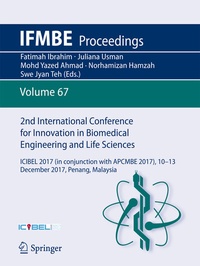
2nd International Conference for Innovation in Biomedical Engineering and Life Sciences
ICIBEL 2017 (in conjunction with APCMBE 2017),10 - 13 December 2017, Penang, Malaysia
Published on 6. December 2017
XV, 297 pages
978-981-10-7554-4 (ISBN)
Description

This volume presents the proceedings of ICIBEL 2017, organized by the Centre for Innovation in Medical Engineering (CIME) under Innovative Technology Research Cluster, University of Malaya. It was held in George Town, Penang, Malaysia, from 10-13 December 2017.
The ICIBEL 2017 conference promotes the latest research and developments related to the integration of the Engineering technology in medical fields and life sciences. This includes the latest innovations, research trends and concerns, challenges and adopted solution in the field of medical engineering and life sciences.
More details
Series
Edition
1st ed. 2018
Language
English
Place of publication
Singapore
Singapore
Publishing group
Springer Singapore
Target group
Professional and scholarly
Product notice
Reflowable
Illustrations
XV, 297 p. 171 illus.
File size
13,82 MB
ISBN-13
978-981-10-7554-4 (9789811075544)
DOI
10.1007/978-981-10-7554-4
Schweitzer Classification
Other editions
Additional editions
Fatimah Ibrahim | Juliana Usman | Mohd Yazed Ahmad
2nd International Conference for Innovation in Biomedical Engineering and Life Sciences
ICIBEL 2017 (in conjunction with APCMBE 2017),10 - 13 December 2017, Penang, Malaysia
Book
12/2017
Springer
€160.49
Shipment within 15-20 days
Content
- Intro
- Preface
- Conference Details
- About IFMBE
- Contents
- Telemedicine and Point of Care Healthcare Solutions
- 1 Pathological Hand Tremor Measurement-Challenges and Advances
- Abstract
- Introduction
- Tremor Assessment Protocol
- 2.1 Types of Diagnostic Procedure for Tremor
- 2.1.1 Clinical Evaluation
- 2.1.2 Biomechanical Evaluation
- 2.2 Activities Perform During Upper Limb Tremor Assessment
- 2.3 Data Processing and Analysis
- Tremor Measurement Technology
- 3.1 Challenges in Tremor Measurement
- Advances and Challenges in Hand Tremor Measurement
- 4.1 Wearable Wireless Measurement System
- 4.2 An Algorithm to Separate Postural and Rest Tremor
- 4.2.1 Tremor Stability Index
- Conclusion
- References
- 2 Non Invasive Cardiovascular Health Assessment in Post-adolescent Age Group Using Augmentation Index
- Abstract
- Introduction
- Methodology
- 2.1 Dataset Overview and Acquisition
- 2.2 Preprocessing
- 2.3 Feature Extraction
- 2.4 Classification
- Results and Discussion
- Conclusion
- Acknowledgements
- References
- 3 Novel and Security Connections for Extending Mobile Audio Signal Delivery to Personal/Notebook Computer
- Abstract
- Introduction
- Methods
- Results
- Discussion
- Conclusion
- Acknowledgements
- References
- 4 Sensitivity Improvement of Respiratory Movement Detection in Non-contact In-Bed Cardiopulmonary Measurements During Sleep
- Abstract
- Introduction
- Measurement System
- 2.1 Multilayered Cloth Electrode
- 2.2 Front-End Voltage Follower
- 2.3 Signal Detection Circuitry
- Method
- 3.1 Evaluation of the Capacitance in the VMC
- 3.2 Overnight Measurements
- 3.3 Analysis of the RM Signals
- Results and Discussions
- 4.1 Effect of CVMC on the RM Signal Quality
- 4.2 RM Sensitivities Obtained by the Conventional and Modified Systems During the Overnight Experiments
- Conclusion
- Acknowledgements
- References
- 5 Model Iterative Airway Pressure Reconstruction During Mechanical Ventilation Asynchrony: Shapes and Sizes of Reconstruction
- Abstract
- Introduction
- Methods
- 2.1 Patient Data
- 2.2 Model Iterative Pressure Reconstruction (MIPR)
- 2.3 Data Analysis
- 2.3.1 Respiratory Mechanics
- 2.3.2 Coefficient of Variation and Spread Analysis
- Results and Discussion
- 3.1 Case 1: A Typical Pressure Reconstruction
- 3.2 Case 2: Late Asynchronies
- 3.3 Case 3: Early Asynchrony
- 3.4 Respiratory Mechanics and Variation Analysis
- Discussion
- Conclusion
- Acknowledgements
- References
- 6 Smart Balance Board to Improve Balance and Reduce Fall Risk: Pilot Study
- Abstract
- Introduction
- Methods
- 2.1 Subjects
- 2.2 FIBOD-Smart Fitness Balance Board
- 2.3 Intervention
- 2.4 Outcome Measures
- Results
- Discussion
- Conclusion
- Acknowledgements
- References
- Biomechanics, Ergonomics, and Rehabilitation
- 7 Pushing a Manual Wheelchair Requires More Muscular Force Than Pulling
- Abstract
- Introduction
- Methodology
- 2.1 Research Participants
- 2.2 Test Protocol
- 2.3 Statistics
- Results
- 3.1 Normality Test
- 3.2 Paired t-Test
- 3.3 Calculations
- Discussion
- Conclusion
- Acknowledgements
- References
- 8 Wearable Instrument Applications for Indonesian's Worker Clothing
- Abstract
- Introduction
- Method
- Result and Discussion
- 3.1 Component Selection
- 3.2 Connection Setup
- 3.3 Instrument Test
- 3.4 Clothing Design
- Conclusion
- Acknowledgements
- References
- 9 Soft Tactile Sensors for Rehabilitation Robotic Hand with 3D Printed Folds
- Abstract
- Introduction
- Sensor Design and Fabrication
- 2.1 Sensor Structure
- 2.2 Sensor Fabrication Procedure
- 2.3 Types of Sensors
- Soft and Flexible Anthropomorphic Robotic Hand
- Experiments and Results
- 4.1 Tests and Comparative Results of Sensors
- 4.2 3D Printed Hand Exoskeleton
- Conclusion
- Acknowledgements
- References
- 10 The Effect of Different Size of Slicing Spheres of Polyaxial Screw Head on Static Compression Mechanical Test
- Abstract
- Introduction
- Material and Method
- 2.1 Pedicle Screw Design and Manufacture
- 2.2 Specimen Preparation and Biomechanical Testing
- 2.3 Statistical Analysis
- Result
- Discussion
- Conclusion
- Acknowledgements
- References
- 11 FES Standing: The Effect of Arm Support on Stability and Fatigue During Sit-to-Stand Manoeuvres in SCI Individuals
- Abstract
- Introduction
- Methodology
- 2.1 Sensor Calibration
- 2.2 Instrumentation of the Standing Frame
- 2.3 Subject Selection
- 2.4 Experimental Protocol
- Results and Discussion
- 3.1 Calibration of FlexiForce Sensors
- 3.2 Experimental Results
- Conclusion
- Acknowledgements
- References
- 12 A Low Cost Street Crossing Electronic Aid for the Deaf and Blind
- Abstract
- Introduction
- 1.1 Motivation
- Methodology
- 2.1 Transmitter Unit
- 2.2 Receiver Unit
- Testing and Calibration
- Distance_Tracking Mode
- Traffic_Light_Status Mode
- Conclusion
- 6.1 Future Work
- References
- 13 Fastest Gait Parameters Estimation Precision Comparison Utilizing High-Sensitivity and Low-Sensitivity Inertial Sensor
- Abstract
- Introduction
- Theory
- 2.1 Calculation of the Foot Trajectory
- 2.2 Determination of Integration Section
- 2.3 Gait Parameters
- Methods
- 3.1 Measurement System
- 3.2 Interpolation Method
- Experiment
- Results
- Discussion
- Acknowledgements
- References
- 14 Changes of the Head Control Ability in Patients with Cervical Spondylotic Myelopathy
- Abstract
- Introduction
- Method
- Result
- Discussion
- Conclusion
- Acknowledgements
- References
- 15 Investigation of the "Pendulum Effect" During Gait Locomotion Under the Novel Body Weight Support System and Counter Weight System
- Abstract
- Introduction
- Method
- 2.1 Experimental Protocol
- 2.2 Data Analysis
- Result and Discussion
- Conclusion
- Acknowledgements
- References
- 16 Balance Ability Affects Dual-Task Strategy in Children with Attention Deficit Hyperactivity Disorder
- Abstract
- Introduction
- Method
- 2.1 Participants
- 2.2 Apparatus
- 2.3 Procedures
- 2.4 Measures
- 2.5 Data Analyses
- 2.6 Statistical Analysis
- Results
- Discussion
- Acknowledgements
- References
- 17 Effects of Haptic Sensory Input of a Fluttering Cloth on Static and Dynamic Postural Control
- Abstract
- Introduction
- Method
- 2.1 Participants
- 2.2 Experimental Setup (Fig. 1)
- 2.3 Protocol
- 2.4 Statistical Analysis
- Results
- Discussion
- Conclusion
- Acknowledgements
- References
- 18 Design and Development of Low Cost Hand Exoskeleton for Rehabilitation
- Abstract
- Introduction
- Methodology
- 2.1 Design Architecture (Exoskeleton)
- 2.2 Circuit Design (Electronics)
- 2.3 Rehabilitation Exercise
- 2.4 Computer Interface (GUI)
- Design and System Implementation
- 3.1 Design
- 3.2 Prototype
- Results and Discussion
- Conclusion
- Acknowledgements
- References
- 19 Design and Development of Upper Limb Soft Exoskeleton for Rehabilitation
- Abstract
- Introduction
- Methodology
- 2.1 Rehabilitation Exercise
- 2.2 Design Architecture (Soft Exoskeleton)
- 2.3 Flex Sensors 2.2´´ (SEN-1024)
- 2.4 IMU Sensor (MPU 6050 GY-521)
- 2.5 Pneumatic Muscle
- 2.6 Computer Interface (GUI)
- Design and System Implementation
- 3.1 Design
- 3.2 Prototype
- 3.3 Working Algorithm
- 3.4 GUI Monitoring
- Results and Discussion
- Conclusion
- Acknowledgements
- References
- Biosensing and Life Sciences
- 20 Association of Rainfall and the Occurrence of Pathogenic Leptospira spp. in Recreational Stream Water, Hulu Langat, Selangor
- Abstract
- Introduction
- Materials and Methods
- 2.1 Primer Design and Specificity Test for LipL32 Gene
- 2.2 Optimization of LipL32-PCR Using Synthetic DNA of LipL32 Gene
- 2.3 Samples Collection
- 2.4 Water Samples Preparation
- 2.5 Spiked Sample
- 2.6 LipL32-PCR of Recreational Water Samples
- 2.7 Rainfall Data Collection
- 2.8 Statistical Analysis
- Results
- 3.1 Optimum LipL32 PCR Amplifications
- 3.2 Samples Collection and PCR Amplification
- 3.3 Spearman's Correlation Analysis
- Discussion
- Conclusion
- Acknowledgements
- References
- 21 Optimal EEG Channel Selection for Vascular Dementia Identification Using Improved Binary Gravitation Search Algorithm
- Abstract
- Introduction
- Methods and Materials
- 2.1 Subjects and EEG Recording Procedure
- 2.2 AICA-WT Denoising Technique
- 2.3 Features Extraction
- 2.4 Channel Selection Using IBGSA
- Results and Discussion
- 3.1 Channel Selection
- Conclusion
- References
- 22 Fabrication of Low-Resistance Carbon MEMS/NEMS as Material for Biosensing
- Abstract
- Introduction
- Methodology
- 2.1 Substrate and Sample Preparation
- 2.2 Pyrolysis of the Sample
- Result and Discussion
- Conclusion
- Acknowledgements
- References
- 23 Evaluation of Depth Perturbation Method for Localizing Fluorophore Inside a Pork Chuck Meat Sample
- Abstract
- Introduction
- Materials and Methods
- 2.1 Epi-Fluorescence Continuous Wave Tomography (ECWFMT) System
- 2.2 Resolving Depth by Depth Perturbation [2-4]
- 2.3 Biological Phantom
- Results and Discussion
- Acknowledgements
- References
- 24 An Effect of Magnetic Beads to Boesenbergia rotunda Antioxidant Activity Using Photoprotective Microfluidic CD
- Abstract
- Introduction
- Methodology
- 2.1 Plant Extraction Preparation
- 2.2 Microfluidics CD Construction
- 2.3 Boesenbergia rotunda DPPH Antioxidant Activity by Using Microfluidics CD
- Results and Discussion
- 3.1 Boesenbergia rotunda Antioxidant Activity in Photoprotective Microfluidics CD
- Conclusion
- Acknowledgements
- References
- 25 Assessment of Local Heating Effect on the Cutaneous Microcirculatory Vasodilatation
- Abstract
- Introduction
- Methods
- Results
- Discussion and Conclusion
- Acknowledgements
- References
- 26 Effects of Oral Glutathione Precursors' Supplementation on Human Glutathione Level
- Abstract
- Introduction
- Materials and Methods
- 2.1 Materials
- 2.2 Study Design
- 2.3 Blood Collection and Preparation of Samples
- 2.4 GSH Assay
- Results
- Discussion
- Conclusion
- Acknowledgements
- References
- 27 Review on the Usage of Swarm Intelligence in Gene Expression Data
- Abstract
- Introduction
- SI Optimizers
- 2.1 Particle Swarm Optimization (PSO)
- 2.2 Artificial Bee Colony (ABC)
- Feature Selection Using SI
- 3.1 PSO Based
- 3.2 ABC Based
- 3.3 ACO Based
- 3.4 Firefly Algorithm Based
- Microarray Data
- Conclusion
- Acknowledgements
- References
- 28 Support Vector Machine Classification of EEG Nonlinear Features for Primary Insomnia
- Abstract
- Introduction
- Method
- 2.1 Sleep Data
- 2.2 Nonlinear Feature Extraction
- 2.2.1 Largest Lyapunov Exponent (LLE)
- 2.2.2 Detrended Fluctuation Analysis (DFA)
- 2.2.3 Sample Entropy (SampEnt)
- 2.3 Supervised Learning Technique
- 2.3.1 Support Vector Machine (SVM)
- 2.3.2 Classification Performance Evaluation
- Result and Discussion
- Conclusion
- Acknowledgements
- References
- 29 Prospects of Low-Cost Photometers for Colorimetric Serum Iron Concentration Determination
- Abstract
- Introduction
- Light Absorption Spectroscopy Designs
- 2.1 Microcontroller Based Colorimetric Devices
- 2.1.1 Microcontroller-Based Colorimeter Using RGB LED
- 2.1.2 The SLIM Spectrometer
- 2.1.3 Open Source Colorimeter and Photometer
- 2.2 Dual-Channel Colorimetric Devices
- 2.3 Low-Cost Colorimeter for Serum Iron Detection
- Conclusion and Prospects
- Acknowledgements
- References
- 30 Decision Support for Parenteral Nutrition Supplementation in ICU Using Model-Based Glycemic Control Protocol
- Abstract
- Introduction
- Method
- 2.1 Clinical Data
- 2.2 Analysis Tools
- 2.3 Dataset Preparation
- Results and Discussions
- Conclusion
- Acknowledgements
- References
- 31 Investigation of Glucose-Insulin Model Efficacy for Diabetes Patient in the ICU
- Abstract
- Introduction
- Methodology
- Results
- Discussion
- Conclusion
- Acknowledgements
- References
- 32 Inflammatory Response of Bioscaffolds Decellularized by Sonication Treatment
- Abstract
- Introduction
- Methodology
- 2.1 Sonication Decellularization Treatment
- 2.2 Histological Analysis
- 2.3 Animal Experiment
- Results
- Discussion
- Conclusion
- Acknowledgements
- References
- Medical Device and Clinical Healthcare
- 33 Model-Based Insulin-Nutrition Administration for Glycemic Control in Malaysian Critical Care: First Pilot Trial
- Abstract
- Introduction
- Method
- 2.1 STAR Protocol
- 2.2 STAR Protocol
- 2.3 Virtual Trial
- Results
- Discussion
- Conclusion
- Acknowledgements
- References
- 34 Multi-channel Fabric Based Pressure Mapping Data Acquisition System
- Abstract
- Introduction
- Sensor Design
- 2.1 The Sensor and Electronic Hardware
- 2.2 Data Acquisition System and Software
- 2.3 The Sensor Load Test
- Results and Discussion
- 3.1 Results
- 3.2 Discussion
- Conclusion and Future Works
- Acknowledgements
- References
- 35 Development of Computer Aids ASPECTS System for Acute Ischemic Stroke Patient: A Preliminary Study
- Abstract
- Introduction
- Materials and Methods
- 2.1 Image Source and Software Develop Tool
- 2.2 Preprocessing
- 2.3 Texture Feature Parameter Selection
- 2.4 System Assessment
- Results and Discussion
- Conclusion
- Acknowledgements
- References
- 36 Testing the Effect of H-field Using Biological Phantom
- Abstract
- Introduction
- Method and Materials
- 2.1 Phantom Preparation
- 2.2 Impedance Measurement
- 2.3 H-field Generator
- 2.4 Experimental Setup
- Results and Discussion
- 3.1 Conclusion
- Acknowledgements
- References
- 37 Design Performance of Taylor Spatial Frame in Comparison with Other Orthopaedic Fixation Plate
- Abstract
- Introduction
- Methods
- Results
- 3.1 Ring Fixator Models
- 3.2 Numerical Modelling with Finite Element Method
- Conclusion
- References
- 38 The Effects of Oral Glutathione Supplementation on Human Volunteers: An Observation on Metabolic Syndrome Status
- Abstract
- Introduction
- 1.1 Glutathione Supplementation
- 1.2 Metabolic Syndrome
- Methodology
- 2.1 Data Collection
- 2.2 Measurements
- Results and Discussion
- Conclusion and Future Works
- Acknowledgements
- References
- 39 Robotic Upper Limb Rehabilitation Using Armeo®Spring for Chronic Stroke Patients at University Malaya Medical Centre (UMMC)
- Abstract
- Introduction
- Methodology
- 2.1 Armeo®Spring Therapy Protocol
- 2.2 Patients and Therapists Acceptance
- Results
- 3.1 Armeo®Spring Therapy
- 3.2 Patients and Therapist Acceptance
- Discussion
- Conclusion
- Acknowledgements
- References
- 40 Development of Near-Infrared Diffuse Correlation Spectroscopy for Noninvasive Monitoring of Cerebral Blood Flow
- Abstract
- Introduction
- Methods and Materials
- 2.1 Theory
- 2.2 Near-Infrared DCS Technology
- 2.3 Experiment
- Results
- Conclusion
- Acknowledgements
- References
- 41 Positively Charged Silver Nanoparticles as Labels for Paper-Based Colorimetric Detection of Heparin
- Abstract
- Introduction
- Experimental
- 2.1 Materials
- 2.2 Synthesis of Positively Charged Silver Nanoparticles
- 2.3 Colorimetric Detection of Heparin
- Results and Discussion
- 3.1 Characterization
- 3.2 Quantitative Determination of Heparin
- 3.3 Selectivity
- Conclusion
- Acknowledgements
- References
- 42 Single Image Super-Resolution for MRI Using a Coarse-to-Fine Network
- Abstract
- Introduction
- Method
- 2.1 Problem Formulation: Image Super Resolution
- 2.2 Network Architectures for SISR
- 2.3 Perceptual Loss Function
- Experiments and Results
- 3.1 Training Details and Parameters
- 3.2 Comparison with Other Methods
- Conclusion
- Acknowledgements
- References
- 43 High-Quality 3D Autostereoscopic Medical Display Method with Optical Enhancement and Image Compensation
- Abstract
- Introduction
- Methods
- 2.1 High Accuracy and Resolution Real 3D Medical Display Method
- 2.2 Analysis of Resolution and Viewing Angle of Real 3D Medical Display
- 2.3 Aberration-Compensated Real 3D Image Rendering
- Experiments and Results
- 3.1 Materials
- 3.2 Quantitative Accuracy and Resolution Evaluation of the High Quality 3D Display Method
- 3.3 Volunteer Experiments and the Prototype AR Navigation System
- Discussion and Conclusion
- Acknowledgements
- References
- 44 Application of Sinogram-Based Moving Window Subtraction Technique in OSEM Algorithm to Reduce Ring Artifacts for Cone-Beam Micro-CT Image Quality Assessment
- Abstract
- Introduction
- Materials and Methods
- 2.1 Flowchart of Reduction Method
- 2.2 Experimental Design and Setting
- Results and Discussion
- Conclusions
- Acknowledgements
- References
- 45 Is There a Relationship Between Bone Mineral Density, Mammographic Breast Density and Serum Estrogen Concentration Level? Study on Malaysian Women
- Abstract
- Introduction
- Methodology
- 2.1 Mammogram
- 2.2 Dual Energy X-ray Absorptiometry (DEXA)
- 2.3 Serum Estrogen Concentration Level
- 2.4 Statistical Analysis
- Results
- Discussion
- Conclusion
- Acknowledgements
- References
- 46 Blood Glucose and Sepsis Score on Sepsis Patients Requiring Insulin Therapy
- Abstract
- Introduction
- Methods
- 2.1 Glucose-Insulin Systems
- 2.2 Sepsis Classification
- Results
- Discussion
- Conclusions
- References
- 47 Contact Pattern of /b/ and /p/ in Malay Language Using Electropalatography
- Abstract
- Introduction
- Materials and Methods
- 2.1 Subjects
- 2.2 Material
- 2.3 Procedure
- Result and Discussion
- Conclusion
- Acknowledgements
- References
- 48 Knee Cartilage Ultrasound Image Segmentation Using Locally Statistical Level Set Method
- Abstract
- Introduction
- Materials and Methods
- 2.1 Data Acquisition
- 2.2 Locally Statistical Level Set Method
- Results and Discussion
- 3.1 Comparison with Other Level Set Methods
- 3.2 Knee Cartilage Ultrasound Image Segmentation
- Conclusion
- Acknowledgements
- References
- 49 Adaptive Network Based Fuzzy Inference System (ANFIS) for an Active Transfemoral Prosthetic Leg by Using In-Socket Sensory System
- Abstract
- Introduction
- ANFIS Development Method
- 2.1 Development of ANFIS for the Control Framework of Transfemoral Prosthetic Leg
- 2.2 Design of ANFIS for Control Framework
- ANFIS Data Analysis
- Conclusion
- Acknowledgements
- References
- 50 Vibroarthrography Difference Between Left and Right Knee for Osteoarthritis Detection
- Abstract
- Introduction
- Data Acquisition Method
- 2.1 Data Acquisition
- 2.2 VAG Data Logger
- Data Analysis
- Conclusion
- Acknowledgements
- References
- Author Index
- 51 Erratum to: Is There a Relationship Between Bone Mineral Density, Mammographic Breast Density and Serum Estrogen Concentration Level? Study on Malaysian Women
- Erratum to: Chapter "Is There a Relationship Between Bone Mineral Density, Mammographic Breast Density and Serum Estrogen Concentration Level? Study on Malaysian Women" in: F. Ibrahim et al. (eds.), 2nd International Conference for Innovation in Biomedical Engineering and Life Sciences, IFMBE Proceedings 67, https://doi.org/10.1007/978-981-10-7554-4_45
