

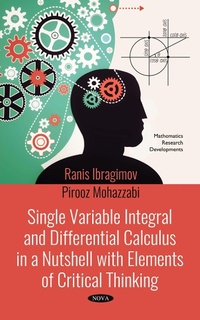
Single Variable Integral and Differential Calculus in a Nutshell with Elements of Critical Thinking
Published on 1. August 2018
331 pages
978-1-5361-4048-4 (ISBN)
Description

This book presents a variety of calculus problems concerning different levels of difficulty with technically correct solutions and methodological steps that look also correct, but that have obviously wrong results (like 0 = 1). Those errors are aimed to be resolved by applying critical thinking (i.e., reasonable, reflective, responsible, and skillful thinking). This book is structured in such a way that finding a problem for a given solution with the wrong answer requires a proper diagnosis by asking the right questions, which is one of the first steps to critical thinking. The objective of this book is to motivate students to identify various strategies and to develop criteria for choosing a suitable strategy to resolve obvious errors or illogical statements.
More details
Other editions
Additional editions
Ranis Ibragimov | Pirooz Mohazzabi
Single Variable Integral and Differential Calculus in a Nutshell with Elements of Critical Thinking
Book
09/2018
Nova Science Publishers Inc
€303.05
Shipment within 15-20 days
Content
- Intro
- SINGLE VARIABLE INTEGRALAND DIFFERENTIAL CALCULUS INA NUTSHELL WITH ELEMENTS OFCRITICAL THINKING
- SINGLE VARIABLE INTEGRALAND DIFFERENTIAL CALCULUS INA NUTSHELL WITH ELEMENTS OFCRITICAL THINKING
- Contents
- Preface
- Chapter 1Introduction
- 1. Review of Algebra
- Complex Numbers
- Quadratic Equations
- Equations of Line, Parabola and Circle
- Distance between Two Points
- Domain and Range of a Function
- One-to-One Functions and Their Inverses
- Systems of Simultaneous Equations
- Polynomial Functions
- Rational Functions and the Method of Partial Fractions
- Exponential Functions
- Logarithmic Functions
- The Laws of Logarithm
- The Sigma Notation
- Properties of Sums
- The Binomial Theorem
- Even and Odd Functions
- 1.1. Exercises
- 1.2. Critical Thinking
- Review of Trigonometry
- Trigonometric Functions of Simple Angles
- Trigonometric Functions of Angles with Terminal Points Not in theFirst Quadrant
- Trigonometric Identities
- Addition and Subtraction Identities
- Double-Angle Identities
- Identities for Lowering Power
- Half-Angle Identities
- Product-to-Sum Identities
- Sum-to-Product Identities
- Linear Combination of Sine and Cosine
- Euler's Formula
- Exercises
- 1.3. Critical Thinking
- Chapter 2Limits, Continuity andDerivatives
- 2. Sequences. Limits of Sequences
- 2.1. Motivation
- 2.2. Basic Concepts
- 2.3. Examples
- 2.4. Exercises
- 3. Finding the Limits of Sequences
- 3.1. Basic Concepts
- 3.2. Examples
- 3.3. Exercises
- 3.4. Critical Thinking
- 4. Existence of the Limit of a Sequence
- 4.1. Basic Concepts
- 4.2. Examples
- 4.3. Exercises
- 5. Limit of a Function
- 5.1. Motivation
- 5.2. Basic Concepts
- 5.3. Examples
- 5.4. Exercises
- 5.5. Critical Thinking
- 6. Techniques for Finding Limits of Functions
- 6.1. Basic Concepts
- 6.2. Examples
- 6.3. Exercises
- 6.4. Critical Thinking
- 7. Infinitely Small and Infinitely Large Functions
- 7.1. Motivation
- 7.2. Basic Concepts
- Useful Facts to Remember
- 7.3. Examples
- 7.4. Exercises
- 8. Equivalent Infinitesimals and Applicationsto Finding Limits
- 8.1. Basic Concepts
- 8.2. Examples
- 8.3. Exercises
- 8.4. Critical Thinking
- 9. One-Sided Limits
- 9.1. Basic Concepts
- 9.2. Examples
- 9.3. Exercises
- 10. Continuity, Singularities and Their Classification
- 10.1. Basic Concepts
- 10.2. Examples
- 10.3. Exercises
- 11. Properties of Continuous Functions, Continuity ofComposite and Inverse Functions
- 11.1. Basic Concepts
- 11.2. Examples
- 11.3. Exercises
- 11.4. Critical Thinking
- Chapter 3Derivative and Differentiation
- 12. Derivative
- 12.1. Motivation
- 12.2. Basic Concepts
- 12.3. Examples
- 12.4. Exercises
- 13. Differentiation of Explicit Functions
- 13.1. Motivation
- The Chain Rule
- 13.2. Basic Concepts
- I. Basic Rules of Differentiation
- II. Differentiation of a Composite Function (Chian Rule)
- III. Differentiation of Basic Elementary Functions
- 13.3. Examples
- 13.4. Exercises
- 13.5. Critical Thinking
- 14. Higher-Order Derivatives. Leibniz Formula
- 14.1. Motivation
- 14.2. Basic Concepts
- 14.3. Examples
- 14.4. Exercises
- 15. Differentiation of Inverse, Implicit and ParametricFunctions
- 15.1. Motivation
- 15.2. Basic Concepts
- 15.3. Examples
- 15.4. Mathematical Modeling
- 15.5. Exercises
- Chapter 4Applications of Derivative
- 15.6. Motivation
- Equation of a Line Tangent to a Curve
- 15.7. Basic Concepts
- 15.8. Examples
- 15.9. Mathematical Modeling
- 15.10. Exercises
- 15.11. Critical Thinking
- 16. Differential and Small Variations of Functions
- 16.1. Motivation
- 16.2. Basic Concepts
- 16.3. Examples
- 16.4. Mathematical Modeling
- 16.5. Exercises
- 17. Main Theorems about Differentiable Functions
- 17.1. Basic Concepts
- 17.2. Examples
- 17.3. Exercises
- 18. Indeterminate Forms and L'H^opital's Rule
- 18.1. Motivation
- 18.2. Basic Concepts
- 18.3. Examples
- 18.4. Exercises
- 18.5. Critical Thinking
- 19. Taylor's Expansion. Application to ApproximateCalculus
- 19.1. Motivation
- 19.2. Basic Concepts
- 19.3. Examples
- 19.4. Exercises
- 20. Maxima and Minima of Functions
- 20.1. Motivation
- 20.2. Basic Concepts
- Minimum and Maximum Values of Explicit Functions
- Minimum and Maximum Values of Parametric Functions
- 20.3. Examples
- 20.4. Mathematical Modeling
- 20.5. Exercises
- 20.6. Critical Thinking
- 21. Optimization
- 21.1. Motivation
- 21.2. Basic Concepts
- 21.3. Examples
- 21.4. Mathematical Modeling
- An Asteroid on a Collision Course with a Planet
- 21.5. Exercises
- 21.6. Critical Thinking
- Circle Paradox
- 22. Concavity, Points of Inflections and Asymptotes
- 22.1. Basic Concepts
- 22.2. Examples
- 22.3. Exercises
- Chapter 5Integration
- 23. Indefinite Integral
- 23.1. Motivation
- Integration by Parts
- 23.2. Basic Concepts and Methods
- 23.3. Examples
- Generalized Integration by Parts
- 23.4. Mathematical Modeling
- 23.5. Exercises
- 23.6. Critical Thinking
- 24. Definite Integral
- 24.1. Motivation
- Limits and Integration - Definite Integrals
- Average Value of a Function
- 24.2. Basic Concepts
- Basic Properties
- 24.3. Examples
- Critical Thinking
- 24.4. Exercises
- 24.5. Critical Thinking
- 25. Basic Methods for Evaluating Definite Integrals
- 25.1. Basic Concepts
- Change of Variable
- Simplifications Based on Symmetry of Integrands
- Integration by Parts
- Approximate Evaluation of Definite Integrals
- 25.2. Examples
- 25.3. Exercises
- 25.4. Critical Thinking
- 26. Applications of Definite Integrals
- 26.1. Basic Concepts
- 26.2. Examples
- 26.3. Exercises
- 26.4. Critical Thinking
- 27. Improper Integrals
- 27.1. Basic Concepts
- The p-Integrals
- The p-Test:
- Comparison Test for Improper Integrals
- Improper Integrals of Unbounded Functions
- 27.2. Examples
- 27.3. Mathematical Modeling
- 27.4. Exercises
- 27.5. Critical Thinking
- References
- About the Authors
- Index
- Blank Page
