

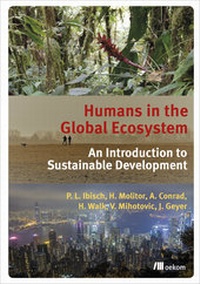
Humans in the Global Ecosystem
An Introduction to Sustainable Development
1st Edition
Published on 6. June 2019
416 pages
978-3-96238-578-1 (ISBN)
Description

The term 'sustainability' is on everyone's lips, but nevertheless we struggle to transpose the idea into our economic and social structures. This book aims to provide an overview of the relevant discourses, but also - and above all - a stimulus for fresh thinking, with new suggestions for the defence and further development of the concept of sustainable development. It addresses the position of humans in the global (eco)system, and it interprets and applies sustainability as a multi- and inter-disciplinary concept. It is concerned as much with problem analysis as with proposed solutions and with the necessary conditions for sustainable development. The Eberswalde University for Sustainable Development (EUSD) is committed to a comprehensive implementation of sustainability, in all its complexity, in teaching, research, knowledge transfer and operational practice. It was the first German university to develop and implement, in a wide-ranging participatory process involving all staff and students, a detailed programme of sustainable development, and is considered a pioneer in this regard among German higher education institutions. This textbook has grown out of a foundation course lecture on sustainable development at the Eberswalde University for Sustainable Development. The editors conceived the book from that starting point and developed and elaborated it with the help of many colleagues.
More details
Other editions
Additional editions
Pierre L. Ibisch | Heike Molitor | Alexander Conrad
Humans in the Global Ecosystem
An Introduction to Sustainable Development
Book
06/2019
oekom verlag
€29.00
Shipment within 10-20 days
Persons
Author
Pierre L. Ibisch ist habilitierter Biologe und nach langjähriger Tätigkeit in der Entwicklungszusammenarbeit seit 2004 Professor für Nature Conservation an der Hochschule für nachhaltige Entwicklung Eberswalde, wo er in Kooperation mit einem britischen Kollegen das Centre for Econics and Ecosystem Management leitet. Seit 2009 ist er Inhaber verschiedener Forschungsprofessuren (Biodiversität und Naturressourcenmanagement im globalen Wandel, bis 2015; Ökosystembasierte nachhaltige Entwicklung, seit 2015). Er ist Mitglied des Vorstands der Deutschen Umweltstiftung.
ISNI: GND:
ISNI: GND:
Heike Molitor ist seit 2009 Professorin für Umweltbildung und Bildung für nachhaltige Entwicklung an der Hochschule für nachhaltige Entwicklung Eberswalde und Forschungsprofessorin (2018-2020). Sie war und ist Mitglied in diversen Beiräten (Beirat für nachhaltige Entwicklung des Landes Brandenburg 2010 bis 2014, Sachverständigenbeirat für Naturschutz und Landschaftspflege Berlin 2017-2021, Fachforum Hochschule des Weltaktionsprogramms Bildung für nachhaltige Entwicklung 2015-2019).
ISNI: GND:
ISNI: GND:
Alexander Conrad ist seit 2014 Professor für Volkswirtschaftslehre, insbesondere nachhaltiges Regionalmanagement und Kommunalfinanzen, an der Hochschule für nachhaltige Entwicklung Eberswalde. Er leitet den Studiengang Regionalmanagement und hat seinen Forschungsschwerpunkt im Bereich nachhaltige Versorgungssysteme im ländlichen Raum.
ISNI: GND:
ISNI: GND:
Heike Walk ist habilitierte Politikwissenschaftlerin und Professorin für Transformation Governance an der Hochschule für nachhaltige Entwicklung Eberswalde. Seit 2003 ist sie Mitherausgeberin der Buchreihe >Bürgergesellschaft und Demokratie< im Verlag Springer Fachmedien. Darüber hinaus ist sie Sprecherin des Arbeitskreises >Zivilgesellschaftsforschung< des Bundesnetzwerks Bürgerschaftliches Engagement.
ISNI: GND:
ISNI: GND:
Vanja Mihotovic ist Professor für Technische Mechanik, Physik und Elektrotechnik an der Hochschule für nachhaltige Entwicklung Eberswalde. Er promovierte im Bereich Fertigungstechnik/Produktionstechnik und war langjähriger Mitarbeiter bei Siemens Energy, Bereich Gasturbine.
ISNI: GND:
ISNI: GND:
Juliane Geyer promovierte zur Anpassung von Naturschutzmanagement an den Klimawandel und war seit 2009 als freie und akademische Mitarbeiterin in diversen Projekten des Centre for Econics and Ecosystem Management an der Hochschule für nachhaltige Entwicklung Eberswalde vor allem zu Schutzgebietsmanagement tätig. Außerdem engagiert sie sich in lokalen Initiativen für eine nachhaltige Entwicklung.
Content
- Humans in the Global Ecosystem
- Contents
- Preface I by Michael Succow
- Preface II by Marlehn Thieme
- Foreword by the Editors
- Part 1: Understanding the challenge: the systems question
- 1.1 The biosphere: a short report on the state of the Earth. Pierre L. Ibisch
- Human life and its impact on the biosphere: the Anthropocene and the 'Tachycene'
- The growth of interacting environmental problems
- 1.2 Sustainability as a reaction: what has been happening so far. Heike Molitor and Pierre L. Ibisch
- The origin of sustainability - as a reaction to an increasing scarcity of wood in Europe
- The birth of environmental consciousness and awareness of the limits to growth
- Development: a discourse becomes sustainable
- Models of sustainability
- Fundamental principles of sustainable development
- Concluding remarks
- 1.3 Systems theory: towards a holistic and interdisciplinary understanding of sustainable development. Pierre L. Ibisch
- The search for a scientific theory of sustainability
- Systems: from self-organization and self-regulation to husbandry and long-term functionality
- Humans, social systems and sustainable development
- Part 2: We humans: the agents of sustainable development
- 2.1 Good or evil - are we capable of sustainability? Pierre L. Ibisch and Norbert Jung
- Introduction: our relatives
- The emergence of human beings was only possible through cooperation and fairness
- From biological to cultural evolution, and the growth of human power
- From revolution to revolution: ever faster, more, bigger and better
- Is the sustainability revolution on its way?
- 2.2 What motivates people to sustainability-oriented action? Heike Molitor
- What motivates people to act?
- Case study: How aware are Germans of the environment or sustainability?
- How can environmentally friendly or sustainable behaviour be promoted? Behavioural interventions
- How much 'energy' do I have to expend on new behavioural offers? A cost-benefit analysis undertaken by
- Homo oeconomicus
- In uence of environmental awareness
- The psychological explanation for sustainable behaviour
- Part 3: (Un)sustainable systems: analysis and strategic approaches
- 3.1 The foundations: ecosystems and ecosystem management
- The foundations of ecosystem use
- Ecosystems as a productive force and a source of human well-being
- The application of economics to ecosystem management
- 3.2 The drivers: economic systems. Alexander Conrad and Jan König
- Introduction: What is economics?
- The economic system
- Decoupling of the monetary sphere
- Economic growth
- The focus on growth, and its consequences
- To what extent is economic policy focused on economic growth, and is this focus justified?
- Can economic growth improve environmental protection?
- Has the economy always been geared towards growth?
- 3.3 The power source: energy supply systems. Vanja Mihotovic
- Energy supply now
- Energy production technologies
- Conventional energy production technologies
- Heat engines
- Nuclear energy
- Shale gas as an energy source
- CCS technologies
- Technologies for the energy transition
- Solar energy
- Wind power
- Use of biomass
- Hydropower
- Geothermal energy
- Heat pumps
- Energy production and sustainability
- Energy supply in Germany in 2050 - possible scenarios
- Closing remarks
- 3.4 The controls: political systems. Benjamin Nölting, Hermann E. Ott and Heike Walk
- The politics of sustainable development - what is it?
- Setting the political course - simply a case of governing by decree?
- The negotiations leading to the adoption of 'sustainable development' as a policy goal
- The formulation of political sustainability strategies
- The implementation of the politics of sustainability
- Case study: the politics of the Energiewende in Germany - a key to sustainable development
- Is there political support, and a political opportunity, for an energy transition?
- Is there a consistent policy strategy for the energy transition?
- Are appropriate instruments and regulatory measures available for implementation?
- The scope of, and limits to, a politics of sustainability - the governance approach
- 3.5 Everyone affected and involved: civil society systems. Heike Walk, Hermann E. Ott and Martin Welp
- Civil society - a term with a long tradition
- The significance of civil society on different political levels
- From civil society to volunteers: new inequalities
- Different forms of civic participation
- The link between sustainability and civic participation
- Part 4: The transformation to sustainability
- 4.1 Ecosystem-based sustainable development. Pierre L. Ibisch
- The rationalization of nature, and the discovery that it is worth protecting
- From the ecosystem approach to ecosystem law and ecosystem ethics
- Ecosystem-based sustainable development
- 4.2 Sustainability transformation. Heike Walk and Pierre L. Ibisch
- The need for radical changes
- What does transformation mean?
- New forms of cooperation for transformation
- Daring to seek greater solidarity - solutions for a systemic transformation
- The democratic framework for the 'Great Transformation'
- 4.3 A sustainable economy. Alexander Conrad, Jan König and Hans-Peter Benedikt
- Economics in the context of weak and strong sustainability
- The theoretical framework - structure and content of a sustainable economic system
- Implementation approaches for a sustainable economy
- Monitoring the achievement of goals in sustainable economic systems
- Conclusion
- 4.4 Education for sustainable development. Heike Molitor
- Background and political history
- Education (for sustainable development)
- Important features of education for sustainable development in higher education
- Feature 1: Addressing relevant topics or areas within sustainable development - with reference to the SDGs
- Feature 2: Competence orientation in teaching
- Feature 3: Self-determination - co-determination - participation
- Feature 4: The 'Whole Institution Approach'
- Models for the implementation of ESD in higher education institutions
- Model I: Introductory lecture on sustainable development with student participation
- Model II: Project workshops
- Conclusion
- 4.5 Institutional transformation to sustainability: the example of Eberswalde University for Sustainable Development. Wilhelm-Günther Vahrson and Kerstin Kräusche
- Historical background
- Back to the present
- Change Process I: Self-discovery
- Change Process II: The winds of change blow in from outside
- Change Process III: A new name
- Focus
- Achievements and uncertainties
- Conclusion
- Bibliography
- Index
- Editors and co-authors
