

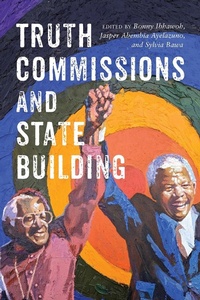
Truth Commissions and State Building
1st Edition
Published on 14. November 2023
422 pages
978-0-2280-1963-3 (ISBN)
Description

More than just an opportunity to uncover fact after conflict, truth commissions can also offer restorative power to nations across the globe. Truth Commissions and State Building presents the first comparative study of the role of its kind, illuminating these possibilities.
Examining truth commissions as mechanisms for civic inclusion, identity formation, institutional reform, and nation (re)building in post-conflict and post-authoritarian societies, the book shifts attention towards institutional innovation in African countries, where approximately a third of all commissions have been established. Contributors explore the mandates, methods, outcomes, and legacies of truth commissions, analyzing their place in transitional and restorative justice. Rather than conceptualizing state building as incidental to their work, they present it as an intrinsic, central component. This flagship volume - authored by a stellar cast of policymakers, practitioners, and scholars - brings multidisciplinary and cross-sectoral perspectives to bear on the complex role of truth commissions in addressing transitional justice, historical injustices, and present-day human rights violations.
As more countries, in both the Global South and the North, adopt this model to address historical and contemporary abuses, the dialogue between different sectors of society modelled here will help inform this process - wherever it might occur.
Examining truth commissions as mechanisms for civic inclusion, identity formation, institutional reform, and nation (re)building in post-conflict and post-authoritarian societies, the book shifts attention towards institutional innovation in African countries, where approximately a third of all commissions have been established. Contributors explore the mandates, methods, outcomes, and legacies of truth commissions, analyzing their place in transitional and restorative justice. Rather than conceptualizing state building as incidental to their work, they present it as an intrinsic, central component. This flagship volume - authored by a stellar cast of policymakers, practitioners, and scholars - brings multidisciplinary and cross-sectoral perspectives to bear on the complex role of truth commissions in addressing transitional justice, historical injustices, and present-day human rights violations.
As more countries, in both the Global South and the North, adopt this model to address historical and contemporary abuses, the dialogue between different sectors of society modelled here will help inform this process - wherever it might occur.
Reviews / Votes
"While there are a few books on transitional justice, broadly construed, and others focusing on Africa, this volume's framing is entirely unique and its discussion of outcomes and legacies, essential." Aderomola Adeola, co-editor of The Palgrave Handbook of Democracy, Governance and Justice in Africa "This is the first time I have seen an effort to develop sustained and systematic investigation of how truth commissions operate as state building tools. The book will be of great interest to those studying transitional justice, as well as African politics, memory politics, and legal pluralism." Bronwyn Leebaw, author of Judging State-Sponsored Violence, Imagining Political Change "Original and noteworthy. Nelson Mandela and the Archbishop Tutu may be the face of truth commissions globally, but Truth Commissions and State Building travels from Sierra Leone, Burkina Faso, and The Gambia to Canada [to] tackle concerns about justice, civic participation, gendered violence, and the voluminous archives created by such commissions while making the case for iterative evaluations of these efforts to build states and nations in the wake of trauma." African Studies Review 2024 Best Africa-Focused Anthology or Edited Collection Prize Jury "More than 50 state-sponsored or civil society-led truth commissions were established by 2023. They seek restorative justice in the face of prior widespread human rights abuses. This collection's 16 chapters move from theoretical engagements to methods and process to documents and archives, concluding with outcomes and legacies. Recommended." Choice "The year 2024 is significant for elections around the world, including on the African continent. Given this, the insights of Truth Commissions and State Building, particularly the chapters that probe civic inclusion, identity formation, and institutional reform, could not have come at a better time." H-DiploMore details
Language
English
Place of publication
Montreal, QC
Canada
Target group
Professional and scholarly
Edition type
Digital original
Illustrations
5 diagrams, 1 table
5 diagrams, 1 table
File size
6,76 MB
ISBN-13
978-0-2280-1963-3 (9780228019633)
Copyright in bibliographic data and cover images is held by Nielsen Book Services Limited or by the publishers or by their respective licensors: all rights reserved.
Schweitzer Classification
Other editions
Additional editions
Bonny Ibhawoh | Jasper Abembia Ayelazuno | Sylvia Bawa
Truth Commissions and State Building
Book
11/2023
McGill-Queen's University Press
€117.80
Shipment within 15-20 days
Bonny Ibhawoh | Jasper Abembia Ayelazuno | Sylvia Bawa
Truth Commissions and State Building
Book
11/2023
McGill-Queen's University Press
€42.00
Shipment within 15-20 days
Persons
Bonny Ibhawoh is professor of history and Senator William McMaster Chair in Global Human Rights at McMaster University.
Jasper Abembia Ayelazuno is associate professor of political science and vice-dean of the Faculty of Communication and Cultural Studies at the University for Development Studies.
Sylvia Bawa is associate professor of sociology at York University.
Jasper Abembia Ayelazuno is associate professor of political science and vice-dean of the Faculty of Communication and Cultural Studies at the University for Development Studies.
Sylvia Bawa is associate professor of sociology at York University.
Content
- Truth Commissions and State Building
- Cover
- Half Title Page
- Title Page
- Copyright
- Dedication
- Contents
- Table and Figures
- Acknowledgments
- Abbreviations
- INTRODUCTION: Truth Commissions and the Politics of State Building
- THE GLOBALIZATION OF TRUTH COMMISSIONS
- TRUTH COMMISSIONS AND STATE BUILDING IN AFRICA
- COLONIAL ANTECEDENTS
- AFRICAN LESSONS AND PERSPECTIVES
- APPROACHES AND METHODOLOGIES
- ORGANIZATION
- NOTES
- SECTION ONE: Conceptual and Theoretical Engagements
- 1 Truth Commissions, Civic Participation, and State Building
- TYPOLOGIZING TRUTH COMMISSIONS
- TRUTH COMMISSIONS AND RESTORATIVE JUSTICE
- PARTICIPATION AND TRANSITIONAL JUSTICE
- TRUTH COMMISSIONS AND CIVIC PARTICIPATION
- CONCLUSION
- NOTES
- 2 Truth-Seeking Processes as Redress for Victims of Conflict-Related Sexual Violence
- TRUTH COMMISSIONS AND REDRESS FOR VICTIMS OF CONFLICT-RELATED SEXUAL VIOLENCE
- TRUTH-SEEKING PROCESSES, CONFLICT-RELATED SEXUAL VIOLENCE, AND VICTIM EMPOWERMENT
- REDRESS FOR THE VICTIMS OF SEXUAL VIOLENCE THROUGH THE GACACA COURTS IN RWANDA
- CONCLUDING REMARKS
- NOTES
- 3 The African Human Rights and Transitional Justice Architecture: An Analytical Outline
- THE AU HUMAN RIGHTS SYSTEM AND THE SHARED VALUES INSTRUMENTS
- MAPPING THE INSTITUTIONAL LANDSCAPE OF TRANSITIONAL JUSTICE IN AFRICA
- STRENGTHS AND WEAKNESSES OF THE AFRICAN HUMAN RIGHTS AND TRANSITIONAL JUSTICE ARCHITECTURE
- PROSPECTS FOR STRENGTHENING HUMAN RIGHTS AND TRANSITIONAL JUSTICE IN AFRICA
- NOTES
- 4 Decolonization, Gender, and Transitional Justice in Post-Colonial Africa
- DECOLONIZATION AND DISCOURSES OF NATION BUILDING AND NATION (RE)CONSTRUCTION IN AFRICA
- RECONCILING THE PERSONAL-PUBLIC POLITICS OF WINNIE AS MOTHER OF THE NATION
- FATHERS AND MOTHERS OF THE NATION: DISRUPTIONS IN GENDERED NATIONALITIES
- CONCLUSION
- NOTES
- SECTION TWO: Methods and Processes
- 5 Whites and the South African Truth and Reconciliation Commission
- THE TRC
- AMNESTY AND THE DEMOBILIZATION OF THE RIGHT WING
- WHITES AND RECONCILIATION
- NOTES
- 6 Truth, Reconciliation, and Peace: Building a National Infrastructure for Peace in Sierra Leone
- SIERRA LEONE: POLITICS AND CONFLICT
- SIERRA LEONE'S TRUTH & RECONCILIATION COMMISSION (TRC)
- TRC'S PROCESSES AND EVENTS
- A ROAD MAP TO PEACE AND NATIONAL COHESION
- CONCLUSION
- NOTES
- 7 Truth, Justice, and National Reconciliation: The Dilemmas of Transitional Justice in Burkina Faso
- TRANSITIONAL JUSTICE AND DEMOCRACY
- TRCS AND THE BUILDING OF DEMOCRATIC STATES
- TRANSITIONAL JUSTICE AS A "POLITICAL FIELD"
- TRANSITIONAL JUSTICE IN BURKINA FASO
- TRANSITIONAL JUSTICE MEASURES AND THE BUILDING OF A DEMOCRATIC STATE
- TAKING MEASURES TO PROVIDE JUSTICE
- THE QUEST FOR NATIONAL RECONCILIATION
- CONCLUSION
- NOTES
- 8 Mali's Truth, Justice, and Reconciliation Commission: Truth Seeking and Peacebuilding across Borders
- MALI'S MAIN TRANSITIONAL JUSTICE INSTITUTION: THE CVJR
- ASFC'S SUPPORT OF THE CVJR
- SHARING LESSONS ACROSS BORDERS
- CONCLUSION
- NOTES
- 9 Post-Authoritarianism, Truth Seeking, and the Judicial Accountability Gap: Lessons from Nigeria
- THE AUTHORITARIAN PAST OF NIGERIA
- POLITICAL CHANGE AND TRANSITIONAL JUSTICE IN NIGERIA
- UNDOING TRUTH AND JUSTICE: THE DELE GIWA PETITION AND THE JUDICIARY
- JUDICIAL ACCOUNTABILITY FOR THE PAST
- THE JUDICIARY AND THE RULE OF LAW
- INTEGRITY VERSUS ACCOUNTABILITY: TWO NORMATIVE ARGUMENTS
- AN UNACCOUNTED JUDICIARY AND A TROUBLED TRANSITION
- CONCLUSION
- NOTES
- SECTION THREE: Documents and Archives
- 10 TRCs and the Archival Imperative
- TRC ARCHIVES, IN PART AND IN WHOLE
- CASE STUDIES OF DISAPPEARANCE AND APPEARANCE
- CONCLUSION
- NOTES
- 11 Nation and Narration: Creative Imaginaries of Truth and Reconciliation
- THEORETICAL AND METHODOLOGICAL FORMULATION
- STORYTELLING AND STATE FORMATION: TESTIMONIES AND NARRATIVE STRATEGIES
- CONCLUDING REMARKS: NATION MAKING AS CULTURAL SIGNIFICATION
- NOTES
- 12 The South African Truth and Reconciliation Commission and Access to its Documentation
- DOCUMENTING THE SOUTH AFRICAN TRC
- UNDERSTANDING OF THE SOUTH AFRICAN TRC'S WORK
- THE PRESERVATION AND USE OF SOUTH AFRICAN TRC DOCUMENTATION
- CONCLUSION
- NOTES
- 13 The Gambian TRRC: Toward a "Comprehensive Model" of Truth Commissions
- THE GAMBIAN TRRC
- THE CONTROVERSIES OF THE GAMBIAN TRRC
- THE COMPREHENSIVE APPROACH OF THE GAMBIAN TRRC TO TRUTH AND RECONCILIATION
- CONCLUSION
- NOTES
- SECTION FOUR: Outcomes and Legacies
- 14 Ghana's National Reconciliation Commission: A Retrospective
- THE WORK OF THE NRC
- FINDINGS OF THE NRC
- THE NRC RECOMMENDATIONS
- IMPLEMENTATION, OR LACK THEREOF, OF THE NRC'S RECOMMENDATIONS
- EXHUMATIONS AND COMMEMORATIVE ACTS
- REPARATIONS AND MONETARY COMPENSATION
- DE-CONFISCATION OF ASSETS
- IMPACT OF THE NRC'S WORK
- IMPLICATIONS OF POST-RECONCILIATION HUMAN RIGHTS VIOLATIONS FOR THE NRC'S WORK
- CONCLUSION: "HIGHLY CONTESTED TRUTHS AND NO RECONCILIATION"
- NOTES
- 15 The Long-Term Legacies of Transitional Justice: Understanding the Paradox of Peace in Sierra Leone
- LIMITS AND FRICTIONS OF THE SIERRA LEONE TRC
- THE PARADOX OF PEACE
- CONCLUSION: ASSESSING LONG-TERM LEGACIES WITH EPR
- NOTES
- 16 Rebuilding Social Cohesion in Post-Genocide Rwanda
- TRANSITIONAL JUSTICE APPROACHES IN RWANDA: REBUILDING SOCIAL COHESION
- THE GACACA COURTS
- NATIONAL COMMISSION FOR THE FIGHT AGAINST GENOCIDE
- FUND FOR NEEDIEST SURVIVORS OF GENOCIDE IN RWANDA
- MEMORIALIZATION EFFORTS
- OTHER INITIATIVES AIMED AT RECONSTRUCTION AND RECONCILIATION
- SECURITY SYSTEM REFORM
- CONCLUSION
- NOTES
- CONCLUSION: Assessing Truth Commission Impacts and Legacies
- UNIVERSALIZING THE RIGHT TO TRUTH
- NOTES
- Contributors
- Index
