

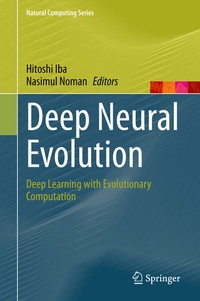
Deep Neural Evolution
Description

This book delivers the state of the art in deep learning (DL) methods hybridized with evolutionary computation (EC). Over the last decade, DL has dramatically reformed many domains: computer vision, speech recognition, healthcare, and automatic game playing, to mention only a few. All DL models, using different architectures and algorithms, utilize multiple processing layers for extracting a hierarchy of abstractions of data. Their remarkable successes notwithstanding, these powerful models are facing many challenges, and this book presents the collaborative efforts by researchers in EC to solve some of the problems in DL.
EC comprises optimization techniques that are useful when problems are complex or poorly understood, or insufficient information about the problem domain is available. This family of algorithms has proven effective in solving problems with challenging characteristics such as non-convexity, non-linearity, noise, and irregularity, which dampen the performance of most classic optimization schemes. Furthermore, EC has been extensively and successfully applied in artificial neural network (ANN) research -from parameter estimation to structure optimization. Consequently, EC researchers are enthusiastic about applying their arsenal for the design and optimization of deep neural networks (DNN). This book brings together the recent progress in DL research where the focus is particularly on three sub-domains that integrate EC with DL: (1) EC for hyper-parameter optimization in DNN; (2) EC for DNN architecture design; and (3) Deep neuroevolution. The book also presents interesting applications of DL with EC in real-world problems, e.g., malware classification and object detection. Additionally, it covers recent applications of EC in DL, e.g. generative adversarial networks (GAN) training and adversarial attacks. The book aims to prompt and facilitate the research in DL with EC both in theory and in practice.More details
Other editions
Additional editions
Persons
Hitoshi Iba received his Ph.D. degree from The University of Tokyo, Japan, in 1990. From 1990 to 1998, he was with the Electro Technical Laboratory in Ibaraki, Japan. Since 1998, he has been with The University of Tokyo, where he is currently a professor in the Graduate School of Information Science and Technology. His research interests include evolutionary computation, artificial life, artificial intelligence, and robotics. He is an associate editor of the Journal of Genetic Programming and Evolvable Machines (GPEM). Dr. Iba is also is an underwater naturalist and experienced Professional Association of Diving Instructors (PADI) divemaster, having completed more than a thousand dives.
Nasimul Noman received his Ph.D. degree from The University of Tokyo, Japan, in 2007. He was a faculty member in the Department of Computer Science and Engineering, University of Dhaka, Bangladesh, from 2002 to 2012. In 2013, he joined the School of Electrical Engineering and Computing at The University of Newcastle, Australia, and currently he is working as a senior lecturer there. His research interests include evolutionary computation, computational biology, bioinformatics, and machine learning.
