

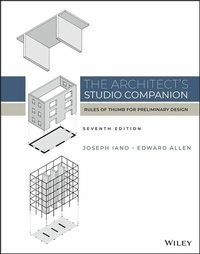
The Architect's Studio Companion
Description

The latest edition of the guidebook every architect needs at their fingertips, updated and expanded throughout
Start your designs on solid ground with The Architect's Studio Companion! This comprehensive handbook provides everything you need for the preliminary selecting, configuring, and sizing of the structural, environmental, safety, accessibility, and parking systems of a building. Edward Allen and Joseph Iano, authors of the market-leading Fundamentals of Building Construction, use their trademark talent for boiling down complex technical requirements into easy-to-use, time-saving guidelines for the engineering and architectural design of buildings.
The new seventh edition is updated with new building codes, new information on heating and cooling systems for buildings, new structural systems, new requirements for tall mass timber buildings, and more. Throughout the text, straightforward diagrams and user-friendly explanations help you lay out the most important systems of a building in a matter of minutes without stressing about complicated technical concepts. Use this guide to introduce building systems into the early stages of design, and greatly reduce the need for later revisions or redesign???and keep your projects on time and on budget.
Streamline your design process today with The Architect's Studio Companion:
* Explore alternative structural systems quickly and efficiently
* Compare the carbon impacts of alternative system choices... at a glance
* Stay current with the latest information about tall mass timber buildings
* Access information on high-performance heating and cooling systems, passive design, natural daylighting, and other sustainable design strategies with ease
* Incorporate U.S. and Canadian building code requirements and accessibility regulations into your designs
More than just a reference, The Architect's Studio Companion, Seventh Edition is a must-have companion that no practicing architect or student should be without.
More details
Other editions
Additional editions
Persons
Joseph Iano is an author, illustrator, and practicing architect who has taught design and technology in schools of architecture throughout the United States. He has collaborated on numerous publications over a span of more than 30 years. Currently, he runs a Seattle firm that provides technical, quality management, and communications consulting to the design and construction industry.
Edward Allen, FAIA (1938-2020) taught more than 35 years as a faculty member of Yale University, Massachusetts Institute of Technology, and other North American schools of Architecture and Design. Over the course of a professional career spanning five decades, he influenced a generation of architectural educators, designed more than 50 constructed buildings, and was the best-selling coauthor of Fundamentals of Building Construction, Form and Forces, Architectural Detailing, Fundamentals of Residential Construction, and many other architectural works in print.
Content
Acknowledgments ix
How to Use This Book xi
Section 1 Designing with Building Codes 1
1. Designing with Building Codes 3
Section 2 Designing the Structure 19
1. Selecting the Structural System 21
2. Configuring the Structural System 39
3. Sizing the Structural System 55
Section 3 Designing with Daylight 139
1. Design Criteria for Daylighting Systems 141
2. Configuring and Sizing Daylighting Systems 151
Section 4 Designing Spaces for Mechanical and Electrical Services 159
1. Selecting Heating and Cooling Systems for Large Buildings 161
2. Configuring and Sizing Mechanical and Electrical Services for Large Buildings 185
3. Passive Heating and Cooling Systems 221
4. Mechanical and Electrical Systems for Small Buildings 239
Section 5 Designing for Egress And Accessibility 265
1. Configuring the Egress System and Providing Accessible Routes 267
2. Sizing the Egress System 301
3. Stairway and Ramp Design 317
Section 6 Designing for Parking 333
1. Design Criteria for Parking Facilities 335
2. Configuring Parking Facilities 343
3. Sizing Parking Facilities 355
Section 7 Designing with Height And Area Limitations 369
1. Construction Types and Height and Area Limitations 371
2. Height and Area Tables 393
Appendix A Example Use of This Book 481
Appendix B Units of Conversion 487
Bibliography 489
Index 491
1
DESIGNING WITH BUILDING CODES
This section will help you determine which model building code and occupancy classifications to apply to the project you are designing. You will need to know these facts to have full access to the information throughout this book.
- Building Codes and Zoning Ordinances
- Occupancies: International Building Code
- Occupancies: National Building Code of Canada
BUILDING CODES AND ZONING ORDINANCES
A designer works under complex legal constraints that exert a powerful influence on the form a building may take. Local zoning ordinances control building uses, heights, areas, distances from property lines, and on-site parking capacities. Building codes enacted at the municipal, county, state, or provincial level regulate everything from building heights and areas to the types of interior finish materials that may be used. Further constraints are often imposed by local fire districts, by health and safety regulations pertaining to particular uses, and by regulations governing equal access to public facilities and housing.
Zoning laws and use-specific codes are most often promulgated at the local level and do not lend themselves to simple generalization from one jurisdiction to the next. For this reason, this book does not attempt to address these requirements, and the designer should consult the regulations in effect for guidance in these areas. On the other hand, although building codes are also enforced at local levels, the vast majority of North American building codes are derived from just a few nationally recognized model codes. The use of model codes as the basis for the majority of local building codes results in sufficient standardization that these regulations can be simplified and generalized in a meaningful way. Thus, preliminary guidelines can be provided for incorporating building code requirements into your project.
This book provides building code information based on two model building codes: the International Code Council's 2021 International Building Code and the National Research Council of Canada, Canadian Commission on Building and Fire Codes' National Building Code of Canada, 2015.1 These two model codes form the basis for the vast majority of building codes enacted by jurisdictions throughout the United States and Canada. This book condenses from these two model codes the provisions that have the most direct effects on building form: height and area limitations, beginning on page 371, and requirements for the design of egress systems and accessible spaces, starting on page 267. Code requirements having to do with the detailed design of structural and mechanical components of buildings are reflected here indirectly through the preliminary sizing charts for structural elements (beginning on page 55) and the rules of thumb for providing space for mechanical and electrical systems (beginning on page 185).
To make use of the information provided in this book, start by selecting the model code appropriate to your project. For projects in the United States, use the International Building Code, and for projects in Canada, use the National Building Code of Canada. Next, consult the appropriate code-specific index that follows, to ascertain the Occupancies for the building you are designing. These two pieces of information-model code and Occupancies-are the keys that will unlock information throughout other sections of this book.
The building code information provided in the following pages is intended only for preliminary purposes. The extent to which this information will accurately reflect the regulations with which any particular project must comply will differ from one locale to another. In some instances, a jurisdiction may adopt one of the model codes included in this book almost verbatim. In many cases, you will find that your project's locale has adopted one of these model codes, but with amendments or alterations to its requirements. And occasionally, you may encounter building code regulations wholly different from either of the model codes included in this book. For these reasons, before becoming too deeply immersed in your design, be sure exactly which codes and regulations govern your project, and verify that the information you use fully and accurately reflects the legal requirements that apply, whether that information comes from this book or other sources.
OCCUPANCIES: INTERNATIONAL BUILDING CODE
WHEN TO USE THE INTERNATIONAL BUILDING CODE
If your project is in the United States, use the International Building Code, starting on this page, as the basis for determining preliminary code requirements for your project. If your project is in Canada, use the National Building Code of Canada, starting on page 13. For more information about model building codes and their applicability to your project, see page 5.
OCCUPANCY CLASSIFICATION
Buildings, or portions of buildings, are classified by the activities for which they are used, termed Occupancies. These classifications reflect the relative life-safety hazards associated with the activities and occupant characteristics. In general, buildings intended for larger numbers of occupants, for public use, and for inherently hazardous activities are afforded greater levels of protection than those designed for smaller groups, private uses, and nonhazardous activities. Use the information on the following pages to determine which Occupancies most appropriately describe your project.
If your building contains multiple uses, determine the Occupancy classification for each part. Later in this book, you will find more information on how to apply the various code requirements to such mixed-Occupancy facilities; if you would like to learn more about mixed-Occupancy buildings right now, turn to pages 374-377.
GENERAL DESCRIPTION OF OCCUPANCIES
The following table describes each Occupancy according to the International Building Code.
Occupancy General Description A ASSEMBLY Assembly Occupancies include social, recreational, entertainment, and civic gatherings of 50 or more persons. Assembly Occupancy includes five subgroups:- A-1: This group includes theaters and halls for the viewing of motion pictures and performing arts, usually with fixed seating.
- A-2: This group includes food and drink establishments.
- A-3: This group includes recreational, amusement, and religious worship uses not specifically covered by other Assembly subgroups, including, for example, galleries, churches, community halls, courtrooms, dance halls, indoor sports facilities without fixed seating, lecture halls, libraries, museums, passenger station waiting areas, and the like.
- A-4: This group includes indoor sports facilities with spectator seating.
- A-5: This group includes outdoor sports arenas.
Gathering spaces less than 750 sq ft (70 m2) in area or accommodating fewer than 50 persons are treated as Group B, Business Occupancies, or, when located within other Occupancies, as part of the surrounding Occupancy.
Assembly spaces located within Group E, Educational facilities, are treated as part of the Group E Occupancy. B BUSINESS Business Occupancies include office, professional, and service activities, and storage of related records and accounts. Business Occupancy also includes education facilities past the 12th grade, but does not include retail or wholesale sales, which are classified as Group M Mercantile. Meeting rooms, auditoriums, or other spaces related to business uses but with 50 or more persons are classified as Assembly Occupancy. E EDUCATIONAL Educational Occupancies include spaces used for grades K through 12 education and day care facilities for children older than 2½ years of age accommodating six or more children.
Auditoriums, gymnasiums, and other assembly areas within Group E facilities are treated as part of the Group E Occupancy. Educational facilities above the 12th grade are classified as Group B Business.
Educational rooms and auditoriums within religious facilities, accommodating not more than 99 persons, are considered part of that facility's overall classification, usually Group A-3 Assembly. If they accommodate 100 or more persons, such spaces must be classified separately as Group E.
An Educational Occupancy may also include day care for up to 100 children 2½ years and younger when all rooms housing such children are on the ground level and have exit doors leading directly to the exterior. F FACTORY INDUSTRIAL Factory Industrial Occupancies include manufacturing, fabricating, finishing, packaging, repairing, and other industrial processes, except those considered especially hazardous, classified as Group H Hazardous, or those classified Group S Storage. Factory Occupancy has two subgroups:
- F-1 Moderate-Hazard: This group includes manufacturing and industrial processes with moderate fire hazard, such as those involving aircraft, appliances, automobiles, machinery, electronics, plastics, printing, woodworking, and any others not classified as Group F-2.
- F-2 Low-Hazard: This group includes manufacturing and industrial processes using nonflammable materials, such...
