

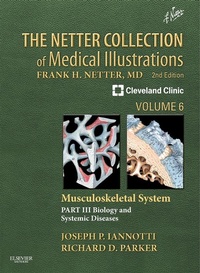
The Netter Collection of Medical Illustrations: Musculoskeletal System, Volume 6, Part III - Musculoskeletal Biology and Systematic Musculoskeletal Disease E-Book
The Netter Collection of Medical Illustrations: Musculoskeletal System, Volume 6, Part III - Musculoskeletal Biology and Systematic Musculoskeletal Disease E-Book
2nd Edition
Published on 15. January 2013
368 pages
978-1-4557-2660-8 (ISBN)
Description

Basic Science and Systemic Disease, Part 3 of The Netter Collection of Medical Illustrations: Musculoskeletal System, 2nd Edition, provides a highly visual guide to this body system, from foundational basic science and anatomy to orthopaedics and rheumatology. This spectacularly illustrated volume in the masterwork known as the (CIBA) "Green Books" has been expanded and revised by Dr. Joseph Iannotti, Dr. Richard Parker, and other experts from the Cleveland Clinic to mirror the many exciting advances in musculoskeletal medicine and imaging - offering rich insights into embryology; physiology; metabolic disorders; congenital and development disorders; rheumatic diseases; tumors of musculoskeletal system; injury to musculoskeletal system; soft tissue infections; and fracture complications.
- Consult this title on your favorite e-reader with intuitive search tools and adjustable font sizes. Elsevier eBooks provide instant portable access to your entire library, no matter what device you're using or where you're located.
- Get complete, integrated visual guidance on the musculoskeletal system with thorough, richly illustrated coverage.
- Quickly understand complex topics thanks to a concise text-atlas format that provides a context bridge between primary and specialized medicine.
- Clearly visualize how core concepts of anatomy, physiology, and other basic sciences correlate across disciplines.
- Benefit from matchless Netter illustrations that offer precision, clarity, detail and realism as they provide a visual approach to the clinical presentation and care of the patient.
- Gain a rich clinical view of embryology; physiology; metabolic disorders; congenital and development disorders; rheumatic diseases; tumors of musculoskeletal system; injury to musculoskeletal system; soft tissue infections; and fracture complications in one comprehensive volume, conveyed through beautiful illustrations as well as up-to-date radiologic and laparoscopic images.
- Benefit from the expertise of Drs. Joseph Iannotti, Richard Parker, and esteemed colleagues from the Cleveland Clinic, who clarify and expand on the illustrated concepts.
- Clearly see the connection between basic science and clinical practice with an integrated overview of normal structure and function as it relates to pathologic conditions.
- See current clinical concepts in orthopaedics and rheumatology captured in classic Netter illustrations, as well as new illustrations created specifically for this volume by artist-physician Carlos Machado, MD, and others working in the Netter style.
More details
Other editions
Additional editions
Joseph P. Iannotti | Richard Parker
The Netter Collection of Medical Illustrations: Musculoskeletal System, Volume 6, Part III - Biology and Systemic Diseases
Part I - Anatomy, Physiology and Metabolic Disorders
Book
03/2013
2nd Edition
Saunders
€105.55
Article exhausted; check for reprint
Content
SECTION 1-EMBRYOLOGY
DEVELOPMENT OF MUSCULOSKELETAL SYSTEM
1-1 Amphioxus and Human Embryo at 16
Days, 2
1-2 Differentiation of Somites into Myotomes,
Sclerotomes, and Dermatomes, 3
1-3 Progressive Stages in Formation of
Vertebral Column, Dermatomes, and
Myotomes; Mesenchymal Precartilage
Primordia of Axial and Appendicular
Skeletons at 5 Weeks, 4
1-4 Fate of Body, Costal Process, and Neural
Arch Components of Vertebral Column,
With Sites and Time of Appearance of
Ossification Centers, 5
1-5 First and Second Cervical Vertebrae at
Birth; Development of Sternum, 6
1-6 Early Development of Skull, 7
1-7 Skeleton of Full-Term Newborn, 8
1-8 Changes in Position of Limbs Before Birth;
Precartilage Mesenchymal Cell
Concentrations of Appendicular Skeleton
at 6 Weeks, 9
1-9 Changes in Ventral Dermatome Pattern
During Limb Development, 10
1-10 Initial Bone Formation in Mesenchyme;
Early Stages of Flat Bone Formation, 11
1-11 Secondary Osteon (Haversian
System), 12
1-12 Growth and Ossification of
Long Bones, 13
1-13 Growth in Width of a Bone and Osteon
Remodeling, 14
1-14 Remodeling: Maintenance of Basic
Form and Proportions of Bone During
Growth, 15
1-15 Development of Three Types of Synovial
Joints, 16
1-16 Segmental Distribution of Myotomes in
Fetus of 6 Weeks; Developing Skeletal
Muscles at 8 Weeks, 17
1-17 Development of Skeletal Muscle
Fibers, 18
1-18 Cross Sections of Body at 6 to
7 Weeks, 19
1-19 Prenatal Development of Perineal
Musculature, 20
1-20 Origins and Innervations of Pharyngeal
Arch and Somite Myotome Muscles, 21
1-21 Branchiomeric and Adjacent Myotomic
Muscles at Birth, 22
SECTION 2-PHYSIOLOGY
2-1 Microscopic Appearance of Skeletal
Muscle Fibers, 25
2-2 Organization of Skeletal Muscle, 26
2-3 Intrinsic Blood and Nerve Supply of
Skeletal Muscle, 27
2-4 Composition and Structure of
Myofilaments, 28
2-5 Muscle Contraction and Relaxation, 29
2-6 Biochemical Mechanics of Muscle
Contraction, 30
2-7 Sarcoplasmic Reticulum and Initiation of
Muscle Contraction, 31
2-8 Initiation of Muscle Contraction by Electric
Impulse and Calcium Movement, 32
2-9 Motor Unit, 33
2-10 Structure of Neuromuscular Junction, 34
2-11 Physiology of Neuromuscular
Junction, 35
2-12 Pharmacology of Neuromuscular
Transmission, 36
2-13 Physiology of Muscle Contraction, 37
2-14 Energy Metabolism of Muscle, 38
2-15 Muscle Fiber Types, 39
2-16 Structure, Physiology, and
Pathophysiology of Growth Plate, 40-41
2-17 Structure and Blood Supply of Growth
Plate, 42
2-18 Peripheral Fibrocartilaginous Element of
Growth Plate, 43
2-19 Composition and Structure of
Cartilage, 44
2-20 Bone Cells and Bone Deposition, 45
2-21 Composition of Bone, 46
2-22 Structure of Cortical (Compact) Bone, 47
2-23 Structure of Trabecular Bone, 48
2-24 Formation and Composition of
Collagen, 49
2-25 Formation and Composition of
Proteoglycan, 50
2-26 Structure and Function of Synovial
Membrane, 51
2-27 Histology of Connective Tissue, 52
2-28 Dynamics of Bone Homeostasis, 53
2-29 Regulation of Calcium and Phosphate
Metabolism, 54
2-30 Effects of Bone Formation and Bone
Resorption on Skeletal Mass, 55
2-31 Four Mechanisms of Bone Mass
Regulation, 56
2-32 Normal Calcium and Phosphate
Metabolism, 57
2-33 Nutritional Calcium Deficiency, 59
2-34 Effects of Disuse and Stress (Weight
Bearing) on Bone Mass, 60
2-35 Musculoskeletal Effects of Weightlessness
(Space Flight), 61
2-36 Bone Architecture and Remodeling in
Relation to Stress, 62
2-37 Stress-Generated Electric Potentials in
Bone, 63
2-38 Bioelectric Potentials in Bone, 64
2-39 Age-Related Changes in Bone
Geometry, 65
2-40 Age-Related Changes in Bone Geometry
(Continued), 66
SECTION 3-METABOLIC DISEASES
3-1 Parathyroid Hormone, 68
3-2 Pathophysiology of Primary
Hyperparathyroidism, 69
3-3 Clinical Manifestations of Primary
Hyperparathyroidism, 70
3-4 Differential Diagnosis of Hypercalcemic
States, 71
3-5 Pathologic Physiology of
Hypoparathyroidism, 72
3-6 Clinical Manifestations of Chronic
Hypoparathyroidism, 74
3-7 Clinical Manifestatio
