

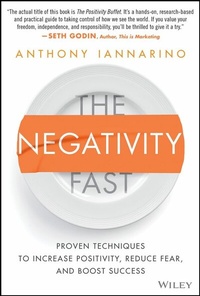
The Negativity Fast
Description

Learn to transform your perspective and lead with positivity
In The Negativity Fast: Proven Techniques to Increase Positivity, Reduce Fear, and Boost Success, sales leader and strategist Anthony Iannarino delivers an exciting and effective new take on creating and sustaining powerful sales processes. You'll learn to lead with positivity as you harness negative emotions to make lasting changes for the better and explore the power of gratitude to transform your mental outlook.
Discover how to reframe the negative events of your life into the ways they made you stronger and prepared you for future setbacks. The author also offers:
* Concrete advice on perspective-taking and strategies for avoiding being triggered by people with different beliefs
* A thirteen-week Negativity Fast, in which you'll eliminate sources of negativity for 90 days and introduce positivity into your mental diet
* Discussions of the necessity for optimism in a difficult world
An inspiring and exciting take on leadership, The Negativity Fast walks you through how to cultivate a positive attitude and perspective you can pass on to the people who follow you.
More details
Other editions
Additional editions
Person
Content
Disclaimer xiii
Acknowledgments xv
Chapter 1 Why You Are Negative 1
Chapter 2 Talking Yourself into a Negative State 19
Chapter 3 Empathy and How to Lie to Yourself 37
Chapter 4 How to Stop Complaining 57
Chapter 5 The Awesome Power of Gratitude 77
Chapter 6 Reframing Negative Events 97
Chapter 7 How to Live Happily with Political Divisiveness 113
Chapter 8 Wanting and the Perils of Social Media 131
Chapter 9 How to Change Your State 149
Chapter 10 Minding Mindfulness 165
Chapter 11 How to Forget Your Problems and Concerns 177
Chapter 12 The Negativity Fast 189
Endnotes 205
Recommended Resources 219
About the Author 223
Index 225
2
Talking Yourself into a Negative State
As a public speaker, I have to fly from Columbus, Ohio, to other cities for work. Many of my flights require connections in the airlines' hub cities. For example, flying on Delta means a trip to Detroit, Atlanta, or Minneapolis before boarding another flight to reach my destination.
I like flying because my iPhone is turned off for a couple of hours. I use the time in the cabin to write books, like the book you are reading now. I put on my noise-canceling headphones and type away while the miles fall away behind me. There is, however, a recurring travel experience that causes me to talk myself into a negative state: a flight delay, especially when I am headed home.
You may not have recognized that you routinely talk yourself into a negative state. Listen, I get it. You think your mental state changes because of other people and circumstances that you are not responsible for. But what if I am right, and you are incredibly adept at talking yourself into negative mood? I spent a chunk of my life being talked into being angry and upset by a voice that I alone can hear.
You know that voice that only you can hear? Yes, that one, the one that just said, "Yes, I know that voice." The voice in my head isn't very helpful when it comes to plane delays, whether they are due to weather or what the industry calls "a mechanical." (For mechanical issues, I am happy to wait for another plane.) No matter the reason, my voice works me into a negative emotional state. After all, it has had plenty of practice to perfect its talk tracks, taking me from zero to one hundred in mere seconds. It starts with catastrophizing the delay.
The Voice:
You are going to be late getting home tonight.Me:
I know. I don't need you to remind me.The Voice:
You are supposed to land at 9:00 p.m., but now it's going to 11:30 p.m. You will not get the seven hours of sleep you need. On seven hours, you are the Dalai Lama. On five hours, you are Joseph Stalin. You should grow a bushy moustache.The Voice:
You are not going to have good energy tomorrow. You are never productive when you get home late. You'd feel better if you ate a bag of peanut butter M&Ms.Me:
I don't want peanut butter M&Ms! (Between you and me, I do really want those M&Ms, but I quit eating sugar.)The Voice:
No one has made an announcement. No one at the airline cares about you. Give them a piece of your mind. They don't respect you. Walk over and see if you see a plane.Me:
You know there isn't a plane there. You're just trying to wind me up. I'll call Cher to tell her I will be late.The Voice:
Fine. But that won't fix anything.This voice isn't very helpful. It is incredibly negative-thank you, negativity bias. I must admire its dedication to its work, which is primarily to cause me to be negative. It's not the best person to travel with, especially while flying.
One trip home from the West Coast found me waiting for a flight at Chicago's O'Hare International Airport. I called Cher to tell her I would be home late, and I started complaining. Cher is a better person than I am, and after listening to me gripe about something I could do nothing about, she asked me, "If you had two free hours with nothing to do, what would you do with that time?" I told her I'd read a book, but I didn't have a book with me." She recommended that I walk to the bookstore and buy a book. Now I carry a large hardcover book on every trip, in case the Gods of Air Travel provide me time to read. You will find this theme repeated throughout this book: It is not a person or an event that causes you to be negative. Instead, it's your interpretation of these experiences. Your voice, if it is anything like mine, will work to make certain you perceive the event as negative.
Can you imagine what it must be like to work in customer service for an airline? The airline, of course, already knows it has a problem. They knew it before I did, and by the time I discovered the plane was delayed, they already sent a plane to pick me up as soon as possible. Maybe you don't fly enough to relate to my example. Here is one I am confident you know.
The Voice:
Why does everyone drive so badly in [insert your city here]? It's like the first time they've ever had to drive in the rain.You:
C'mon! It's 65, not 45. What's wrong with you people?!The Voice:
That bastard cut you off. Honk the horn and give him a lesson in sign language.You:
People are crazy. He probably has road rage. No sign language!The Voice:
Looks like we will be sitting here for a while.You:
I know!How to Examine Your Fears
Much of our negativity comes from our fears. My fear of getting home late is that I am not going to get the sleep I need to be productive. The truth of the matter is that nothing bad will happen because I am not as productive as I want to be. Other people have real fears, many worse than getting home late.
Imagine a single mom who is late to the daycare center, which fines her $10 for being late and an additional $1 for every minute she is late. If she doesn't have an additional $40 dollars for what is already one of her largest expenses, this fear is real. But even when she pays the fine, she is stressed, anxious, and she still must make dinner.
There are fears that come with real-world consequences and some that are simply an inconvenience. I am not a social scientist, but my experience is that our inner voice treats both events in the same way. We sometimes fear the wrong dangers, and in doing so our inner voice makes something more than it is. Much of the time when we are negative, it is because we are afraid. We are afraid of not getting the promotion, afraid of the neighbor's kid and his excessive speed, afraid of how our seventh grader is being treated by the mean girls in her class. Test this by noticing that when you are negative, much of the time it is because of something you fear.
Whose Voice Is It?
The voice that you hear in your head may not be your own. It is likely a composite of your parents, your teachers, your preacher, your boss, your significant other, and society. These expectations your inner voice imposes on you can come from external sources. The idea that causes you to believe you must be productive every minute of the day isn't very helpful, especially when it comes to work-life balance. Many of the standards you observe weren't great for the people who practiced them and infected you with them in the first place. Many of their standards are their fears or something they picked up from other people.
All these sources that make up your composite inner voice may have imparted to you a set of rules you believe you must follow. Many of those expectations and rules serve you well, until they don't. No one-even the sources of your inner voice-has a perfect record of living by the expectations and rules they believe you should follow.
Because this is your one life on this earth, you must live it the best you can, and this means you need to examine your fears to determine when you are going to meet the voice's expectations and when you are going to ignore the voice altogether. Here is a famous example. The most-watched TED Talk on YouTube is Ken Robinson's "Do Schools Kill Creativity?"1 Robinson tells the story of Gillian Lynne, the choreographer of Cats and The Phantom of the Opera. As a young girl, her mother took to see a specialist, because the school told her that Gillian had a learning disability. Gillian sat on her hands while the specialist spoke to her mother. The doctor turned on the radio and watched Gillian as she danced. The specialist told her mother that Gillian didn't have a learning disability. The specialist said Gillian was a dancer and to take her to a dance school, where Gillian thrived. She ended up a multimillionaire. Robinson said that today, we would put Gillian on an ADHD drug instead of sending her to dance school.
There are more stories about a parent who stopped their child from pursuing something they seemed to have little ability to do. In some cases, the parent may be cruel. But most of the time, the person's mother or father was trying to protect them from the harm of failure. Some of the pressure we feel comes from other people's expectations, their rules, and their fears. We must be cautious and not allow this inner voice to feed us other people's fears. We have enough as it is.
Ethan Kross is a psychologist and the author of a book titled Chatter: The Voice in Our Head, Why It Matters, and How to Harness It. Kross has spent his life studying "chatter." The research suggests that "when we experience distress, introspection often does significantly more harm than good."2 The negative outcomes are many,...
