

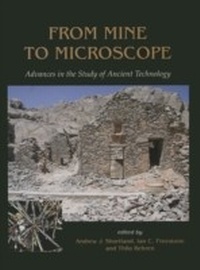
From Mine to Microscope
Advances in the Study of Ancient Technology
1st Edition
Published on 9. April 2009
384 pages
978-1-78297-277-8 (ISBN)
Description

These twenty papers dedicated to Mike Tite focus upon the interpretation of ancient artefacts and technologies, particularly through the application of materials analysis. Instruments from the human eye to mass spectrometry provide insights into a range of technologies ranging from classical alum extraction to Bronze Age wall painting, and cover materials as diverse as niello, flint, bronze, glass and ceramic. Ranging chronologically from the Neolithic through to the medieval period, and geographically from Britain to China, these case studies provide a rare overview which will be of value to students, teachers and researchers with an interest in early material culture.
More details
Other editions
Additional editions
Ian Freestone | Thilo Rehren | Andrew J. Shortland
From Mine to Microscope
Advances in the Study of Ancient Technology
Book
04/2009
Oxbow Books
€100.47
Shipment within 3-4 weeks
Content
- Cover
- Title Page
- Copyright Page
- Contents
- Introduction
- An Apology
- M.S. Tite Bibliography
- Chapter 1: Lead frits in Islamic and Hispano-Moresque glazed productions
- Chapter 2: The emergence of ceramic technology and its evolution as revealed with the use of scientific techniques
- Chapter 3: Neolithic pottery from Switzerland: raw materials and manufacturing processes
- Chapter 4: Low-tech in Amalfi: provenance and date assignation of medieval Middle-Eastern pottery by application of eyeball technique
- Chapter 5: Some implications of the use of wood ash in Chinese stoneware glazes of the 9th-12th centuries
- Chapter 6: The Hispano-Moresque tin glazed ceramics produced in Teruel, Spain: a technology between two historical periods, 13th to 16th c. AD
- Chapter 7: Beads beyond number: faience from the 'Isis Tomb' at Vulci, Italy
- Chapter 8: Egyptian blue in Greek painting between 2500 and 50 BC
- Chapter 9: Links between glazes and glass in mid-2nd millennium BC Mesopotamia and Egypt
- Chapter 10: The fish's tale: a foreign glassworker at Amarna?
- Chapter 11: Ancient copper red glasses: investigation and analysis by microbeam techniques
- Chapter 12: The provenance of archaeological plant ash glasses
- Chapter 13: Microanalysis of glass by Laser Induced Plasma Spectroscopy
- Chapter 14: New thoughts on niello
- Chapter 15: From mine to microbe - the Neolithic copper melting crucibles from Switzerland
- Chapter 16: Across the wine dark seas. sailor tinkers and royal cargoes in the Late Bronze Age eastern Mediterranean
- Chapter 17: What a long, strange trip it's been: lead isotopes and archaeology
- A response to the paper of A.M. Pollard: What a long, strange trip it's been: lead isotopes and archaeology
- Chapter 18: The juice of the pomegranate: processing and quality control of alumen in antiquity, and making sense of Pliny's phorimon and paraphoron
- Chapter 19: Finding the Floorstone
- Chapter 20: 'Sweet waste': The industrial waste from the medieval sugar refinery at the Tawahin es-Sukkar in Jordan
