

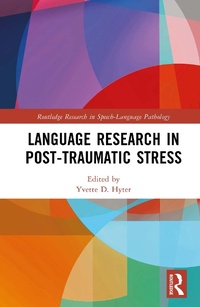
Language Research in Post-Traumatic Stress
1st Edition
Published on 25. July 2024
280 pages
978-1-040-03900-7 (ISBN)
Description

This collection brings together different perspectives on post-traumatic stress, considering its causes, its impact on different groups, and ways forward toward equipping speech-language clinicians, educators, and scholars to better understand and support the individuals and communities with which they work.
The volume defines post-traumatic stress, unpacking its causes and how they might be mitigated. The 11 chapters critically reflect on the wide-ranging effects traumatic stress has on the brain, communication, language, literacy, and life skills of different groups, including children, adolescents, adults, refugees, and victims of racialized violence. This book also includes examples of interventions demonstrated to be effective with affected individuals. The range of perspectives highlights the importance of culturally responsive and trauma-informed practices and the need for language and literacy professionals to engage in transdisciplinary practice in order to develop more effective supports for those experiencing post-traumatic stress. Looking ahead, the volume discusses recommendations for curriculum content, clinical practice, and changes to policy toward ensuring all people with post-traumatic stress are able to fully participate in daily life.
This book will be of interest to students and scholars in speech-language sciences, social work, occupational therapy, and clinical psychology, as well as clinicians and educators in these areas.
The volume defines post-traumatic stress, unpacking its causes and how they might be mitigated. The 11 chapters critically reflect on the wide-ranging effects traumatic stress has on the brain, communication, language, literacy, and life skills of different groups, including children, adolescents, adults, refugees, and victims of racialized violence. This book also includes examples of interventions demonstrated to be effective with affected individuals. The range of perspectives highlights the importance of culturally responsive and trauma-informed practices and the need for language and literacy professionals to engage in transdisciplinary practice in order to develop more effective supports for those experiencing post-traumatic stress. Looking ahead, the volume discusses recommendations for curriculum content, clinical practice, and changes to policy toward ensuring all people with post-traumatic stress are able to fully participate in daily life.
This book will be of interest to students and scholars in speech-language sciences, social work, occupational therapy, and clinical psychology, as well as clinicians and educators in these areas.
More details
Series
Edition
1. Auflage
Language
English
Place of publication
London
United Kingdom
Publishing group
Taylor & Francis Ltd
Target group
College/higher education
Illustrations
17 Tables, black and white; 9 Line drawings, black and white; 1 Halftones, black and white; 10 Illustrations, black and white
ISBN-13
978-1-040-03900-7 (9781040039007)
Copyright in bibliographic data and cover images is held by Nielsen Book Services Limited or by the publishers or by their respective licensors: all rights reserved.
Schweitzer Classification
Other editions
Additional editions
Yvette D. Hyter
Language Research in Post-Traumatic Stress
Book
approx. 11/2025
1st Edition
Routledge
€64.10
Not yet published
Yvette D. Hyter
Language Research in Post-Traumatic Stress
Book
07/2024
1st Edition
Routledge
€194.00
Shipment within 10-20 days
Person
Yvette D. Hyter is an ASHA Fellow, has received ASHA Honors, is a Professor Emerita of Speech, Language and Hearing Sciences at Western Michigan University, USA, and is the Owner of Language & Literacy Practices, LLC, in Kalamazoo, Michigan, USA.
Content
List of Contributors
Acknowledgments
Preface
1 Introduction to Language Research in Post-Traumatic Stress
Yvette D. Hyter
Part One Post-traumatic stress: Considerations, concepts, and consequences within language research
2 Racialized Stress and Trauma in Black Communities: Lessons for Speech and Language Professionals
Paul Archibald and Lajuana Archibald
3 Post-traumatic Stress, Autobiographical Memory, and Cultural Neuroscience: Implications for Migrants and Refugees
Carol Westby
4 Post-traumatic stress and social pragmatic communication
Yvette D. Hyter
5 Neurodevelopmental Impact of Post-Traumatic Stress
Michelle Suarez and Cara Masselink
6 Impact of Post-Traumatic Stress on Cognitive Communication in Multilingual Children And Adults
Sulare Telford Rose and Jennifer Myers
Part Two Post-traumatic stress: Considerations across the lifespan for language development and functioning
7 Post-traumatic stress: Child language development and functioning
Na'ama Yehuda
8 Addressing the Impact of Post-Traumatic Stress on Adolescent Language and Identity: An Interdisciplinary Approach.
Ginger G. Collins, Jayna Maumbauer-Pisano, and Tobias Kroll
9 Attachment-based narrative speech styles in adults with posttraumatic stress
Karin Riber and Emma Beck
10 PTSD and Cognitive Communication Effects
Linda Carozza
11 Language research in post-traumatic stress: Where do we go from here?
Yvette D. Hyter
Index
Acknowledgments
Preface
1 Introduction to Language Research in Post-Traumatic Stress
Yvette D. Hyter
Part One Post-traumatic stress: Considerations, concepts, and consequences within language research
2 Racialized Stress and Trauma in Black Communities: Lessons for Speech and Language Professionals
Paul Archibald and Lajuana Archibald
3 Post-traumatic Stress, Autobiographical Memory, and Cultural Neuroscience: Implications for Migrants and Refugees
Carol Westby
4 Post-traumatic stress and social pragmatic communication
Yvette D. Hyter
5 Neurodevelopmental Impact of Post-Traumatic Stress
Michelle Suarez and Cara Masselink
6 Impact of Post-Traumatic Stress on Cognitive Communication in Multilingual Children And Adults
Sulare Telford Rose and Jennifer Myers
Part Two Post-traumatic stress: Considerations across the lifespan for language development and functioning
7 Post-traumatic stress: Child language development and functioning
Na'ama Yehuda
8 Addressing the Impact of Post-Traumatic Stress on Adolescent Language and Identity: An Interdisciplinary Approach.
Ginger G. Collins, Jayna Maumbauer-Pisano, and Tobias Kroll
9 Attachment-based narrative speech styles in adults with posttraumatic stress
Karin Riber and Emma Beck
10 PTSD and Cognitive Communication Effects
Linda Carozza
11 Language research in post-traumatic stress: Where do we go from here?
Yvette D. Hyter
Index
