


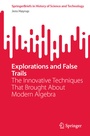
Explorations and False Trails
Description

This book provides a unique perspective on the history of European algebra up to the advent of Viète and Descartes. The standard version of this history is written on the basis of a narrow and misleading source basis: the Latin translations of al-Khwarizmi, Fibonacci's Liber abbaci, Luca Pacioli's Summa, Cardano's Ars magna-with neither Fibonacci nor Pacioli being read in detail. The existence of the Italian abacus and German cossic algebra is at most taken note of but they are not read, leading to the idea that Viète's and Descartes' use of genuine symbolism (not only abbreviations), many unknowns, and abstract coefficients seem to be miraculous leaps. This book traces the meandering development of all these techniques along with the mostly ignored but very important parenthesis function, by means of detailed readings of all pertinent sources, including the abacus and cossic algebra and French algebra from Chuquet to Gosselin. It argues for a necessary distinction between abbreviating glyphs and genuine symbols serving within a symbolic syntax, which allows it to trace the emergence of symbolic calculation. Characterization of the mathematical practice of the environment within which Viète and Descartes moved allows for an explanation of how these two figures did not even need to invent abstract coefficients but rather received them as a gift.
More details
Other editions
Additional editions
Person
Jens Egede Høyrup , born in 1943 in Copenhagen, is a Danish historian of mathematics, specializing in pre-modern and early modern mathematics, ancient Mesopotamian mathematics and the abbacus tradition in particular. He is especially known for his interpretation of what has often been referred to as Old Babylonian "algebra" as consisting of concrete, geometric manipulations.
Content
Preface.- Introduction.- Chapter 1. Geometric proofs.- Chapter 2. Powers of the unknown.- Chapter 3. Abbreviations, glyphs, symbols and symbolic calculation.- Chapter 4. Embedding and parenthesis function.- Chapter 5. Several unknowns.- Chapter 6. The transition to incipient modern algebra.- Bibliography.- Index.
